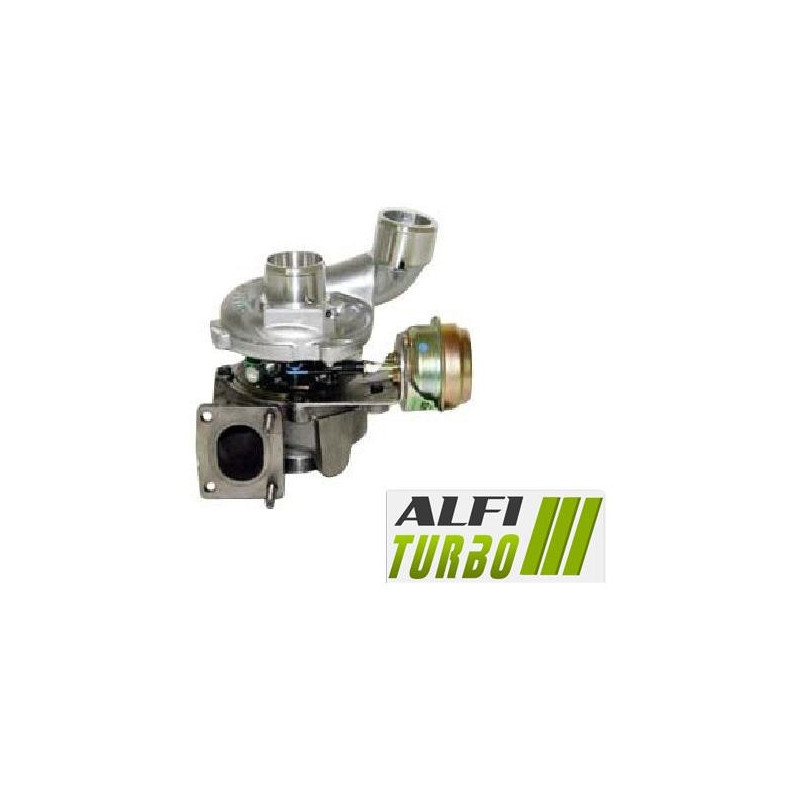
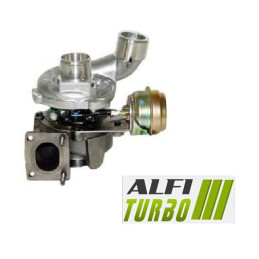
This hybrid turbo for engine variants 1.9 JTD and JTDM is designed for an installation plug & play on compatible apps. Depending on the course chosen, the set-up combines a high-flow MFS compressor wheel, a 360° thrust bearing and appropriate internal modifications.
The documented allocations relate to several models Alfa Romeo, , Fiat and Lancia mainly producing 110 hp or 115 hp. The benchmark for turbochargers dThe origin must be verified before any order is placed.
Available products — Stage 1, Stage 2 and Stage 3
Stage 1 — 200 hp
Compressor wheel: High-capacity MFS
Stop: 360° bearing
Balancing: High speed at 150,000 rpm on a Cimat VSR test bench
This preparation acts on the compressor wheel in order to d’adjust the compression capacity and flow rate’ d’air, whilst retaining the documented turbine configuration.
Stage 2 — 250 hp
Compressor wheel: High-capacity MFS oversized
Carter d’Admission:’ Reprofiled for to receive the new wheel
Stop: 360° bearing
Balancing: High speed at 150,000 rpm on a Cimat VSR test bench
Reprofiling the casing allows d’fit the compressor wheel’ oversized. This configuration is designed to achieve a flow rate of d’upper air, subject to d’a consistent engine preparation programme’.
Stage 3 — 300 hp
Compressor wheel: High-capacity MFS oversized
Carter d’Admission:’ Reprofiled for to receive the new wheel
Stop: 360° bearing
Turbine wheel: High flow rate oversized
Turbine casing: Reprofiled for to receive the new wheel
Balancing: High speed at 150,000 rpm on a Cimat VSR test bench
This modification affects the compressor and turbine sides. The turbine wheel and its matching housing influence the flow rate and the behaviour of the turbocharger, although they do not, on their own, guarantee the final engine power.
What is a hybrid turbo ?
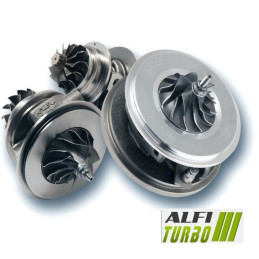
A hybrid turbo is based on an existing architecture that has been adapted for to receive different internal components. Depending on the course, the preparation may cover the compressor wheel, the turbine wheel, the casings, the thrust bearing and balancing. The aim is d’adjust the compression and flow rate’ d’air to meet needs d’a particular engine set-up’.
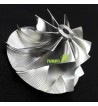
The appearance of the wheel alone is not enough to define a hybrid turbocharger: its geometry, its integration into the sump and the coherence of the rotating assembly are crucial.
MFS compressor wheel: standard or Performance ? ?
MFS stands for ‘Milled From Solid’, meaning a wheel machined from a solid block. This manufacturing process does not, on its own, guarantee an increase in throughput dair. A standard MFS wheel can retain a geometry equivalent to that d’origin’.
An MFS wheel Performance can be configured to suit the application: the profile, height, width, diameter or arrangement of the blades may vary where the technical specifications so require.
A standard MFS wheel can be just as shiny as an MFS wheel Performance. It is not its appearance that determines its performance, but its geometry and its ability to move more dair. Higher power output can only be utilised effectively with the appropriate engine tuning.
Why does the geometry of the blades affect the flow rate? d’air ?
The compressor wheel draws in and then compresses the air. Its diameter, profile, height, width and the arrangement of its blades all influence its aerodynamic behaviour. The result also depends on the casings, the turbine, the boost pressure and the engine management system. A larger wheel therefore does not automatically guarantee a better result and may affect the response time.
Reliability and balancing of the hybrid turbocharger
The three work placements offer da 360° bearing stop, designed to distribute axial forces more evenly. The rotating assembly is balanced at high speeds, up to 150,000 rpm on a Cimat VSR test bench, in order to minimise vibrations and mechanical stresses. However, this balancing does not compensate for any faults in assembly or lubrication.
Engine remapping and tuning
The farm dA hybrid turbo requires appropriate engine management. Mapping, boost pressure and wastegate settings must be checked during remapping. Depending on the objective, the systems d’injection, dExhaust and cooling systems may also need to be adapted. The turbo alone does not guarantee that the power specified by the tuning programme will be achieved.
Turbo part numbers
OEM part numbers
46779032
46786078
55191596
60816402
71723495
71783325
71785250
Manufacturer’s part numbers
712766
712766-0001
712766-0002
712766-1
712766-2
712766-5002S
Compatible vehicles and assignments
Alfa Romeo
145 — 1.9 JTD 115 hp
From 2000 — end date unspecified
Engine code : not specified
146 — 1.9 JTD 115 hp
From 2000 — end date unspecified
Engine code : not specified
147 — 1.9 JTD 115 hp
From 2000 — end date unspecified
Engine code : not specified
147 — 1.9 JTDM 115 hp
From 2000 — end date unspecified
Engine code : not specified
156 — 1.9 JTD 110/115 hp
From 1997 — end date unspecified
Engine code : not specified
156 — 1.9 JTD 110/115 hp
From 2000 — end date unspecified
Engine code : not specified
156 — 1.9 JTD 115 hp
From 2003 — end date not specified
Engine code : not specified
Fiat
Marea — 1.9 JTD 110 hp
From 1999 — end date unspecified
Engine code : not specified
Multipla — 1.9 JTD 110/115 hp
From 1998 — end date unspecified
Engine code : not specified
Multipla — 1.9 JTD 110 hp
From 2004 — end date not specified
Engine code : not specified
Punto — 1.9 JTD 110 hp
From 2000 — end date unspecified
Engine code : not specified
Stilo — 1.9 JTD 115 hp
From 2001 — end date not specified
Engine code : not specified
Stilo — 1.9 JTD 115 hp
From 2003 — end date not specified
Engine code : not specified
Stilo — 1.9 JTD 80/115 hp
From 2004 — end date not specified
Engine code : not specified
Stilo — 1.9 JTD 115 hp
From 2004 — end date not specified
Engine code : not specified
Lancia
Lybra — 1.9 JTD 110/115 hp
From 1999 — end date unspecified
Engine code : not specified
Lybra SW — 1.9 JTD 110/115 hp
From 1999 — end date unspecified
Engine code : not specified
Additional technical specifications
Product type: Hybrid Turbo
Engine options: 1.9 JTD and 1.9 JTDM depending on the vehicle
Powers dMain sources: 110 hp and 115 hp
Editing: Plug and play on compatible applications
Engine codes: Not specified
Assembly instructions
⚠️ WARNING — IMPORTANT BEFORE ASSEMBLY
Identify and rectify the cause of the previous fault. Check the lubrication circuit, as well as the supply and return lines doil. Check that the ducts and the intake are clean and free from foreign objects. Carry out the priming in accordance with the relevant guidelines and follow the manufacturer’s instructions. The wastegate must be adjusted when tuning the engine management system. If a lubrication fault is not rectified, it may lead to the turbocharger failing again.
How do you choose the right turbo ?
Check the turbo part number d’origin, OEM and manufacturer part numbers, as well as the make, model, body style, engine type, power output, theYear installation and engine code. The same engine can be fitted with several different turbo set-ups.
⚠️ Check your turbo’s part numbers
Before placing your order, Compare the part number on your turbocharger d’origin’ using the references given in this fact sheet. Having the same motor does not always guarantee compatibility.
If you are in any doubt, please contact us, quoting the reference number clearly visible on your turbocharger.