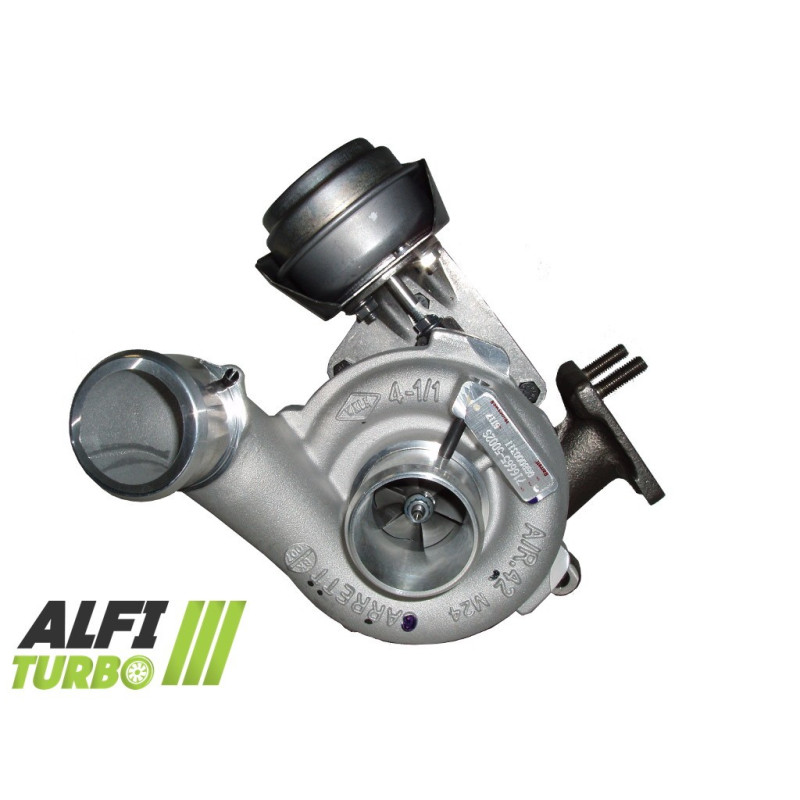
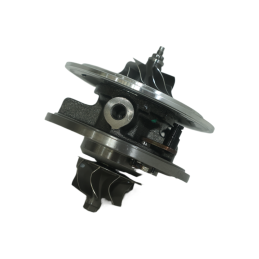
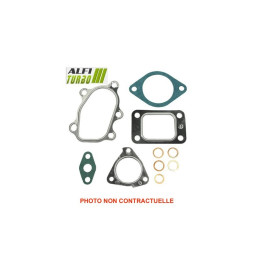
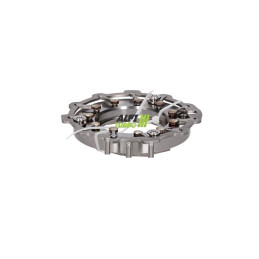
This hybrid turbo for engine variants 1.9 JTD and 1.9 JTDM benefits from d'a mechanical adjustment designed to adapt its compression capacity and flow rate' d'air'. Depending on the configuration selected, it is fitted with a high-flow MFS compressor wheel, a 360° bearing retainer and additional modifications to the wheels or housings.
The documented assignments relate to several Alfa Romeo 147 and 156, Fiat Stilo and Lancia Lybra. Compatibility must always be confirmed using the turbo’s part number d'origin'.
Available products — Stage 1, Stage 2 and Stage 3
Stage 1
Compressor wheel: High-capacity MFS
Stop: 360° bearing stop
Balancing: high speed at 150,000 rpm on a Cimat VSR test bench
This preparation acts mainly on the compressor side. The MFS wheel described here is designed for to increase compression capacity and flow rate d'air relative to the configuration' d'as originally stated, subject to' d'appropriate engine management'.
Stage 2
Compressor wheel: High-capacity MFS oversized
Carter d'Admission:' reprofiled for to receive the new wheel oversized
Stop: 360° bearing stop
Balancing: high speed at 150,000 rpm on a Cimat VSR test bench
The Stage 2 incorporates a compressor wheel oversized to a casing d're-profiled intake'. This adaptation makes it possible to d'accommodate the new geometry and may alter the flow rate' d'air and the behaviour of the compressor'.
Stage 3
Compressor wheel: High-capacity MFS oversized
Carter d'Admission:' reprofiled for to receive the new wheel oversized
Stop: 360° bearing stop
Turbine wheel: high-speed oversized
Turbine casing: reprofiled for to receive the new wheel oversized
Balancing: high speed at 150,000 rpm on a Cimat VSR test bench
The Stage 3 includes documented modifications to the compressor and turbine sides. The resizing of the wheels and the reshaping of the casings are intended to adjust the airflow and gas flow capacities, although the final power output cannot be guaranteed regardless of the engine configuration.
What is a hybrid turbo ?
A hybrid turbo utilises a turbocharger design that has been adapted to accommodate modified internal components. Depending on the course, the preparation may involve the compressor wheel, the turbine wheel, the casings, the thrust bearing system and rotor balancing.
The aim is d'adjust the compression capacity and flow rate' d'air from the turbocharger'. However, a hybrid turbo is not defined solely by the appearance of its impeller: the geometry of the components, how they are assembled, and the machining of the housings also play a vital role.
MFS compressor wheel: standard or Performance ? ?
MFS stands for ‘Milled From Solid’, meaning a wheel machined from a solid block. This technology describes its manufacturing process and does not, on its own, guarantee an increase in throughput d'air'. A standard MFS wheel can retain a geometry equivalent to that d'origin'.
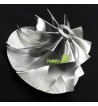
An MFS wheel Performance is based on a geometry tailored to the preparation objective. On this product, the wheel shown is made of forged aluminium; it is lighter, larger and taller than the one d'as originally specified; the technical data sheet states up to 15 per cent additional compression'.
A standard MFS wheel can be just as shiny as an MFS wheel Performance. It is not its appearance that determines its performance, but its geometry and its ability to move more d'air'. A higher flow rate can help to increase power output when the engine has been properly prepared and tuned.
Why does the geometry of the blades affect the flow rate? d'air?' ?
The compressor wheel draws in and then compresses the air fed to the engine. Its diameter, profile, height, width and the arrangement of its blades all influence its aerodynamic behaviour. The right geometry can move more d'air within certain operating ranges'.
The result also depends on the compressor housing, the impeller and the turbine housing, the boost pressure and the engine tuning. A larger wheel does not automatically guarantee a better result and may affect the response time as well as the range d'optimal use'.
Reliability and balancing of the hybrid turbocharger
The 360° stop fitted to all three stages distributes the axial forces over a wide area. It helps to cope with the stresses associated with preparation without making the turbocharger immune to faults arising from incorrect fitting or lubrication.
Every work placement offers d'high-speed balancing at 150,000 rpm on a Cimat VSR test bench'. This procedure is designed to minimise vibrations and mechanical stresses on the rotor, but does not compensate for a circuit d'faulty oil or the presence of foreign matter'.
Engine remapping and tuning
Making use of characteristics d'A hybrid turbo requires appropriate engine management'. The mapping, boost pressure and wastegate settings must be checked when remapping the ECU.
Depending on the desired configuration, it is also advisable to check whether or d'adjust the fuel injection, exhaust and air cooling' d'the intake, the clutch or the gearbox'. The hybrid turbo alone does not guarantee a power boost.
Turbo part numbers
Manufacturer’s part numbers
716665-5002S
716665-9003S
716665-0002
716665-0001
OEM part numbers
55191934
46793334
71783873
71785259
71785260
71783874
Compatible vehicles and assignments
Alfa Romeo
147 1.9 JTD — 126 / 136 hp
1.9 JTD — from 2000, end date unspecified
Engine code : not specified
147 1.9 JTDM — 140 hp
1.9 JTDM — from 2000, end date unspecified
Engine code : not specified
156 1.9 JTD — 126 / 136 / 140 hp
1.9 JTD — from 2003, end date unspecified
Engine code : not specified
156 1.9 JTD — 140 hp
1.9 JTD — from 1997, end date unspecified
Engine code : not specified
156 1.9 JTD — 140 hp
1.9 JTD — from 2000, end date unspecified
Engine code : not specified
156 1.9 JTD — 150 hp
1.9 JTD — from 2003, end date unspecified
Engine code : not specified
Fiat
Stilo 1.9 JTDM — 126 / 136 / 140 hp
1.9 JTDM — from 2004, end date unspecified
Engine code : not specified
Lancia
Lybra 1.9 JTD — 140 hp
1.9 JTD — from 2003, end date unspecified
Engine code : not specified
Additional technical specifications
Product type: hybrid turbo
Engine options: 1.9 JTD and 1.9 JTDM
Documented power ratings: 126, 136, 140 and 150 hp depending on the vehicle
Installation: configuration plug & play documented
Assembly instructions
⚠️ WARNING — IMPORTANT BEFORE ASSEMBLY
Identify and rectify the cause of the previous fault before d'fit the turbo'.
Carefully check the lubrication circuit, the supply and the return d'oil'. Check that the ducts and the intake are clean and free from foreign objects.
Carry out the priming in accordance with the relevant guidelines and follow the manufacturer’s instructions. Engine mapping, boost pressure and the wastegate must be adjusted by a qualified professional.
If a lubrication fault is not rectified, it may lead to the turbocharger failing again.
How do you choose the right turbo ?
Check the part number on the turbocharger d'original, then compare it with the manufacturer’s and OEM part numbers listed on this data sheet'. Also check the make, model, version, engine type and power output in hp, theYear the mounting code and the engine code, where available.
The same engine can be fitted with different turbocharger set-ups depending on the vehicle or its production period.
⚠️ Check your turbo’s part numbers
Before placing your order, Compare the part number on your turbocharger d'origin' using the references given in this fact sheet. Having the same motor does not always guarantee compatibility.
If in doubt, please contact us, quoting the reference number clearly visible on your turbocharger d'origin'.