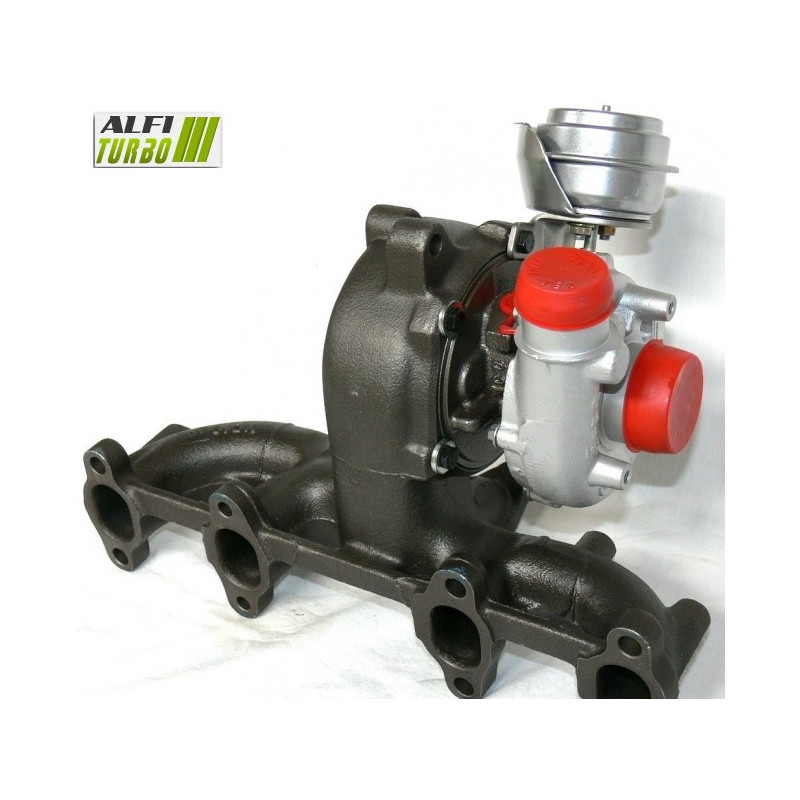
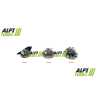
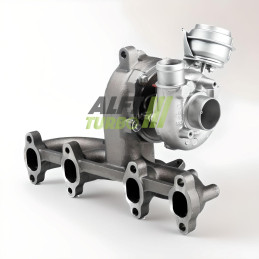
This hybrid turbo for engine variants 1.9 TDI is available in three documented levels of preparation. Its architecture allows for a Installation without modification, whilst its MFS compressor wheels Performance, its 360° stop and high-speed balancing meet the requirements d'suitable engine preparation'.
The assignments include, amongst others, several Audi A3, Ford Galaxy, Seat The Alhambra, León and Toledo, Skoda Octavia and Volkswagen Bora, Golf and Sharan. The benchmark for turbochargers d'The origin must always be checked before placing an order'.
Available products — Stage 1, Stage 2 and Stage 2+
Stage 1
Compressor wheel: High-capacity MFS Performance
Dimensions: 32.94 / 49.00 mm
Blade configuration: 6+6
Level: 360° stop
Balancing: high speed at 150,000 rpm on a Cimat VSR test bench
This assembly uses an MFS wheel Performance designed for adjust the flow rate d'air whilst retaining a design intended for installation without modification'. Its ultimate performance depends on the engine management system and the overall mechanical configuration.
Stage 2
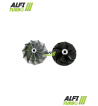
Compressor wheel: High-capacity MFS oversized Performance
Dimensions: 36.77 / 52.19 mm
Blade configuration: 11+0
Carter d'Admission:' reprofiled for to receive the wheel oversized
Level: 360° stop
Balancing: high speed at 150,000 rpm on a Cimat VSR test bench
The larger-diameter wheel requires the casing to be re-profiled d'admission'. This combination aims to alter the compression capacity and flow rate d'air, whilst not in itself a guarantee of power or engine response'.
Stage 2+
Compressor wheel: High-capacity MFS oversized Performance
Dimensions: 39.61 / 56.02 mm
Blade configuration: 11+0
Carter d'Admission:' reprofiled for to receive the wheel oversized
Level: 360° stop
Balancing: high speed at 150,000 rpm on a Cimat VSR test bench
This level uses the largest documented compressor wheel for this product, with a casing d'adapted admission'. Increasing the dimensions may affect flow rate and response time; the result therefore depends on the vehicle’s overall configuration.
What is a hybrid turbo ?
A hybrid turbo is based on a specially adapted turbocharger design for to receive internal components that differ from the configuration d'origin'. Depending on the modification, changes may relate to the compressor impeller, its dimensions and the geometry of its blades, the casings, the turbine impeller, the thrust bearing system or the balancing.
The aim is d'adjust the compression capacity and flow rate' d'air'. However, a hybrid turbo is not defined solely by the appearance of its impeller: the compatibility between the components and the engine tuning remains crucial.
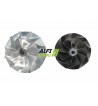
MFS compressor wheel: standard or Performance ? ?
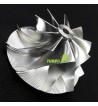
MFS stands for ‘Milled From Solid’, meaning a wheel machined from a solid block. This term describes a manufacturing process and does not, in itself, guarantee an increase in throughput d'air'.
A standard MFS wheel can retain a geometry equivalent to that d'origin'. An MFS wheel Performance can be fitted with a blade geometry, profile, diameter or configuration suited to the preparation task, such as the configurations documented across the three stages of this product.
A standard MFS wheel can be just as shiny as an MFS wheel Performance. It is not its appearance that determines its performance, but its geometry and its ability to move more d'air'. A higher flow rate can help to increase power output when combined with appropriate engine tuning, although it does not in itself guarantee a gain.
Why does the geometry of the blades affect the flow rate? d'air?' ?
The compressor wheel draws in and then compresses the air fed to the engine. Its diameter, profile, height, width and the arrangement of the blades all influence its aerodynamic behaviour. The right geometry can move more d'air within certain operating ranges'.
The result also depends on the compressor housing, the turbine section, the boost pressure and the mapping. A larger wheel therefore does not automatically guarantee a better result and may affect the response time as well as the range d'optimal use'.
Reliability and balancing of the hybrid turbocharger
The 360° stop fitted to each stage helps to distribute the axial forces acting on the rotating assembly. It does not exempt one from either d'proper lubrication nor d'a compliant assembly'.
The rotor is balanced at high speed – up to 150,000 rpm – on a Cimat VSR test bench, in order to minimise vibrations and mechanical stresses. This balancing does not protect the turbocharger against a fault d'oil, the presence d'a foreign object or incorrect installation'.
Engine remapping and tuning
It may be necessary to adjust the engine management system for make the most of the hybrid turbo’s features. Mapping, boost pressure, fuel injection, air cooling d'The intake, exhaust, clutch and transmission must be checked in accordance with the level of preparation'. The wastegate must be adjusted during fitting and remapping. No increase in power can be attributed to the turbo alone.
Turbo part numbers
OEM part numbers
YM219G438AA
1121159
038253019EX
038253019E
038253019DX
038253019D
038253019EV
038253019DV
YM219G438BA
RE6M219G438AA
6M219G438AA
1556572
1556571
038253019N
1135819
038253019NV
03G253014EX
038253019NV225
03G253014E
038253019NX
03G253014EV
038253019NV500
038253019NV220
Manufacturer’s part numbers
454232-0002
454232-0006
454232-0011
454232-11
454232-2
454232-2011
454232-5011S
454232-5014S
454232-6
713673-0002
713673-0005
713673-0006
713673-2
713673-2006
713673-5
713673-5004S
713673-5005S
713673-5006S
713673-5007S
713673-6
Compatible vehicles and assignments
Audi
A3 (8L1) — 100 hp1.9 TDI diesel — October 2000 to May 2003
Engine codes: ATD, AXR from November 2001 onwards
A3 (8L1) — 110 hp1.9 TDI diesel — August 1997 to July 2001
Engine codes: AHF from 08/1997, ASV
Ford
Galaxy I (WGR) — 115 hp1.9 TDI diesel — April 2000 to May 2006
Engine code : AUY
Seat
Alhambra (7V8, 7V9) — 115 hp1.9 TDI diesel — June 2000 to March 2010
Engine codes: AUY, BVK
Alhambra Van (7V8, 7V9), commercial vehicle — 116 hp1.9 TDI diesel — June 2000 to March 2010
Engine codes: AUY, BVK from May 2005 onwards
Leon (1M1) — 110 hp1.9 TDI diesel — November 1999 to June 2006
Engine codes: AHF, ASV
Toledo II (1M2) — 110 hp1.9 TDI diesel — October 1998 to July 2004
Engine codes: AHF, ASV
Skoda
Octavia I (1U2) — 110 hp1.9 TDI diesel — August 1997 to January 2006
Engine codes: AHF, ASV
Octavia I Combi (1U5) — 100 hp1.9 TDI diesel — September 2000 to January 2006
Engine code : ATD
Octavia I Combi (1U5) — 110 hp1.9 TDI diesel — July 1998 to January 2006
Engine codes: AHF, ASV
Volkswagen
Bora I (1J2) — 101 hp1.9 TDI diesel — September 2000 to May 2005
Engine codes: ATD, AXR, BEW
Bora I (1J2) — 101 hp1.9 TDI diesel — September 2000 to May 2005
Engine code : ATD
Bora I (1J2) — 110 hp1.9 TDI diesel — October 1998 to June 2001
Engine codes: AHF from October 1998, ASV
Bora Variant (1J6) — 101 hp1.9 TDI diesel — September 2000 to May 2005
Engine codes: ATD from September 2000, AXR, BEW
Bora Variant (1J6) — 101 hp1.9 TDI diesel — September 2000 to May 2005
Engine code : ATD from September 2000
Bora Variant (1J6) — 110 hp1.9 TDI diesel — May 1999 to June 2001
Engine codes: AHF from May 1999, ASV from May 2000
Golf IV (1J1) — 101 hp1.9 TDI diesel — September 2000 to June 2005
Engine codes: ATD, AXR, BEW
Golf IV (1J1) — 101 hp1.9 TDI diesel — September 2000 to June 2005
Engine code : ATD
Golf IV (1J1) — 110 hp1.9 TDI diesel — August 1997 to May 2004
Engine codes: AHF from 08/1997, ASV
Golf IV Van (1J1), commercial vehicle — 116 hp1.9 TDI diesel — January 2000 to April 2001
Engine code : AUY
Golf IV Variant (1J5) — 101 hp1.9 TDI diesel — September 2000 to June 2006
Engine codes: ATD, AXR
Golf IV Variant (1J5) — 101 hp1.9 TDI diesel — September 2000 to June 2006
Engine code : ATD
Golf IV Variant (1J5) — 110 hp1.9 TDI diesel — May 1999 to June 2001
Engine codes: AHF from May 1999, ASV
Golf Van IV Variant (1J5), utility vehicle — 110 hp1.9 TDI diesel — May 1999 to May 2006
Engine codes: AHF, ASV
Sharan (7M8, 7M9, 7M6) — 115 hp1.9 TDI diesel — March 2000 to March 2010
Engine codes: AUY from April 2000, BVK
Sharan (7M8, 7M9, 7M6) — 115 hp1.9 TDI diesel — April 2000 to March 2010
Engine codes: AUY, BVK
Additional technical specifications
Product type: hybrid turbo
Engine: 1.9 TDI
Fuel: diesel
Documented power ratings: 100, 101, 110, 115 and 116 hp
Engine codes: AHF, ASV, ATD, AXR, AUY, BEW, BVK
Documented periods: August 1997 to March 2010, depending on the assignment
Installation: configuration plug & play, unchanged
Assembly instructions
⚠️ WARNING — IMPORTANT BEFORE ASSEMBLY
Identify and rectify the cause of the previous fault before d'fit the turbo'.
Check the lubrication circuit, the supply and the return d'oil, as well as the cleanliness of all the pipes'.
Check the intake and ensure that no foreign objects can reach the turbocharger wheels.
Carry out oil priming in accordance with the relevant guidelines and follow the vehicle manufacturer’s instructions.
The wastegate and boost management settings must be adjusted during installation and remapping. If a lubrication fault is not rectified, it may lead to the turbocharger failing again.
How do you choose the right turbo ?
Check the part number marked on the turbocharger d'origin and compare it with the OEM and manufacturer part numbers listed on this sheet'. Also check the make, model, generation, body style, engine type and power output in hp, the installation dates and the engine code.
The same engine can be fitted with different turbo set-ups depending on the vehicle and its production period.
⚠️ Check your turbo’s part numbers
Before placing your order, Compare the part number on your turbocharger d'origin' using the references given in this fact sheet. Having the same motor does not always guarantee compatibility.
If you are in any doubt, please contact us with the reference number clearly visible on your turbo and the exact vehicle details.