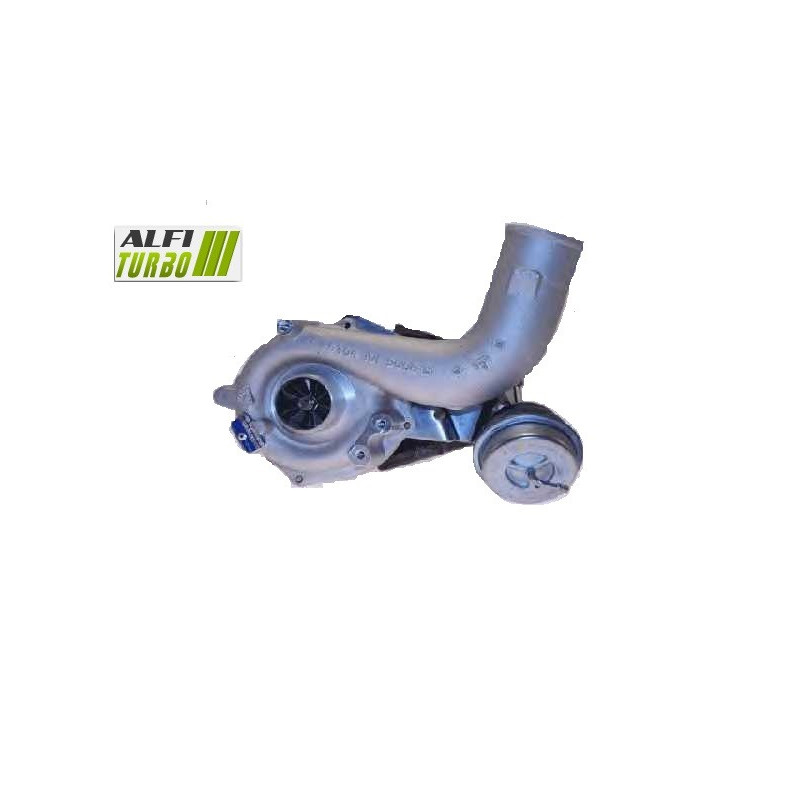
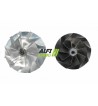
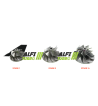
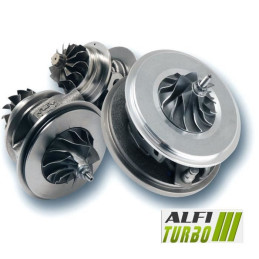
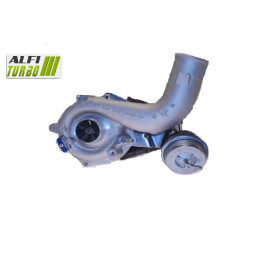
This hybrid turbo for petrol engines 1.8T, 150 and 180 hp is available in three levels of preparation. Each course is provided with an MFS compressor wheel Performance and a 360° bearing stop, with high-speed balancing documented on a Cimat VSR test bench.
The assignments identified relate in particular to Audi A3 and TT, Seat Leon, Volkswagen Bora and Golf IV. Compatibility must be confirmed using the turbo’s part number d'origin and engine code'.
Available products — Stage 1, Stage 2 and Stage 2+
Stage 1
Compressor wheel: MFS Performance high-speed
Dimensions: 36.00 / 49.97 mm
Blade configuration: 7+7
Bearing stop: 360°
Balancing: 150,000 rpm on a Cimat VSR test bench
This assembly uses an MFS wheel Performance whose geometry is designed to adjust the flow rate d'compressor air'. The final behaviour also depends on the engine management system and all the associated components.
Stage 2
Compressor wheel: MFS Performance high-speed oversized
Dimensions: 42.00 / 56.08 mm
Blade configuration: 11+0
Carter d'Admission:' re-profiled for to receive the wheel oversized
Bearing stop: 360°
Balancing: 150,000 rpm on a Cimat VSR test bench
The larger diameter of the wheel means the casing needs to be re-profiled d'admission'. This combination may affect the flow capacity and behaviour of the compressor, but does not in itself guarantee the final power output.
Stage 2+
Compressor wheel: MFS Performance high-speed oversized
Dimensions: 48.50 / 61.00 mm
Blade configuration: 11+0
Carter d'Admission:' re-profiled for to receive the wheel oversized
Bearing stop: 360°
Balancing: 150,000 rpm on a Cimat VSR test bench
This version features the largest documented compressor wheel for this product and a casing d'adapted admission'. An increase in diameter can affect flow rate, response time and the optimum operating range.
What is a hybrid turbo ?
A hybrid turbo is based on a specially adapted turbocharger design for to receive internal changes. Depending on the course, these may relate to the compressor wheel, its dimensions, the geometry of the blades, or the housing d'Intake, the stop system and balancing'.
The aim is d'adjust the compression capacity and flow rate' d'air'. However, a hybrid turbo is not defined solely by the appearance of its impeller: the dimensions, the geometry, the fit of the casings and the overall coherence of the assembly are crucial.
MFS compressor wheel: standard or Performance ? ?
MFS stands for ‘Milled From Solid’, meaning a wheel machined from a solid block. This term describes a manufacturing process and does not, in itself, guarantee an increase in throughput d'air'.
A standard MFS wheel can retain a geometry equivalent to that d'origin'. An MFS wheel Performance can be fitted with a blade geometry, diameter or configuration suited to the preparation objective, such as the configurations documented for the three stages of this product.
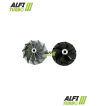
A standard MFS wheel can be just as shiny as an MFS wheel Performance. It is not its appearance that determines its performance, but its geometry and its ability to move more d'air'. A higher flow rate can help to increase power output with the appropriate engine tuning, although this does not guarantee a performance gain.
Why does the geometry of the blades affect the flow rate? d'air?' ?
The compressor wheel draws in and then compresses the air admitted by the engine. Its diameter, profile, height, width and the arrangement of its blades influence its aerodynamic behaviour and its ability to move air under different operating conditions.
The result also depends on the compressor housing, the turbine section, the boost pressure and the engine tuning. A larger wheel therefore does not automatically guarantee better performance and may affect response time.
Reliability and balancing of the hybrid turbocharger
The three work placements offer d'a 360° bearing stop, designed for distribute axial forces over a suitable surface. His presence does not exempt him from d'proper lubrication nor d'a compliant assembly'.
High-speed balancing is carried out at 150,000 rpm on a Cimat VSR test bench. This procedure is designed to minimise vibrations and mechanical stress on the rotor, but does not protect the turbocharger against a fault d'oil, contamination or incorrect installation'.
Engine remapping and tuning
It may be necessary to adjust the mapping and management of boost pressure for make the most of the hybrid turbo’s features. The wastegate must be adjusted during the installation and remapping of the ECU.
Depending on the level of preparation, injection, fuel supply and air cooling d'The intake, exhaust, clutch or transmission must also be checked or adjusted'. A hybrid turbo does not automatically guarantee a performance gain without appropriate engine tuning.
Turbo part numbers
OEM part numbers
06A145704A
06A145704AV
06A145713K
06A145713KX
06A145703QX
06A145703QV
06A145703Q
06A145704AX
06A145713KV
06A145704B
06A145704BV
06A145704BX
Manufacturer’s part numbers
53039700026
53039880026
53039700035
53039880035
Compatible vehicles and assignments
Audi
A3 (8L1) PC — 150 hp1.8T petrol — December 1996 to May 2003
Engine codes: AGU, AQA (08.98-.), ARX
A3 (8L1) PC — 150 hp1.8T petrol — December 1996 to May 2003
Engine codes: AGU, AQA (08.98-.), ARZ (08.98
A3 (8L1) PC — 180 hp1.8T petrol — October 1998 to May 2003
Engine codes: AJQ, ARY
A3 (8L1) PC — 180 hp1.8T petrol — December 1998 to May 2003
Engine codes: AJQ, APP (12.98-.), ARY, AUQ
TT (8N3) PC — 180 hp1.8T petrol — October 1998 to June 2006
Engine codes: AJQ, APP, ATC, AUQ, AWP
TT (8N3) PC — 180 hp1.8T petrol — October 1998 to June 2006
Engine codes: AJQ, ARY, ATC, AUQ
TT Roadster (8N9) PC — 180 hp1.8T petrol — October 1999 to June 2006
Engine codes: AJQ, APP, ATC, AUQ, AWP
TT Roadster (8N9) PC — 180 hp1.8T petrol — Feb 2000 to Jun 2006
Engine codes: AJQ, ARY, AUQ
Seat
Leon (1M1) PC — 180 hp1.8T petrol — November 1999 to June 2006
Engine codes: AJQ, ARY (03.00-.)
Volkswagen
Bora I (1J2) PC — 150 hp1.8T petrol — May 2000 to May 2005
Engine codes: AGU (05.00-.), ARX, AUM, AWD,
Bora Variant (1J6) PC — 150 hp1.8T petrol — May 2000 to May 2005
Engine codes: AGU (05.00-.), ARX, AUM, AWD,
Golf IV (1J1) PC — 150 hp1.8T petrol — August 1997 to June 2005
Engine codes: AGU (08.97-.), AQA (05.98–04.0
Golf IV Variant (1J5) PC — 150 hp1.8T petrol — May 2000 to June 2006
Engine codes: AGU (05.00-.), ARZ, AUM (09.00
Additional technical specifications
Product type: hybrid turbo
Engine: 1.8T
Fuel: petrol
Powers d'Documented origins:' 150 and 180 hp
Documented overall period: December 1996 to June 2006
Installation: configuration plug & play as announced, with no changes to the production
Assembly instructions
⚠️ WARNING — IMPORTANT BEFORE ASSEMBLY
Search for and correct the cause of the previous failure. Check the lubrication circuit, the supply and the return d'the oil and the cleanliness of all the pipes'.
Check the intake and ensure there are no foreign objects present. Carry out turbocharger spool-up in accordance with the relevant guidelines and follow the manufacturer’s instructions.
If a lubrication fault is not rectified, it may lead to the turbocharger failing again.
How do you choose the right turbo ?
Check the part number engraved or marked on the turbocharger d'origin', then compare the OEM and manufacturer part numbers. Also check the make, model, generation, body style, engine type and power output in hp, the assembly period and the engine code.
The same engine can be fitted with several different turbo set-ups: the vehicle model is therefore not always sufficient for confirm compatibility.
⚠️ Check your turbo’s part numbers
Before placing your order, Compare the part number on your turbocharger d'origin' using the references given in this fact sheet. Having the same motor does not always guarantee compatibility.
If you are in any doubt, please contact us with the full reference number of your turbocharger d'Vehicle origin and details'.