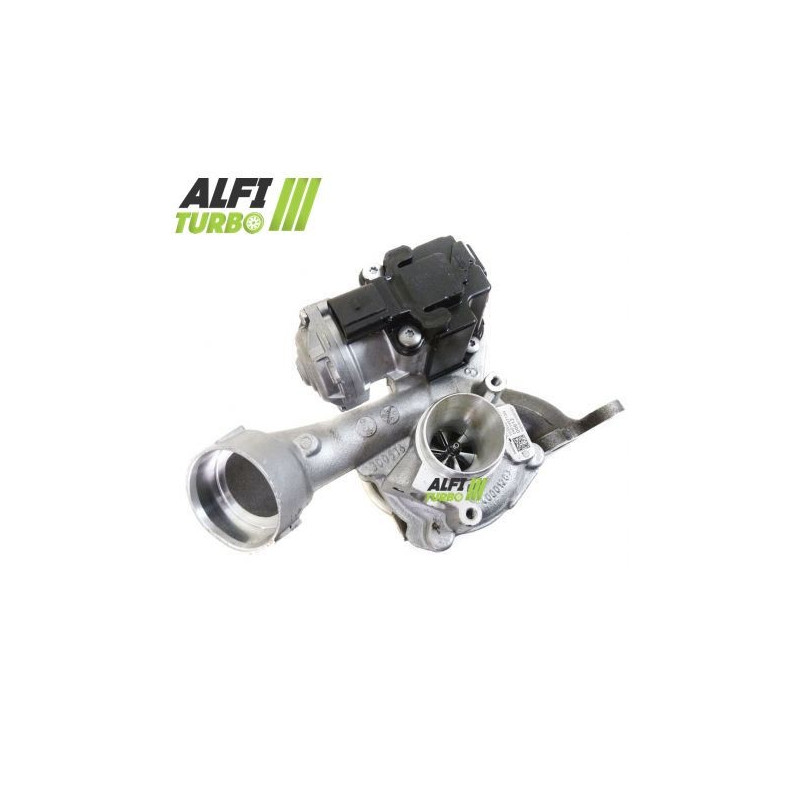
This hybrid turbo is designed for the 1.and 2 TSI engines with 105 and 110 hp, fitted to certain Audi, Seat, Skoda and Volkswagen. . The kit combines a high-flow MFS compressor wheel, a dre-profiled intake housing and a 360° bearing retainer.
Designed for to Installation without modification the mechanical dof the original assembly, it nevertheless requires a suitable engine management system in order dto utilise its characteristics correctly.
Available versions — Stage 2 and Stage 2+
Stage 2
Compressor wheel: MFS high-flow oversized 39 mm
dintake housing: re-profiled for accommodate the new impeller
Thrust bearing: 360°
Balancing: high-speed at 150,000 rpm on a Cimat VSR test bench
This configuration is designed to optimise the air compressor’s compression capacity and flow rate dthrough the use of a larger impeller and a specifically re-profiled housing.
Stage 2+
Compressor impeller: MFS high-flow, oversized of 43 mm
dintake housing: reprofiled for ccommodate the new impeller
Thrust bearing: 360° bearing
Balancing: high-speed balancing at 150,000 rpm on a Cimat VSR test bench
The 43 mm impeller alters the aerodynamic characteristics of the. compressor. Its performance depends on the engine tuning and other associated components.
Understanding hybrid tuning
What is a hybrid turbo?
A hybrid turbo retains an architecture suited to the original ‘ d’ fitment whilst incorporating internal modifications. Depending on the tuning, these may involve the compressor impeller, the housings, the turbine, the thrust bearing or the balancing. The aim is dto adapt the compression capacity and the air flow rate d, as a larger impeller alone does not guarantee better performance.
MFS compressor impeller: standard or ‘ Performance ’?
MFS stands for ‘Milled From Solid’, meaning a wheel machined from a solid block. A standard MFS wheel can retain a geometry close to the original, whilst an MFS ‘ Performance ’ impeller can have a diameter or profile tailored to the set-up. A standard MFS impeller can be just as polished as an MFS ‘ Performance ’ impeller. It is not its appearance that determines its performance, but its geometry and its ability to move more dair.
Blade geometry and air flow d’air
The diameter, profile, height, width and arrangement of the blades influence air intake and compression. The final performance also depends on the casings, the turbine, the boost pressure and the mapping. An increase in diameter can also alter the response time and the range dof optimal use.
Reliability and balancing of the hybrid turbocharger
The 360° thrust bearing distributes axial forces over a wide surface area. The rotor is balanced at 150,000 rpm on a Cimat VSR test bench to minimise vibrations and mechanical stresses. However, this balancing does not compensate for inadequate lubrication or incorrect installation.
Engine remapping and preparation
The mapping and boost pressure management must be adjusted for to make the most of the turbo’s characteristics. The fuel injection, exhaust, intercooler d’intake and transmission must also be checked in line with the level of tuning. The wastegate must be adjusted when remapping the ECU.
Turbo part numbers
OEM part numbers
04E145703Q
04E145703QV
04E145703QX
04E145704LV
04E145704LX
04E145704N
04E145704NV
04E145704NX
04E145704T
04E145704TV
04E145704TX
04E145713B
04E145713BV
04E145713BX
04E145713Q
04E145713QV
04E145713QX
04E145721L
04E145721LV
04E145721LX
Manufacturer’s part numbers
030TC11001000
030-TC-11001-000
F026510031
Compatible vehicles and applications
Audi
A3 1.2 TSI — 105 hp
From 2011, end date unspecified
Engine code : unspecified
A3 1.2 TSI — 110 hp
From 2011, end date unspecified
Engine code : unspecified
Seat
Leon 1.2 TSI 16V — 110 hp
From 2011, end date unspecified
Engine code : unspecified
Skoda
Octavia 1.2 TSI 16V — 110 hp
From 2011, end date unspecified
Engine code : unspecified
Volkswagen
Golf VII 1.2 TSI — 105 hp
From 2012, end date unspecified
Engine code : unspecified
Golf VII 1.2 TSI 16V — 110 hp
From 2011, end date unspecified
Engine code : unspecified
Additional technical specifications
Type: turbo hybrid
Engine: 1,.2 TSI
Fuel: petrol
Power: 105/110 hp
Installation: no mechanical modifications required to the original d’s mounting
Fitting instructions
⚠️ WARNING — IMPORTANT BEFORE INSTALLATION
Identify and rectify the cause of the previous fault. Check the lubrication system, the oil supply and return lines d, as well as the cleanliness of the oil lines. Check the intake for any foreign objects, then prime the system in accordance with the applicable recommendations. Follow the manufacturer’s instructions. A lubrication fault that is not rectified may lead to further turbocharger failure.
How do you identify the correct turbo?
Check the turbo part number d, the original OEM and manufacturer part numbers, as well as the vehicle’s make, model, generation, engine type, power output,Year and engine code. An identical engine type does not automatically guarantee compatibility.
⚠️ Check your turbo’s part numbers
Before ordering, compare the part number marked on your original turbo d with the part numbers listed in this specification sheet. An identical engine specification does not always guarantee compatibility. If in doubt, please contact us at for to check your fitment.