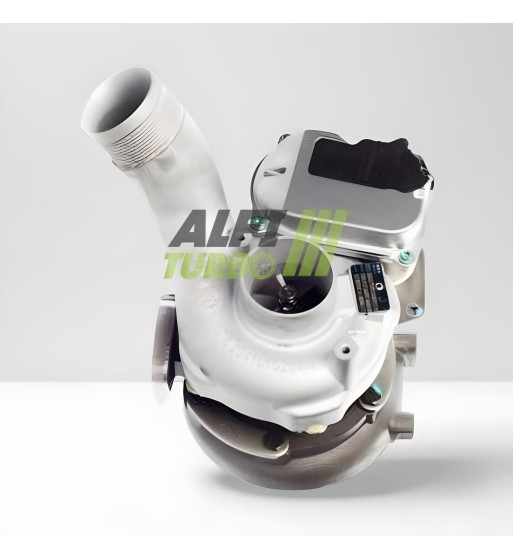
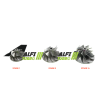
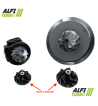
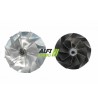
This hybrid turbo for engine options Audi 2.7 TDI is available in various forms Stage 1, Stage 2 and Stage 2+. Its design combines a high-flow MFS compressor wheel, a 360° bearing retainer and high-speed balancing at 150,000 rpm on a Cimat VSR test bench.
The applications documented relate mainly to Audi A4 B7 and A6 C6 diesel engines producing 163 or 180 hp. The benchmark for turbochargers d'The origin must be verified before any order is placed'.
Available products — Stage 1, Stage 2 and Stage 2+
Stage 1
Compressor wheel: High-capacity MFS
Stop: 360° bearing stop
Balancing: high speed at 150,000 rpm on a Cimat VSR test bench
This system is based on an MFS compressor wheel designed for adjust the turbo’s flow rate and boost pressure. It retains its configuration plug & play scheduled for one Installation without modification of the vehicle.
Stage 2
Compressor wheel: High-capacity MFS oversized
Carter d'Admission:' reprofiled for to receive the new wheel oversized
Stop: 360° bearing stop
Balancing: high speed at 150,000 rpm on a Cimat VSR test bench
The wheel oversized requires the casing to be re-profiled d'admission'. This adaptation is intended to increase mobility d'air, with behaviour that also depends on the engine mapping and configuration'.
Stage 2+
Compressor wheel: High-capacity MFS oversized
Carter d'Admission:' reprofiled for to receive the new wheel oversized
Stop: 360° bearing stop
Balancing: high speed at 150,000 rpm on a Cimat VSR test bench
The documented evidence for This kit includes an MFS wheel oversized and a casing d're-profiled intake'. The choice of training course must be determined by the engine project and the planned peripheral modifications.
What is a hybrid turbo ?
A hybrid turbo retains a design suited to the mounting points of the relevant application whilst incorporating internal modifications. Depending on the specific application, these may relate to the compressor wheel, its dimensions, the geometry of the blades, the casings, the thrust bearing or the balancing.
The aim is d'adjust the compression capacity and flow rate' d'air'. However, a hybrid turbo is not defined solely by the appearance of its impeller: the consistency between the components, their machining and the balancing of the rotor remain crucial.
MFS compressor wheel: standard or Performance ? ?
MFS stands for ‘Milled From Solid’, meaning a wheel machined from a solid block. This manufacturing process does not, on its own, guarantee an increase in throughput d'air'. A standard MFS wheel can retain a geometry equivalent to that d'origin'.
An MFS wheel Performance can be designed with a geometry suited to the intended application, in particular through its profile, dimensions or the configuration of its blades. For this product, the wheels listed are described as being lighter, larger and taller than the original ones, with a claimed 15 per cent increase in compression capacity.
A standard MFS wheel can be just as shiny as an MFS wheel Performance. It is not its appearance that determines its performance, but its geometry and its ability to move more d'air'. A higher flow rate can help to increase power output when the engine has been suitably tuned.
Why does the geometry of the blades affect the flow rate? d'air?' ?
The compressor wheel draws in and then compresses the air fed to the engine. Its diameter, profile, height, width and the arrangement of the blades influence the aerodynamic behaviour of the compressor and the quantity d'air displaced under certain operating conditions'.
The result also depends on the compressor housing, the turbine, the boost pressure and the engine management system. A larger wheel does not automatically guarantee better performance and may affect response time and range d'optimal use'.
Reliability and balancing of the hybrid turbocharger
The documented 360° bearing stop helps to distribute the axial forces around the axis. It supports the preparation of the turbocharger, without removing the constraints relating to lubrication, assembly or operating conditions d'use'.
The rotor is balanced at high speed, at 150,000 rpm on a Cimat VSR test bench. This procedure is designed to minimise vibrations and mechanical stresses, but does not protect against incorrect installation, inadequate lubrication or the presence of d'a foreign body'.
Engine remapping and tuning
The engine mapping needs to be adjusted for make the most of the hybrid turbo’s features. The wastegate must be adjusted when remapping the ECU.
Depending on the level of preparation, the fuel injection, exhaust, cooling, boost pressure management and transmission must be checked or adjusted. The editing d'A hybrid turbo alone does not guarantee a power boost'.
Turbo part numbers
OEM part numbers
059145715E
059145715N
059145715T
Manufacturer’s part numbers
53049700044
53049700051
53049700055
53049800044
53049800051
53049800055
53049880044
53049880051
53049880055
53049900044
53049900051
53049900055
Compatible vehicles and assignments
Audi
A4 B7 (8EC) — 180 hp
2.7 TDI diesel — Jan 2006 to June 2008
Engine code : BPP
A4 B7 Front (8ED) — 180 hp
2.7 TDI diesel — Jan 2006 to June 2008
Engine code : BPP
A4 B7 Convertible (8HE) — 180 hp
2.7 TDI diesel — June 2006 to March 2009
Engine code : BPP
A6 Allroad C6 (4FH) — 180 hp
2.7 TDI diesel — March 2006 to October 2008
Engine code : BPP
A6 C6 (4F2) — 163 hp
2.7 TDI diesel — November 2004 to March 2011
Engine codes: BSG, CANB
A6 C6 (4F2) — 163 hp
2.7 TDI diesel — June 2005 to March 2011
Engine codes: BSG, CAND
A6 C6 (4F2) — 180 hp
2.7 TDI diesel — November 2004 to October 2008
Engine code : BPP
A6 C6 Front (4F5) — 163 hp
2.7 TDI diesel — March 2005 to August 2011
Engine codes: BSG, CANB
A6 C6 Front (4F5) — 163 hp
2.7 TDI diesel — June 2005 to August 2011
Engine codes: BSG, CAND
A6 C6 Front (4F5) — 180 hp
2.7 TDI diesel — November 2004 to October 2008
Engine code : BPP
A6 C6 Front (4F5) — 180 hp
2.7 TDI diesel — March 2005 to October 2008
Engine code : BPP
Additional technical specifications
Product type: hybrid turbo
Engine: Audi 2.7 TDI
Fuel: diesel
Power ratings: 163, 177 and 180 hp
Documented engine codes: BPP, BSG, CANB, CAND
Documented periods: November 2004 to August 2011, depending on the assignment
Installation: configuration plug & play as planned, without any modifications to the vehicle
Assembly instructions
⚠️ WARNING — IMPORTANT BEFORE ASSEMBLY
Identify and rectify the cause of the previous fault before d'fit the turbo'. Check the lubrication circuit, the supply and the return d'the oil and the cleanliness of all the pipes'.
Check the intake and ensure that no foreign objects can reach the compressor wheel. Carry out the priming in accordance with the relevant guidelines and follow the manufacturer’s instructions.
If a lubrication fault is not rectified, it may lead to the turbocharger failing again.
How do you choose the right turbo ?
Check the part number marked on the turbocharger d'origin', then compare the OEM and manufacturer part numbers. Also check the make, model, generation, body style, engine type and power output in hp, the assembly period and the engine code. Having the same engine is not always enough to confirm compatibility.
⚠️ Check your turbo’s part numbers
Before placing your order, Compare the part number on your turbocharger d'origin' using the references given in this fact sheet. Having the same motor does not always guarantee compatibility.
If you are in any doubt, please contact us with the full reference number shown on your turbocharger d'origin'.