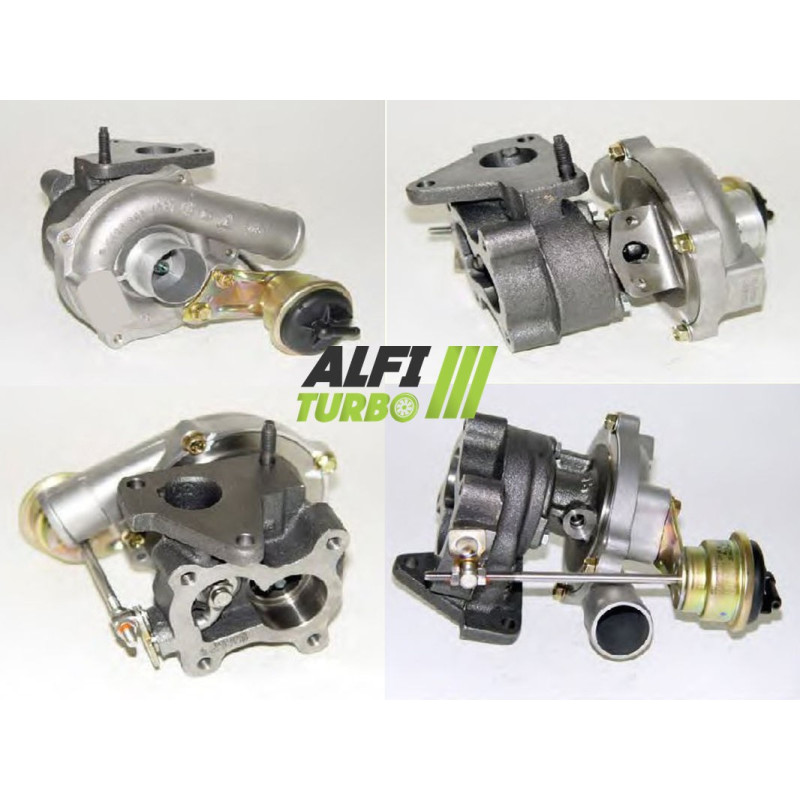
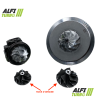
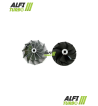
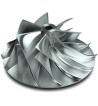
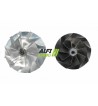
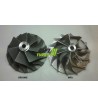
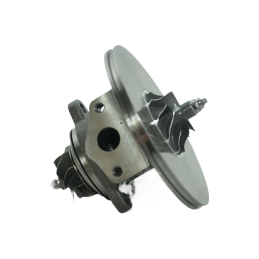
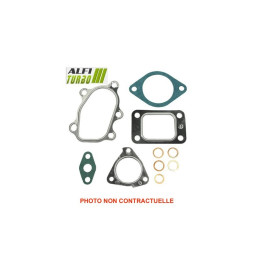
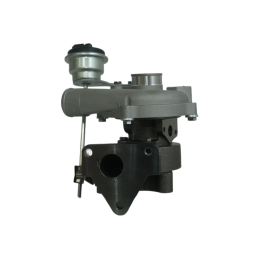
This hybrid turbo for engine variants 1.5 DCI and 1.5 DDIS is available in three levels of preparation. Each version is fitted with an MFS compressor wheel Performance and a 360° bearing stop, with high-speed balancing on a Cimat VSR test bench.
Designed for an installation plug & play Without requiring any modifications to the vehicle’s mounting, it is suitable for a range of applications Dacia, , Nissan, , Renault and Suzuki. Compatibility must be confirmed using the turbo’s part number d’origin’.
Available products — Stage 1, Stage 2 and Stage 2+
Stage 1
Compressor wheel: MFS Performance high-speed
Dimensions: 29.50 / 40.81 mm
Blade configuration: 5+5
Stop: 360° bearing
Balancing: 150,000 rpm on a Cimat VSR test bench
This unit uses an MFS compressor wheel, the geometry of which is designed to adjust the flow rate d’air, with no documented changes to the casing for this work placement.
Stage 2
Compressor wheel: MFS Performance high-speed oversized
Dimensions: 33.64 / 46.00 mm
Blade configuration: 11+0
Carter d’Admission:’ reprofiled for to receive the wheel oversized
Stop: 360° bearing
Balancing: 150,000 rpm on a Cimat VSR test bench
Reprofiling the casing allows d’fit the wheel with the larger diameter’. This change may affect the compression ratio and the turbo’s performance, depending on the engine configuration.
Stage 2+
Compressor wheel: MFS Performance high-speed oversized
Dimensions: 36.00 / 49.97 mm
Blade configuration: 6+6
Carter d’Admission:’ reprofiled for to receive the wheel oversized
Stop: 360° bearing
Balancing: 150,000 rpm on a Cimat VSR test bench
This version features a larger wheel and a specific blade configuration. Its performance depends on the overall engine set-up and the conditions dIntended uses.
What is a hybrid turbo ?
A hybrid turbo is based on a specially adapted turbocharger design for to receive internal components that differ from the configuration d’origin’. Depending on the service, modifications may relate to the compressor wheel, its geometry, its dimensions, or the housing d’intake, stop or balancing’.
The aim is d’adjust the compression capacity and flow rate’ dair. A hybrid turbo is not defined solely by the appearance of its impeller: the dimensions, the profile of the blades, the machining of the housing and the overall balance are all crucial factors.
MFS compressor wheel: standard or Performance ? ?
MFS stands for ‘Milled From Solid’, meaning a wheel machined from a solid block. This manufacturing process does not, on its own, guarantee an increase in throughput dair. A standard MFS wheel can retain a geometry equivalent to that d’origin’.
A standard MFS wheel can be just as shiny as an MFS wheel Performance. It is not its appearance that determines its performance, but its geometry and its ability to move more dair. A wheel Performance may use a blade diameter, profile or arrangement suited to the preparation. A higher flow rate can contribute to power output with appropriately adjusted engine management, although it does not in itself guarantee a gain in power.
Why does the geometry of the blades affect the flow rate? d’air ?
The compressor wheel draws in and then compresses the air fed to the engine. Its diameter, profile, height, width and the arrangement of its blades all influence its aerodynamic behaviour. The result also depends on the compressor housing, the turbine section, the boost pressure and the engine tuning. A larger wheel therefore does not automatically guarantee a better result and may affect the response time as well as the range doptimal use.
Reliability and balancing of the hybrid turbocharger
The 360° bearing stop fitted to each stage helps to distribute the axial forces. The rotor is balanced at high speed – up to 150,000 rpm – on a Cimat VSR test bench in order to minimise vibrations and mechanical stresses. However, this balancing does not compensate for either incorrect installation or inadequate lubrication.
Engine remapping and tuning
The mapping and management of boost pressure need to be adjusted for make the most of the hybrid turbo’s features. Depending on the course and the objective, fuel injection, exhaust and air cooling d’The intake system, clutch or gearbox may also need to be checked or adjusted. The wastegate must be adjusted during installation and when reprogramming the ECU.
Turbo part numbers
OEM part numbers
8200119854
8200189536
8200351471
8200409037
8200409838
1441100QAG
14411BN700
7701473673
119854H118218
7711135039
Manufacturer’s part numbers
54359700002
54359800002
54359880002
54359900002
KP35-002
Compatible vehicles and assignments
Dacia
Logan 1.5 DCI 65 hp
From 2004 — end date not specified
Engine code : not specified
Nissan
Almera 2 1.5 DCI 80/82 hp
From 2003 — end date not specified
Engine code : not specified
Kubistar 1.5 DCI 65 hp
From 2003 — end date not specified
Engine code : not specified
Kubistar 1.5 DCI 80/82 hp
From 2003 — end date not specified
Engine code : not specified
Micra 3 1.5 DCI 65 hp
From 2003 — end date not specified
Engine code : not specified
Micra 3 1.5 DCI 68 hp
From 2005 — end date not specified
Engine code : not specified
Micra 3 1.5 DCI 80/82 hp
From 2003 — end date not specified
Engine code : not specified
Note 1.5 DCI 80/82 hp
From 2001 — end date not specified
Engine code : not specified
Renault
Clio 2 1.5 DCI 65 hp
From 2000 — end date not specified
Engine code : not specified
Clio 2 1.5 DCI 80/82 hp
From 2001 — end date not specified
Engine code : not specified
Kangoo 1.5 DCI 57 hp
From 2003 — end date not specified
Engine code : not specified
Kangoo 1.5 DCI 65 hp
From 2000 — end date not specified
Engine code : not specified
Kangoo 1.5 DCI 80/82 hp
From 2002 — end date not specified
Engine code : not specified
Megane 2 1.5 DCI 80/82 hp
From 2002 — end date not specified
Engine code : not specified
Mode 1.5 DCI 80/82 hp
From 2002 — end date not specified
Engine code : not specified
Scenic 2 1.5 DCI 80/82 hp
From 2003 — end date not specified
Engine code : not specified
SYMBOL 1.5 DCI 65 hp
From 2002 — end date not specified
Engine code : not specified
Thalia 1.5 DCI 65 hp
From 2002 — end date not specified
Engine code : not specified
Suzuki
Jimny (SN413V) 1.5 DDIS 65 hp
From 2003 — end date not specified
Engine code : not specified
Additional technical specifications
Product type: hybrid turbo
Engine options: 1.5 DCI and 1.5 DDIS
Documented power ratings: 57, 65, 68, 80 and 82 hp depending on the purpose
Documented periods: from 2000 onwards, depending on the vehicle
Editing: plug & play, without any modifications to the vehicle’s installation
Assembly instructions
⚠️ WARNING — IMPORTANT BEFORE ASSEMBLY
Identify and rectify the cause of the previous fault. Check the lubrication circuit, the supply and the return doil, then check that the ducts and the intake are clean and that there are no foreign objects.
Carry out the priming in accordance with the relevant guidelines and follow the manufacturer’s instructions. The wastegate must be adjusted during installation and whilst the map is being fine-tuned.
If a lubrication fault is not rectified, it may lead to the turbocharger failing again.
How do you choose the right turbo ?
Check the part number marked on the turbocharger d’origin, as well as the OEM and manufacturer’s part numbers. Also check the make, model, generation, engine type, power output, and theYear the mounting code and the engine code, where available. The same engine can be fitted with several different turbo set-ups.
⚠️ Check your turbo’s part numbers
Before placing your order, Compare the part number on your turbocharger d’origin’ using the references given in this fact sheet. Having the same motor does not always guarantee compatibility. If you have any queries, please contact us before placing your order.