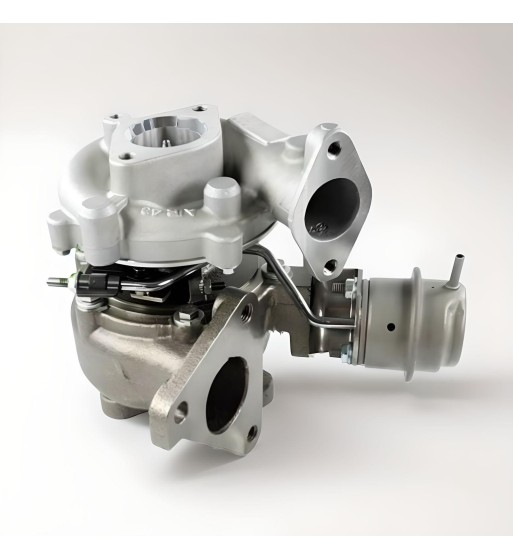
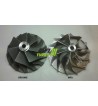
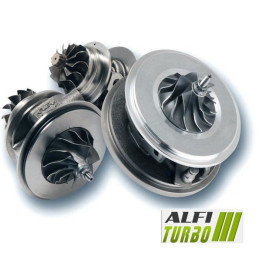
This hybrid turbo for engine options Nissan 2.2 DCI and 2.2 DI benefits from d'an internal mechanism designed to adjust the compression capacity and flow rate' d'air'. Depending on the configuration chosen, the set comprises a high-flow MFS compressor wheel, a 360° bearing retainer and additional modifications to the casings or the turbine section.
The documented assignments relate in particular to Nissan Almera, Almera Tino, Primera 2 and X-Trail. Compatibility must always be confirmed using the turbocharger’s part number d'origin'.
Available products — Stage 1, Stage 2 and Stage 3
Stage 1
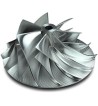
Compressor wheel: High-capacity MFS
Level: 360° stop
Balancing: high speed at 150,000 rpm on a Cimat VSR test bench
This product acts mainly on the compressor section. The high-flow MFS impeller is designed to regulate air flow, whilst the 360° thrust bearing helps to distribute axial forces more evenly.
Stage 2
Compressor wheel: High-capacity MFS oversized
Carter d'Admission:' re-profiled for to receive the new wheel oversized
Level: 360° stop
Balancing: high speed at 150,000 rpm on a Cimat VSR test bench
The Stage 2 incorporates a compressor wheel oversized to a casing d're-profiled intake'. This configuration may affect the compressor’s flow capacity and behaviour; its operation depends on the overall condition of the engine.
Stage 3
Compressor wheel: High-capacity MFS oversized
Carter d'Admission:' re-profiled for to receive the new wheel oversized
Level: 360° stop
Turbine wheel: high-speed oversized
Turbine casing: re-profiled for to receive the new wheel oversized
Balancing: high speed at 150,000 rpm on a Cimat VSR test bench
The Stage 3 includes documented modifications to the compressor and turbine sections. Larger wheels and the reshaping of the casings affect the flow rate and may also alter the response time and the range d'optimal use'.
What is a hybrid turbo ?
A hybrid turbocharger is based on a turbocharger design that has been adapted to accommodate components or machining processes that differ from the standard configuration d'origin'. Depending on the course, the preparation may involve the compressor wheel, the casings, the turbine wheel, the thrust bearing and balancing.
The aim is d'adjust the compression capacity and flow rate' d'air'. However, a hybrid turbo is not defined solely by the appearance of its compressor wheel: the balance between the wheels, the housings and the engine management system remains crucial.
MFS compressor wheel: standard or Performance ? ?
MFS stands for ‘Milled From Solid’, meaning a wheel machined from a solid block. This manufacturing process does not, on its own, guarantee an increase in throughput d'air'. A standard MFS wheel can retain a geometry equivalent to the original.
An MFS wheel Performance may utilise a geometry suited to the purpose of the preparation, in particular with regard to the profile, height, width or arrangement of the blades. A standard MFS wheel can be just as shiny as an MFS wheel Performance. It is not its appearance that determines its performance, but its geometry and its ability to move more d'air'.
A higher flow rate can enable the engine to produce more power when combined with appropriate engine tuning, although no specific power gain can be guaranteed by the turbocharger alone.
Why does the geometry of the blades affect the flow rate? d'air?' ?
The compressor wheel draws in and then compresses the air fed to the engine. Its diameter, profile, height, width and the arrangement of its blades all influence its aerodynamic behaviour. The right geometry can move more d'air under certain operating conditions'.
The result also depends on the casings, the turbine wheel, the boost pressure and the engine tuning. A larger wheel does not automatically guarantee better performance and may affect the turbocharger’s response time.
Reliability and balancing of the hybrid turbocharger
The 360° stop fitted to all three stages helps to distribute the axial forces. However, it does not protect the turbocharger against a lack of lubrication, contamination or incorrect fitting.
Each advertised product benefits from d'high-speed balancing at 150,000 rpm on a Cimat VSR test bench'. The aim of this operation is to minimise vibrations and mechanical stresses on the rotor.
Engine remapping and tuning
It may be necessary to adjust the engine mapping and boost pressure control for make the most of the hybrid turbo’s features. The fuel injection, exhaust, cooling system, clutch and gearbox must also be checked, depending on the level of preparation. The wastegate must be adjusted when the ECU is remapped. A turbocharger on its own does not guarantee a power increase.
Turbo part numbers
OEM part numbers
14411AW400EP
14411AW40AEP
14411AW40A
14411AW400
Manufacturer’s part numbers
727477-0002
727477-0005
727477-0006
727477-0007
727477-0010
727477-5002S
727477-5006S
727477-5007S
727477-5010S
Compatible vehicles and assignments
Nissan
Almera 2.2 DCI — 136 hp
2.2 DCI — from 2003, end date not specified
Engine code : not specified
Almera Tino 2.2 DCI — 136 hp
2.2 DCI — from 2003, end date not specified
Engine code : not specified
Primera 2 2.2 DCI — 126 hp
2.2 DCI — from 2001, end date unspecified
Engine code : not specified
Primera 2 2.2 DCI — 132/136 hp
2.2 DCI — from 2001, end date unspecified
Engine code : not specified
Primera 2 2.2 DCI — 138 hp
2.2 DCI — from 2001, end date unspecified
Engine code : not specified
X-Trail 2.2 DCI — 114/136 hp
2.2 DCI — from 2001, end date unspecified
Engine code : not specified
X-Trail 2.2 DCI — 136 hp
2.2 DCI — from 2003, end date not specified
Engine code : not specified
X-Trail 2.2 DI — 136 hp
2.2 DI — from 2001, end date unspecified
Engine code : not specified
Additional technical specifications
Product type: hybrid turbo
Turbo families: GT1749V, GT1849V
Documented engine specifications: 2.2 DCI and 2.2 DI
Product features: 125 and 136 hp
Installation: configuration plug & play, with no changes to the assembly planned
Assembly instructions
⚠️ WARNING — IMPORTANT BEFORE ASSEMBLY
Identify and rectify the cause of the previous fault before d'fit the turbo'.
Check the entire lubrication circuit, including the supply and return lines d'oil'. Also check that the ducts and the intake are clean and free from foreign objects.
Carry out the priming in accordance with the relevant guidelines and follow the vehicle manufacturer’s instructions.
If a lubrication fault is not rectified, it may lead to the turbocharger failing again.
How do you choose the right turbo ?
Check the part number engraved or marked on the turbocharger d'original', then compare it with the OEM and manufacturer part numbers listed on this sheet. Also check the make, model, generation, engine type and power output in hp, theYear the mounting code and the engine code, where available. Having the same motor does not always guarantee compatibility.
⚠️ Check your turbo’s part numbers
Before placing your order, Compare the part number on your turbocharger d'origin' using the references given in this fact sheet. Having the same motor does not always guarantee compatibility.
If you are in any doubt, please contact us with the full part number of your turbocharger d'origin'.