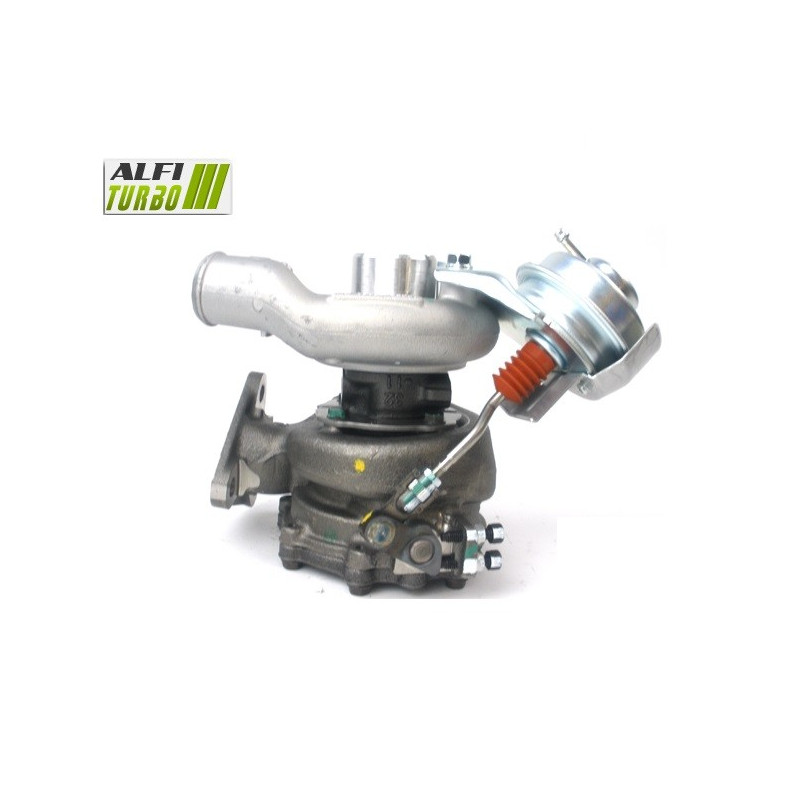
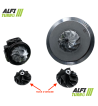
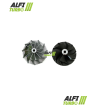
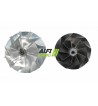
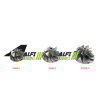
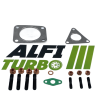
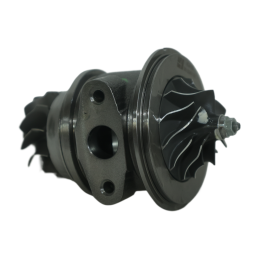
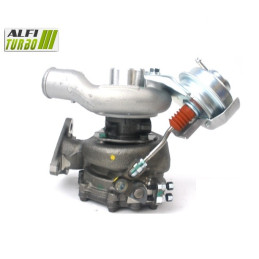
This hybrid turbo for, designed for the Opel 1.7 CDTI engine, is available in three performance levels.. Each stage is fitted with a specially adapted MFS compressor wheel Performance, a 360° bearing stop and high-speed balancing on a Cimat VSR test bench.
Designed for to Installation without modification with a range of mounting interfaces, it is particularly suitable for various versions of the Opel Astra H, Combo, Corsa C and Meriva A fitted with Z 17 DT or Z 17 DTH engines.
Available set-ups — Stage 1, Stage 2 and Stage 2+
Stage 1
Compressor wheel: MFS Performance high-flow
Dimensions: 33.00 / 44.01 mm
Configuration: 6+6 blades
Bearing: 360° thrust
Balancing: 150,000 rpm on a Cimat VSR test bench
This set-up utilises an MFS Performance impeller, the geometry of which is designed to adapt the air flow rate d whilst retaining the documented installation characteristics.
Stage 2
Compressor impeller: MFS Performance, high flow rate oversized
Dimensions: 34.30 / 47.43 mm
Configuration: 6+6 blades
Inlet housing: reprofiled for accommodate the impeller oversized
Bearing: 360° thrust bearing
Balancing: 150,000 rpm on a Cimat VSR test bench
The increased diameter and the reprofiling of the intake casing d allow d to accommodate this specific impeller. The performance achieved also depends on the engine management system and the vehicle’s other components.
Stage 2+
Compressor impeller: MFS Performance high-flow oversized
Dimensions: 39.55 / 51.00 mm
Configuration: 11+0 blades
Inlet housing: re-profiled for to accommodate the impeller oversized
Bearing: 360° thrust
Balancing: 150,000 rpm on a Cimat VSR test bench
This version features a larger-diameter impeller with a specific blade configuration. Its installation must take into account the desired response time, the mapping and the overall engine set-up.
What is a hybrid turbo?
A hybrid turbo utilises a turbocharger architecture adapted for accommodate specific internal components. Depending on the upgrade stage, modifications may involve the compressor wheel, its dimensions, the blade geometry, the housing machining, the thrust bearing system or the balancing.
The aim is d to adapt the compression capacity and air flow rate d. However, a hybrid turbo is not defined solely by the appearance of its impeller: its operation depends on the compatibility between the components and the engine settings.
MFS compressor wheel: standard or Performance?
MFS stands for ‘Milled From Solid’, meaning a wheel machined from a solid block. This manufacturing process alone does not guarantee an increase in airflow d. A standard MFS wheel may retain a geometry equivalent to that d of the original.
A standard MFS impeller can be just as shiny as an MFS impeller Performance. It is not its appearance that determines its performance, but its geometry and its ability to move more d'air. An Performance impeller may have a diameter, profile or blade configuration suited to the engine set-up. A higher airflow can allow for more power with the appropriate engine set-up, though this is no guarantee of results.
Why does the blade geometry influence the air flow rate d?
The compressor impeller draws in and then compresses the air sent to the engine. Its diameter, profile, height, width and blade arrangement influence its aerodynamic behaviour. A suitable geometry can move more d air under certain conditions, but the result also depends on the housings, the turbine wheel, the boost pressure and the mapping. A larger wheel therefore does not automatically guarantee better performance and may alter the response time.
Reliability and balancing of the hybrid turbocharger
The documented 360° thrust bearing distributes axial forces over a wide surface area. The rotor is balanced at high speeds, up to 150,000 rpm, on a Cimat VSR test bench to minimise vibrations and mechanical stresses. However, this balancing does not compensate for inadequate lubrication, contamination of the system or incorrect installation.
Engine remapping and preparation
The engine management system must be adapted for to make full use of the hybrid turbo’s characteristics. The mapping, boost pressure, fuel injection, exhaust and cooling systems must be checked or adjusted depending on the level of tuning. The wastegate must be adjusted during fitting and remapping. The clutch, gearbox and other components must also be checked depending on the vehicle.
Turbo specifications
OEM part numbers
8973000921
93169104
97300092
860070
8973000923
8973000924
8973000925
8973000926
98102364
8981023640
860147
860128
Manufacturer’s part numbers
49131-06001
49131-06003
49131-06004
49131-06005
49131-06006
49131-06007
Compatible vehicles and assignments
Opel
ASTRA H (A04) — 100 hp1,.,7 CDTI diesel — 03/2004 to 10/2010
Engine code: Z 17 DTH
ASTRA H Estate (A04) — 101 hp1,..7 CDTI diesel — 08/2004 to 10/2010
Engine code: Z 17 DTH
ASTRA H Estate Van (L70) — 101 hp1,..7 CDTI diesel — 03/2004 to 10/2010
Engine code: Z 17 DTH
ASTRA H GTC (A04) — 101 hp1,..7 CDTI diesel — 03/2005 to 10/2010
Engine code: Z 17 DTH
ASTRA H Saloon (A04) — 101 hp1,.,7 CDTI diesel — 02/2007 to 10/2010
Engine code: Z 17 DTH
COMBO Box Van/MPV — 101 hp1,..7 CDTI diesel — Dec 2004 to unspecified end date
Engine code: Z 17 DTH
COMBO Tour — 101 hp1,..7 CDTI diesel — 07/2004 to 12/2011
Engine code: Z 17 DTH
CORSA C (X01) — 100 hp1.7 CDTI diesel — 06/2003 to 12/2009
Engine code: Z 17 DTH
CORSA C Hatchback Van (X01) — 101 hp1,.,7 CDTI diesel — 08/2003 to 12/2012
Engine code: Z 17 DTH
MERIVA A MPV (X03) — 100 hp1,..7 CDTI diesel — 09/2003 to 05/2010
Engine codes: Z 17 DT, Z 17 DTH
Additional technical specifications
Product type: turbo hybrid
Engine: Opel 1.7 CDTI
Fuel: diesel
Power: 100 to 101 hp depending on application
Engine codes: Z 17 DT, Z 17 DTH
Installation: see installation guides Installation without modification
Installation advice
⚠️ WARNING — IMPORTANT BEFORE INSTALLATION
Identify and rectify the cause of the previous fault. Carefully check the lubrication circuit, as well as the oil supply and return d. Check that the pipes are clean, the inlet and that there are no foreign objects. Prime the system in accordance with the applicable recommendations and follow the manufacturer’s instructions. A lubrication fault that is not rectified may lead to further turbocharger failure.
How do you identify the correct turbo?
Check the part number engraved or marked on the original turbo d, then compare the OEM and manufacturer part numbers.. Also check the model, generation, body style, engine type, power output, years of manufacture and engine code.. An identical engine type does not always guarantee compatibility.
⚠️ Check your turbo’s part numbers
Before ordering, compare the part number marked on your original turbo d with the part numbers listed in this specification sheet. An identical engine specification does not always guarantee compatibility. If in doubt, please contact us with the full part number of your turbo.