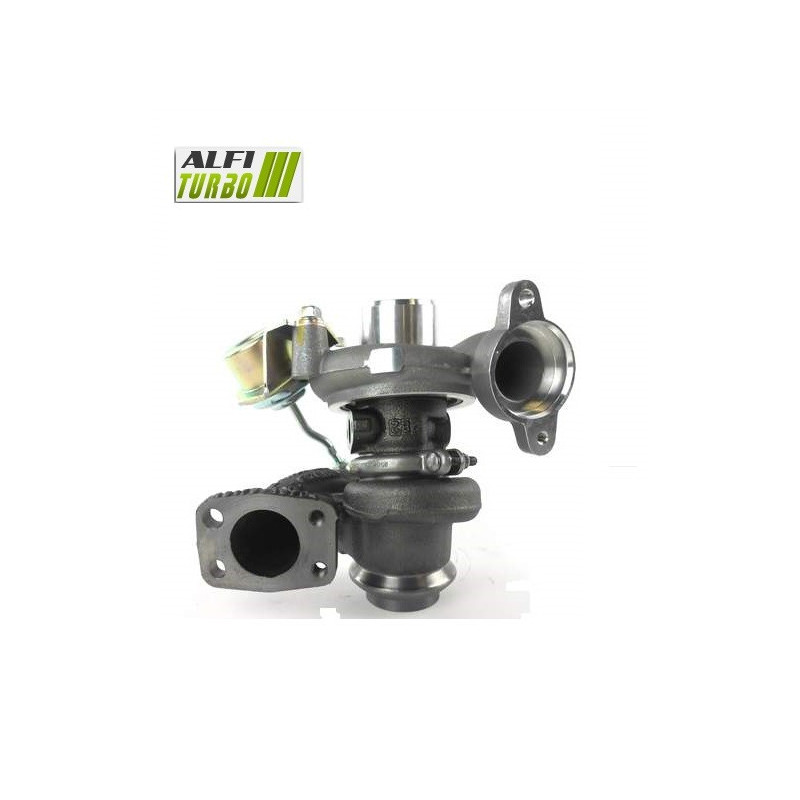
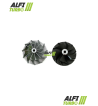
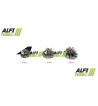
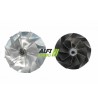
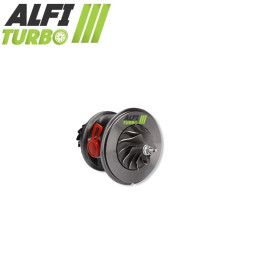
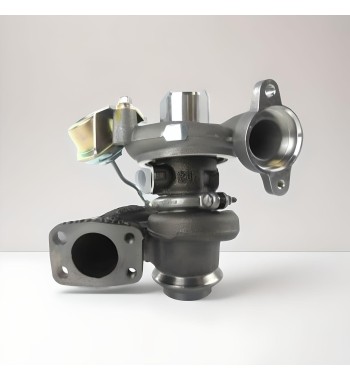
This hybrid turbo for engine variants 1.6 HDI and 1.6 TDCI benefits from d'an internal preparation suitable for various purposes' d'use'. Depending on the course chosen, he receives an MFS compressor wheel Performance high flow rate, a 360° bearing stop and high-speed balancing.
The documented allocations relate in particular to several models Citroën, , Ford, , Peugeot and Volvo. The benchmark for turbochargers d'The origin must be verified before any order is placed'.
Available products — Stage 1, Stage 2 and Stage 2+
Stage 1
Compressor wheel: MFS Performance high-speed
Dimensions: 29.07 / 39.98 mm
Blade configuration: 6+6
Bearing stop: 360°
Balancing: 150,000 rpm on a Cimat VSR test bench
This setup is based on an MFS wheel Performance designed to regulate the flow rate d'air, whilst retaining the documented dimensions' for this work placement. The 360° stop helps to distribute axial forces.
Stage 2
Compressor wheel: MFS Performance high-speed oversized
Dimensions: 33.00 / 42.50 mm
Blade configuration: 6+6
Carter d'Admission:' Reprofiled for to accommodate the wheel oversized
Bearing stop: 360°
Balancing: 150,000 rpm on a Cimat VSR test bench
The Stage 2 pairs a wheel oversized to a casing d're-profiled intake'. This configuration may increase the range d'air, but its behaviour also depends on the boost setting and the engine tuning'.
Stage 2+
Compressor wheel: MFS Performance high-speed oversized
Dimensions: 35.65 / 46.00 mm
Blade configuration: 6+6
Carter d'Admission:' Reprofiled for to accommodate the wheel oversized
Bearing stop: 360°
Balancing: 150,000 rpm on a Cimat VSR test bench
The Stage 2+ uses the largest dimensions documented on this data sheet. Increasing the diameter may affect the available flow rate, response time and range d'optimal use; on its own, it does not guarantee an improvement in all conditions'.
What is a hybrid turbo ?
A hybrid turbo utilises a suitably adapted turbocharger design for to receive internal components or machining operations that differ from the standard configuration. Depending on the modification, changes may relate to the compressor impeller, its dimensions, the geometry of the blades, the casings, the turbine impeller, the thrust bearing or the balancing.
The aim is d'adjust the compression capacity and flow rate' d'air'. However, a hybrid turbo is not defined solely by the appearance of its impeller: all the dimensions, profiles, mechanical clearances and settings must be consistent.
MFS compressor wheel: standard or Performance ? ?
MFS stands for ‘Milled From Solid’, meaning a wheel machined from a solid block. This term describes a manufacturing process and does not, in itself, guarantee an increase in throughput d'air'. A standard MFS wheel can retain a geometry equivalent to that d'origin'.
An MFS wheel Performance can use a geometry and dimensions suited to the preparation objective. A standard MFS wheel can be just as shiny as an MFS wheel Performance. It is not its appearance that determines its performance, but its geometry and its ability to move more d'air'. A higher flow rate can help to generate more power only if the engine has been properly tuned.
Why does the geometry of the blades affect the flow rate? d'air?' ?
The compressor wheel draws in and then compresses the air admitted by the engine. Its diameter, profile, height, width and the arrangement of the blades all influence its aerodynamic behaviour. The result also depends on the compressor housing, the turbine section, the boost pressure and the engine management system. A larger wheel can move more d'air under certain conditions, but can also affect the response time'.
Reliability and balancing of the hybrid turbocharger
The three documented work placements include d'a 360° bearing stop, designed for to distribute axial forces more evenly. The rotor is balanced at high speed – up to 150,000 rpm – on a Cimat VSR test bench, in order to minimise vibrations and mechanical stresses. This balancing does not compensate for a lack of lubrication, contamination or incorrect installation.
Engine remapping and tuning
It may be necessary to adjust the mapping and pressure management for make the most of the hybrid turbo’s features. According to the design, the injection, exhaust and air cooling systems d'The intake, clutch or gearbox must also be checked'. The wastegate must be adjusted during the installation and remapping of the ECU. No increase in power is automatic without the appropriate engine settings.
Turbo part numbers
OEM part numbers
9657603780
9670371380
9657530580
9662371080
9685293080
9682881780
9682881380
71793889
0375J0
0375N0
0375N5
0375K5
0375Q2
0375Q3
0375Q4
0375Q5
1441254
1479841
1523337
1684949
3M5Q6K682DA
3M5Q6K682DB
3M5Q6K682DC
3M5Q6K682DD
3M5Q6K682DE
3M5Q6K682D
Manufacturer’s part numbers
49173-07502
49173-07503
49173-07504
49173-07505
49173-07506
49173-07507
49173-07508
49173.047515
49173.07516
49173.07517
49173.07518
49173.07522
49173.07527
49173.07528
4917307502
4917307503
4917307504
4917307505
4917307506
4917307507
4917307508
4917307515
4917307516
4917307517
4917307518
4917307522
4917307527
4917307528
Compatible vehicles and assignments
Citroën
Berlingo — 90/92 hp
1.6 HDI — from 2002, end date unspecified
Engine code : not specified
C3 — 90/92 hp
1.6 HDI — from 2005, end date unspecified
Engine code : not specified
C3 Picasso — 90/92 hp
1.6 HDI — from 2009, end date unspecified
Engine code : not specified
C4 — 90/92 hp
1.6 HDI — from 2004, end date unspecified
Engine code : not specified
Jumpy 2 — 90/92 hp
1.6 HDI — from 2005, end date unspecified
Engine code : not specified
Partner — 90/92 hp
1.6 HDI — from 2005, end date unspecified
Engine code : not specified
Xsara Picasso — 90/92 hp
1.6 HDI — from 1999, end date unspecified
Engine code : not specified
Ford
C-Max — 90/92 hp
1.6 TDCI — from 2007, end date unspecified
Engine code : not specified
Fiesta 5 — 90/92 hp
1.6 TDCI — from 2002, end date unspecified
Engine code : not specified
Fiesta 5 Phase 2 — 90/92 hp
1.6 TDCI — from 2005, end date unspecified
Engine code : not specified
Fiesta 6 — 90/92 hp
1.6 TDCI — from 2008, end date unspecified
Engine code : not specified
Focus 2 — 90/92 hp
1.6 TDCI — from 2001, end date unspecified
Engine code : not specified
Focus 2 C-Max — 90/92 hp
1.6 TDCI — from 2003, end date unspecified
Engine code : not specified
Focus 2 Phase 2 — 90/92 hp
1.6 TDCI — from 2007, end date unspecified
Engine code : not specified
Fusion — 90/92 hp
1.6 TDCI — from 2005, end date unspecified
Engine code : not specified
Peugeot
207 — 90/92 hp
1.6 HDI — from 2006, end date unspecified
Engine code : not specified
207 SW — 90/92 hp
1.6 HDI — from 2007, end date unspecified
Engine code : not specified
307 — 90/92 hp
1.6 HDI — from 2001, end date unspecified
Engine code : not specified
307 Phase 2 — 90/92 hp
1.6 HDI — from 2005, end date unspecified
Engine code : not specified
307 SW — 90/92 hp
1.6 HDI — from 2002, end date unspecified
Engine code : not specified
308 — 90/92 hp
1.6 HDI — from 2007, end date unspecified
Engine code : not specified
308 SW — 90/92 hp
1.6 HDI — from 2008, end date unspecified
Engine code : not specified
Partner — 90/92 hp
1.6 HDI — from 2005, end date unspecified
Engine code : not specified
Volvo
S40 — 90/92 hp
1.6 HDI — from 2004, end date unspecified
Engine code : not specified
V50 — 90/92 hp
1.6 HDI — from 2004, end date unspecified
Engine code : not specified
Additional technical specifications
Product type: Hybrid Turbo
Engine options: 1.6 HDI and 1.6 TDCI
displacement : 1.6
Fuel: Diesel
Power ratings: 75 and 90 hp in the title; postings documented in 1990–92 hp
Period covered: From 1999 onwards, depending on the vehicle; purposes not specified
Engine codes: Not specified
Assembly instructions
⚠️ WARNING — IMPORTANT BEFORE ASSEMBLY
Identify and rectify the cause of the previous fault before d'fit the turbo'. Check the lubrication circuit, the supply and the return d'the oil and the cleanliness of all the pipes'.
Check the intake and ensure there are no foreign objects present. Carry out the priming in accordance with the relevant guidelines and follow the manufacturer’s instructions. The wastegate must be adjusted during installation and whilst fine-tuning the engine management system.
If a lubrication fault is not rectified, it may lead to the turbocharger failing again.
How do you choose the right turbo ?
Check the part number marked on the turbocharger d'origin', then compare the OEM and manufacturer part numbers. Also check the make, model, generation, body style, engine type and power output in hp, theYear the mounting code and the engine code, where available. Having the same motor does not always guarantee compatibility.
⚠️ Check your turbo’s part numbers
Before placing your order, Compare the part number on your turbocharger d'origin' using the references given in this fact sheet. Having the same motor does not always guarantee compatibility.
If you are in any doubt, please contact us, quoting the full part number shown on your turbocharger.