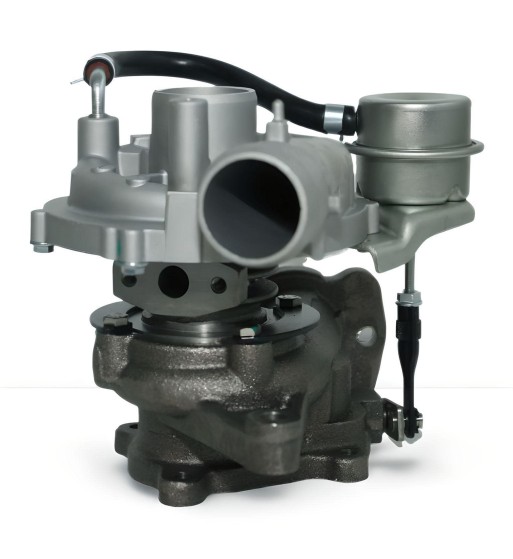
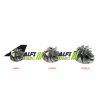
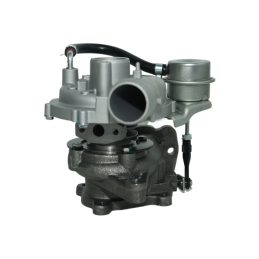
This hybrid turbo for engine options 2.0 HDI and 2.0 JTD is available in three documented levels of preparation. Depending on the course, he is issued with an MFS compressor wheel Performance, a 360° bearing stop and high-speed balancing on a Cimat VSR bench.
The specifications listed cover several models Citroën, , Fiat, , Lancia and Peugeot. Installation is designed to require no external modifications, but the engine setup and wastegate adjustment must be adapted to the chosen tuning specification.
Available products — Stage 1, Stage 2 and Stage 2+
Stage 1
Compressor wheel: High-capacity MFS Performance
Dimensions: 34.10 / 46.03 mm
Blade configuration: 6+6
Bearing stop: 360°
Balancing: 150,000 rpm on a Cimat VSR test bench
This kit includes an MFS wheel Performance with a specific blade configuration. It aims to adjust the flow rate d'the atmosphere whilst retaining the specific details and changes associated with this course'.
Stage 2
Compressor wheel: High-capacity MFS oversized Performance
Dimensions: 36.30 / 49.00 mm
Blade configuration: 11+0
Carter d'Admission:' Reprofiled for to accommodate the wheel oversized
Bearing stop: 360°
Balancing: 150,000 rpm on a Cimat VSR test bench
The wheel oversized requires the casing to be re-profiled d'admission'. This combination may increase mobility d'air, with behaviour that also depends on engine management and the overall configuration'.
Stage 2+
Compressor wheel: High-capacity MFS oversized Performance
Dimensions: 38.62 / 52.19 mm
Blade configuration: 11+0
Carter d'Admission:' Reprofiled for to accommodate the wheel oversized
Bearing stop: 360°
Balancing: 150,000 rpm on a Cimat VSR test bench
This machine uses a larger wheel and a casing d'adapted admission'. A larger wheel alone does not guarantee better performance in all conditions: response time and range d'Use depends on the preparation being carried out in full'.
What is a hybrid turbo ?
A hybrid turbo is based on a specially adapted turbocharger design for to receive modified internal components. Depending on the course, the preparation may cover the compressor wheel, its geometry, its dimensions and the casing d'the intake, the stop system and rotor balancing'.
The aim is d'adjust the compression capacity and flow rate' d'air'. However, a hybrid turbo is not defined solely by the appearance of its impeller: the dimensions, geometry, machining of the housings and the overall coherence of the assembly are all crucial factors.
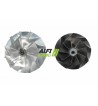
MFS compressor wheel: standard or Performance ? ?
MFS stands for ‘Milled From Solid’, meaning a wheel machined from a solid block. This is d'a manufacturing process which, on its own, does not guarantee an increase in throughput' d'air'.
A standard MFS wheel can retain a geometry equivalent to that d'origin'. An MFS wheel Performance may have a blade profile, dimensions or configuration suited to the preparation objective, such as the configurations documented for the three stages of this product.
A standard MFS wheel can be just as shiny as an MFS wheel Performance. It is not its appearance that determines its performance, but its geometry and its ability to move more d'air'. A higher flow rate can contribute to power output when the engine is suitably tuned, although this alone does not guarantee a gain in power.
Why does the geometry of the blades affect the flow rate? d'air?' ?
The compressor wheel draws in and then compresses the air fed to the engine. Its diameter, profile, height, width and the arrangement of its blades influence the aerodynamic behaviour of the compressor and the volume d'air displaced under certain operating conditions'.
The result also depends on the compressor housing, the turbine section, the boost pressure and the engine tuning. An increase in diameter may affect the response time and the optimum operating range; it therefore does not automatically guarantee better performance.
Reliability and balancing of the hybrid turbocharger
The 360° bearing stop, which is present on each of the documented stages, helps to distribute the axial forces. It must operate with adequate lubrication and does not protect the turbocharger against faulty installation or a fault d'oil supply'.
The rotor is balanced at high speed, up to 150,000 rpm, on a Cimat VSR test bench. This procedure is designed to minimise the vibrations and mechanical stresses associated with rotation.
Engine remapping and tuning
The farm d'A hybrid turbo may require adjustments to the engine mapping, boost pressure and fuel supply'. Fuel injection, exhaust, air cooling d'The intake system, clutch or gearbox may also need to be checked, depending on the vehicle and the level of modification'.
The wastegate must be adjusted during installation and during the tuning of the engine management system. A hybrid turbo does not automatically deliver a power boost without proper preparation.
Turbo part numbers
OEM part numbers
00000375E3
0375C8
0375E0
0375E1
0375E2
0375E3
0375F1
0375F2
0375H8
0375H7
0375H9
0375E9
0375F0
9622526980
9625526980
9633382180
9633382380
9645247080
9645247280
9633614180
9639563080
Manufacturer’s part numbers
706977-0001
706977-0002
706977-0003
706977-1
706977-2
706977-3
53039700009
53039800009
53039880009
53039900009
F400002
RHF4VVP1
VVP1
Compatible vehicles and assignments
Citroën
Berlingo — 90 hp
2.0 HDI • From 1996 — end date unspecified
C5 — 90 hp
2.0 HDI • From 2001 — end date not specified
Evasion — 110 hp
2.0 HDI • From 1998 — end date not specified
Jumpy — 109/110 hp
2.0 HDI • From 1995 — end date unspecified
Picasso — 90 hp
2.0 HDI • From 1999 — end date unspecified
Synergy — 109 hp
2.0 HDI • From 1998 — end date not specified
Xantia 2 — 90 hp
2.0 HDI • From 1997 — end date not specified
Xsara — 90 hp
2.0 HDI • From 1998 — end date not specified
Xsara Phase 2 — 90 hp
2.0 HDI • From 2000 — end date not specified
Xsara Picasso — 90 hp
2.0 HDI • From 1999 — end date unspecified
Fiat
Scudo — 95 hp
2.0 JTD • From 1995 — end date unspecified
Ulysses — 107/109 hp
2.0 JTD • From 1998 — end date not specified
Ulysses 2 — 107/109 hp
2.0 JTD • From 2002 — end date not specified
Lancia
Phedra — 110 hp
2.0 JTD • From 2001 — end date not specified
Zeta — 108 hp
2.0 HDI • From 2001 — end date not specified
Peugeot
206 — 90 hp
2.0 HDI • From 1998 — end date not specified
306 — 90 hp
2.0 HDI • From 1998 — end date not specified
307 — 90 hp
2.0 HDI • From 2001 — end date not specified
307 Phase 2 — 90 hp
2.0 HDI • From 2005 — end date not specified
307 SW — 90 hp
2.0 HDI • From 2002 — end date not specified
406 — 90 hp
2.0 HDI • From 1999 — end date unspecified
806 — 109 hp
2.0 HDI • From 1998 — end date not specified
Boxer — 108 hp
2.0 HDI • From 1999 — end date unspecified
Expert — 95 hp
2.0 HDI • From 1995 — end date unspecified
Partner — 90 hp
2.0 HDI • From 2002 — end date not specified
Engine codes: not specified in the available data.
Additional technical specifications
Product type: Hybrid Turbo
Documented engine specifications: 2.0 HDI and 2.0 JTD
Power ratings by application: 90, 95, 107, 108, 109 and 110 hp
Editing: Plug-and-play, with no documented external modifications
Setting: Adjusting the wastegate during installation and engine tuning
Assembly instructions
⚠️ WARNING — IMPORTANT BEFORE ASSEMBLY
Identify and rectify the cause of the previous fault before d'fit the turbo'.
Check the lubrication circuit, the supply and the return d'oil, as well as the cleanliness of all the pipes'.
Check the intake and ensure there are no foreign objects present. Carry out the priming in accordance with the relevant guidelines and follow the manufacturer’s instructions.
If a lubrication fault is not rectified, it may lead to the turbocharger failing again.
How do you choose the right turbo ?
Check the part number engraved or marked on the turbocharger d'original', then compare it with the OEM and manufacturer part numbers listed on this sheet. Also check the make, model, generation, engine type and power output in hp, theYear the mounting code and the engine code, where available.
The same engine can be fitted with several different turbocharger set-ups. Simply matching the model or engine capacity is therefore not always sufficient.
⚠️ Check your turbo’s part numbers
Before placing your order, Compare the part number on your turbocharger d'origin' using the references given in this fact sheet. Having the same motor does not always guarantee compatibility.
If you are in any doubt, please contact us, quoting your turbo’s legible reference number d'Vehicle origin and details'.