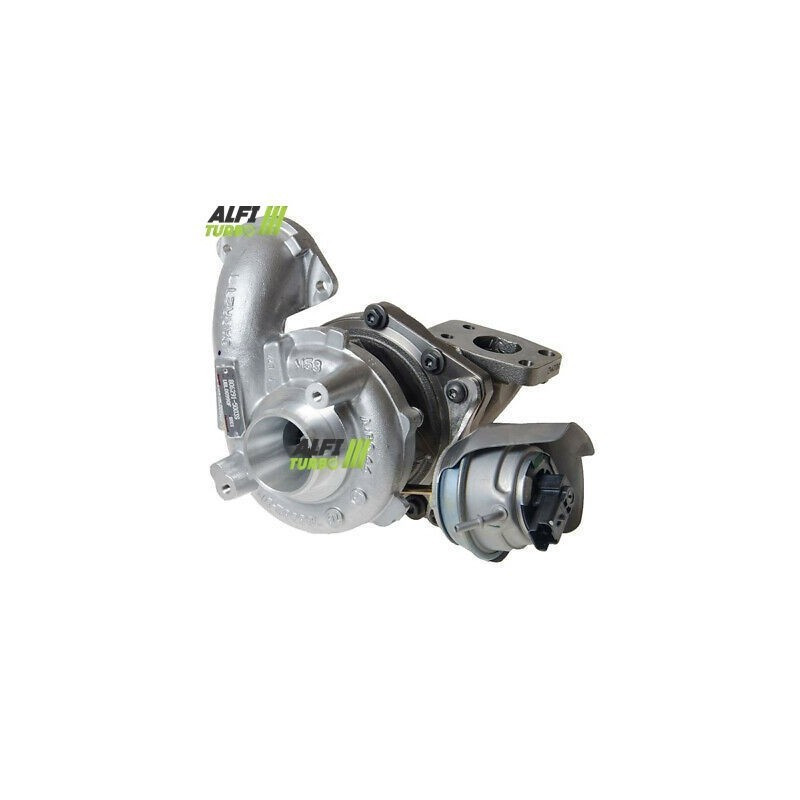
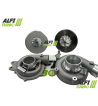
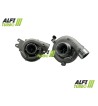
This hybrid turbocharger, designed for 1.6-litre diesel engines, features an internal configuration based on da high-flow MFS compressor wheel Performance. It retains the original configuration plug & play, with no modifications dto the announced installation.
Documented applications include, amongst others, vehicles Citroën, DS, Ford, Mazda, Peugeot and Volvo. The part number of the original turbo dmust be checked before placing any order.
Available tuning options — Stage 1, Stage 2 and Stage 2+
Stage 1
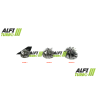
MFS Performance high-flow compressor wheel
Dimensions: 31.10 / 44.00 mm
Blade configuration: 6+6
360° thrust bearing
Balanced at 150,000 rpm on a Cimat VSR test bench
This modification alters the compressor impeller to d’adapt to the air flow rate d’whilst retaining the dimensions documented for this stage.
Stage 2
MFS compressor wheel Performance for high air flow oversized
Dimensions: 36.40 / 49.00 mm
Blade configuration: 6+6
Intake housing d’reprofiled for the new impeller
360° thrust bearing
Balanced at 150,000 rpm on a Cimat VSR test bench
The larger diameter requires re-profiling of the intake housing d. This modification can increase air flow capacity d, with performance depending on the engine configuration and mapping.
Stage 2+
MFS compressor impeller Performance with high flow rate oversized
Dimensions: 38.40 / 52.00 mm
Blade configuration: 6+6
Redesigned intake housing d for the new impeller
360° thrust bearing
Balanced at 150,000 rpm on a Cimat VSR test bench
This version uses the largest impeller of the three documented set-ups. Its use requires a consistent set-up and does not, on its own, guarantee a specific engine power output.
What is a hybrid turbo?
A hybrid turbo features a turbocharger architecture adapted for to accommodate different internal components or machining processes. In this case, the modification specifically concerns the compressor wheel, the thrust bearing and, for for the Stage 2 and Stage 2+ models, the re-profiling of the intake housing d’admission.
The aim is dto adapt the compression capacity and the air flow rate d. The result also depends on the compressor housing, the turbine section, the boost pressure and the engine tuning. A larger impeller therefore does not automatically guarantee better performance in all conditions.
MFS compressor impeller: standard or ‘ Performance ’?
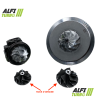
MFS stands for ‘Milled From Solid’, meaning a wheel machined from a solid block. A standard MFS wheel may retain a geometry close to the original: the manufacturing process and the polished finish do not, in themselves, prove an increase in flow rate.
A standard MFS impeller can be just as shiny as a high- Performance MFS impeller. It is not its appearance that determines its performance, but its geometry and its ability to move more dair. Depending on the specification, the diameter, profile and arrangement of the blades can alter the compressor’s aerodynamic behaviour.
Reliability, balancing and engine preparation
The 360° thrust bearing distributes axial forces across the entire surface. The rotor is balanced at 150,000 rpm on a Cimat VSR test bench to minimise vibrations and mechanical stresses. However, this balancing does not compensate for inadequate lubrication or incorrect installation.
Appropriate mapping may be required for to make the most of the turbo’s characteristics. Fuel injection, boost pressure, exhaust, cooling, transmission and wastegate adjustment must be checked or adjusted according to the chosen tuning setup.
Turbo specifications
OEM part numbers
968612068005
Y65013700
0375P7
0375P8
31319528
9686120680
36001457
968612068006
CV6Q6K682AA
CV6Q6K682AB
CV6Q6K682AC
31836499
36010147
AV6Q6K682AA
RMAV6Q6K682AA
AV6Q6K682AB
AV6Q6K682AC
1801856
1844193
1902475
2008127
1945757
1685819
Manufacturer’s part numbers
784011-0005
784011-2005
784011-5
784011-5005S
806291-0002
806291-2
806291-2002
806291-5002S
806291-5003S
824060-0005
824060-2005
824060-5
824060-5005S
824060-5006S
824060-5007S
Compatible vehicles and applications
Documented applications by version, model year, power output and engine code:
Citroën
Berlingo B9 van and Multispace, C3 II, C3 Picasso, C4 II and variants, C4 Aircross, C4 Picasso I and II, C4 Grand Picasso I and II, C5 III saloon and estate, DS3, DS4 and DS5 — 111 to 115 hp depending on configuration, DV6C, DV6CTED and DV6FC engines.
DS
DS 5 (KF_) — 116 hp, engine code BHX (DV6C), from 06/2015 to 12/2018.
Ford
C-Max II and C-Max II Van, Grand C-Max and Grand C-Max Van, Focus III saloon, hatchback, Turnier and estate, Galaxy II, Mondeo IV saloon and Turnier, S-Max, Tourneo Connect, Grand Tourneo Connect and Transit Connect — 95 to 115, hp depending on configuration.
Mazda
Mazda 5 (CW) — 116, hp, engine codes Y650, Y655 and Y6Y1, from 07/2010.
Peugeot
2008 I, 207, 207+, 207 CC, 207 SW, 208 I, 3008, 308 I, 308 II, 308 CC, 308 SW I and II, 4008, 5008, 508 I, 508 SW, 508 SW estate, Partner estate and Partner Tepee — 111 to 115, hp, depending on application.
Volvo
C30, S40 II, S60 II, S80 II, V40 and V40 estate, V50, V60 and V60 estate, V70 III — 114 or 115 hp, engine code D 4162 T.
Additional technical specifications
Type: turbo hybrid
Engine: 1.6-litre diesel
Installation: plug & play configuration as specified
Documented production periods: January 2010 to February 2020, depending on application
Documented power outputs: 95 to 116 hp depending on application
Fitting instructions
⚠️ WARNING — IMPORTANT BEFORE INSTALLATION
Identify and rectify the cause of the previous fault. Check the lubrication circuit, as well as the oil supply and return d, clean the pipes, check the inlet for foreign objects, then prime the system in accordance with the applicable recommendations. Follow the manufacturer’s instructions and have the wastegate adjusted during fitting and mapping. A lubrication fault that is not rectified may lead to further turbocharger failure.
How do you identify the correct turbo?
Check the turbo part number d, the original OEM and manufacturer part numbers, the model, generation, body style, power output, production period and engine code.. An identical engine may be fitted with several different turbocharger set-ups.
⚠️ Check your turbo’s part numbers
Before ordering, compare the part number marked on your original turbo d with the part numbers listed in this specification sheet. An identical engine does not always guarantee compatibility. If in doubt, please contact us with the part number you have noted from your turbo.