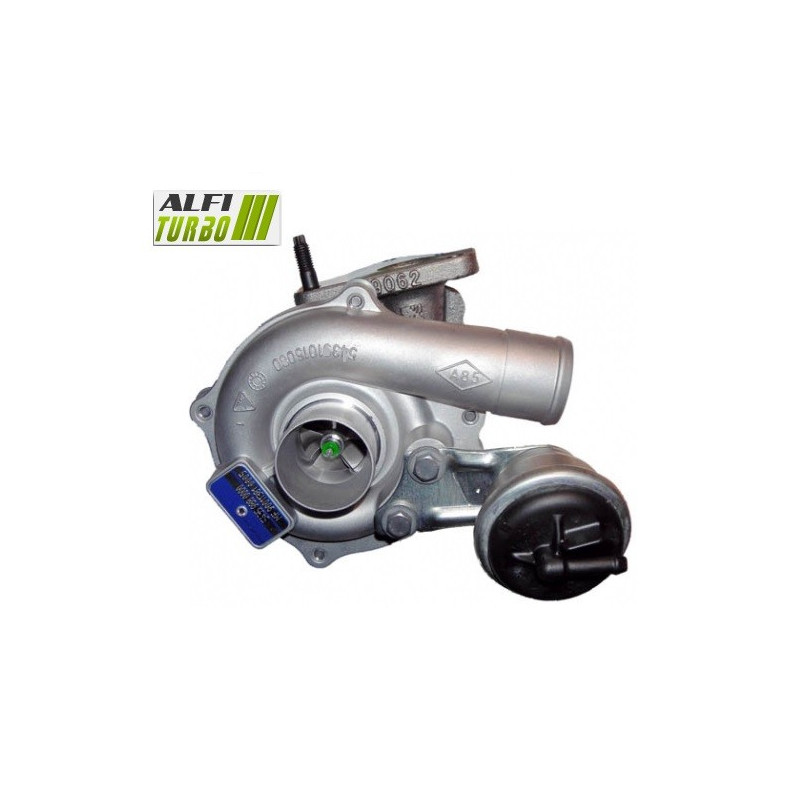
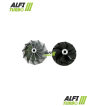
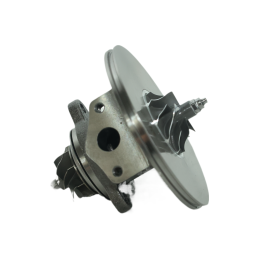
This hybrid turbocharger is designed for for various applications: 1.; 5 dCi, fitted with K9K engines.. Its architecture plug & play allows for Installation without modification of the original dassembly, whilst its tuning is aimed at adapting the dair flow to the requirements dof an optimised engine configuration.
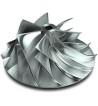
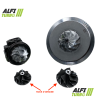
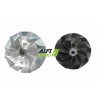
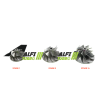
Stage 1: high-flow MFS compressor impeller, 29.50/40.81 mm, with a 5+5 blade configuration, 360° bearing stop and balanced at 150,000 rpm on a Cimat VSR test bench. Stage 2: oversized MFS impeller, 33.64/46.00 mm, with an 11+0 blade configuration, d’ re-profiled inlet casing, 360° stop and Cimat VSR balancing at 150,000 rpm. Stage 2+: MFS impeller oversized, 36.00/49.97 mm with 6+6 blade configuration, d’ intake housing, reprofiled, 360° stop and Cimat VSR balancing at 150,000 rpm.
MFS stands for ‘Milled From Solid’: the impeller is machined from a solid block. A standard MFS impeller can be just as shiny as an MFS impeller Performance; it is not its appearance that determines its performance, but its geometry and its ability to move more dair. The diameter, the profile and the arrangement of the blades all influence the compressor’s behaviour, although a larger impeller does not automatically guarantee better performance. The 360° thrust bearing helps to distribute axial forces, whilst high-speed balancing helps to limit vibrations and mechanical stresses.
OEM part numbers: 7701473122, 7711135037, 8200022735, 8200351439, 8200409030, 1441100QAF, 14411BN701. Manufacturer part numbers: 54359700000, 54359800000, 54359880000, 54359900000, KP35-000. Documented applications: Dacia Logan Pickup K9K 794 65 hp, Logan K9K 790 65 hp and Sandero K9K 790 65 hp; Nissan Kubistar and Micra III K9K 704 65 hp; Renault Clio II 57/65 hp, Clio III Grandtour 65 hp, Kangoo and Kangoo Express 57/61/65 hp, Logan I 65 hp and Thalia I 65/68 hp, depending on the periods and engine codes specified.
Appropriate engine mapping may be required for to make the most of the turbo’s performance. Fuel injection, exhaust, cooling, boost pressure and transmission must be checked depending on the modification; the wastegate must be adjusted during fitting and remapping. Before installation, identify the cause of the previous fault, check the oil supply and return d, clean the pipes, check the intake and prime the system in accordance with the applicable recommendations. Before ordering, compare the part number marked on your original turbo dwith the part numbers listed, as an identical engine type does not always guarantee compatibility.