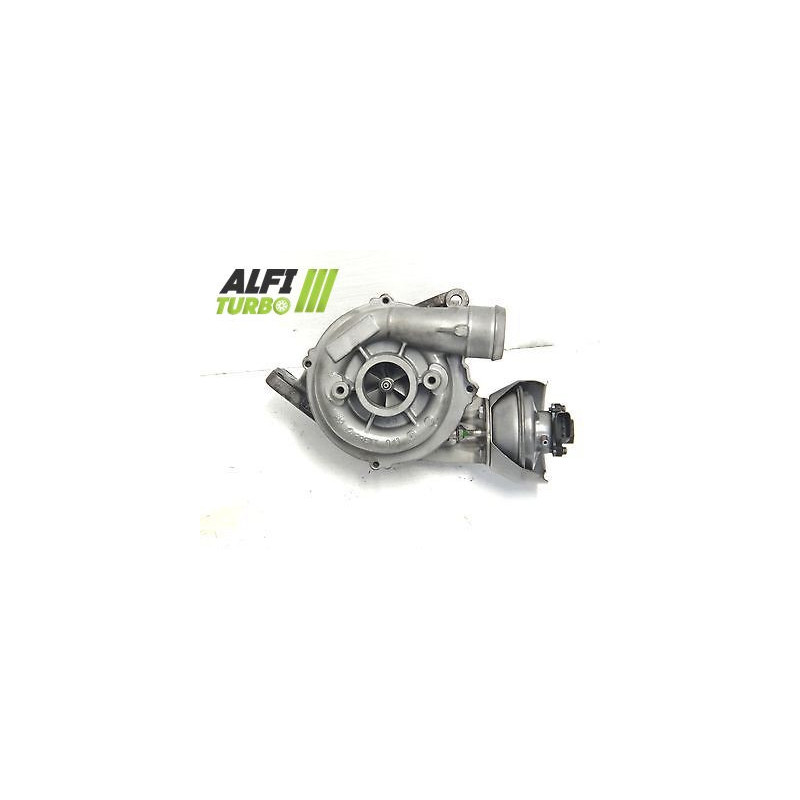
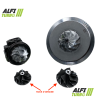
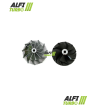
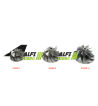
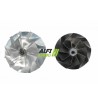
This hybrid turbo plug & play is designed for diesel engines 2.0 D and 2.0 TDCI documented. The three available formulations all incorporate an MFS compressor wheel Performance high flow rate, a 360° bearing stop and high-speed balancing.
The main applications relate to several Ford C-Max, Focus, Galaxy, Kuga, Mondeo and S-Max, as well as the Volvo C30, C70, S40, S80, V50 and V70. Compatibility must always be confirmed using the turbo’s part number d'origin'.
Available products — Stage 1, Stage 2 and Stage 2+
Stage 1
Compressor wheel: MFS Performance high-capacity
Dimensions: 36.39 / 49.00 mm
Blade configuration: 11+0
Stop: 360° bearing
Balancing: 150,000 rpm on a Cimat VSR test bench
This modification alters the compressor wheel so that d'adjust the flow rate' d'air, whilst maintaining the intended configuration' for installation without any modifications to the vehicle. The result depends on the engine management system and the associated components.
Stage 2
Compressor wheel: MFS Performance high-throughput oversized
Dimensions: 40.10 / 52.19 mm
Blade configuration: 7+7
Intake manifold: re-profiled for to receive the wheel oversized
Stop: 360° bearing
Balancing: 150,000 rpm on a Cimat VSR test bench
The wheel oversized and the re-profiling of the casing d'The admission measures are aimed at increasing travel capacity' d'air'. This change may also affect the turbocharger’s response and requires appropriate tuning.
Stage 2+
Compressor wheel: MFS Performance high-throughput oversized
Dimensions: 41.52 / 56.02 mm
Blade configuration: 11+0
Intake manifold: re-profiled for to receive the wheel oversized
Stop: 360° bearing
Balancing: 150,000 rpm on a Cimat VSR test bench
This version uses the largest compressor wheel on record for this product. Its suitability depends on the overall engine configuration, and it is not automatically the most appropriate choice for all applications.
What is a hybrid turbo ?
A hybrid turbo is based on a specially adapted turbocharger design for to receive modified internal components. Depending on the design, these modifications may relate to the compressor wheel, its dimensions, the geometry of the blades, the casings, the thrust bearing or the balancing.
The aim is d'adjust the compression capacity and flow rate' d'air'. A hybrid turbo is therefore not defined solely by the appearance of its impeller: the compatibility between the components and the tuning remain crucial.
MFS compressor wheel: standard or Performance ? ?
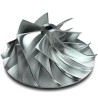
MFS stands for ‘Milled From Solid’, meaning a wheel machined from a solid block. This manufacturing process does not, on its own, guarantee an increase in throughput d'air'. A standard MFS wheel can retain a geometry equivalent to that d'origin'.
A standard MFS wheel can be just as shiny as an MFS wheel Performance. It is not its appearance that determines its performance, but its geometry and its ability to move more d'air'. A geometry Performance may use a blade diameter, profile or configuration suited to the preparation objective. A higher flow rate can deliver more power when combined with appropriate engine tuning, although this alone does not guarantee a performance gain.
Why does the geometry of the blades affect the flow rate? d'air?' ?
The compressor wheel draws in and then compresses the air. Its diameter, profile, height, width and the arrangement of its blades all influence its aerodynamic behaviour. The right geometry can move more d'air under certain conditions, but the result also depends on the casings, the turbine section, the boost pressure and the engine management system'. A larger wheel can also affect the response time and range d'optimal use'.
Reliability and balancing of the hybrid turbocharger
The documented 360° bearing stop helps to distribute axial forces. The rotor is balanced at high speed – up to 150,000 rpm – on a Cimat VSR test bench, in order to minimise vibrations and mechanical stresses. However, this balancing does not compensate for incorrect assembly or a lack of lubrication.
Engine remapping and tuning
It may be necessary to adjust the mapping and boost pressure for make the most of the hybrid turbo. Fuel injection, exhaust, air cooling d'The intake, clutch or gearbox must be checked in accordance with the level of preparation'. The wastegate must be adjusted during the installation and tuning of the ECU.
Turbo part numbers
OEM part numbers
9654262180
9659667380
9654931780
3M5Q6K682EB
3M5Q6K682CC
3M5Q6K682CB
3M5Q6K682CA
3M5Q6K682BB
3M5Q6K682BA
RE3M5Q6K682CD
9662464980
8603435
8603178
3M5Q6K682CD
36051118
36002265
36000248
36000059
1706184
1590093
1483819
1432212
1406472
1331247
1327582
1231955
Manufacturer’s part numbers
728768-4
728768-0005
728768-2005
728768-5
728768-5005S
753847-0002
753847-2
753847-2002
753847-5002S
760774-0003
760774-2003
760774-3
760774-5003S
760774-5005S
Compatible vehicles and assignments
Ford
C-MAX (DM2) — 110 hp
Diesel, February 2008 to September 2010
Engine code : IXDA
C-MAX (DM2) — 133 hp
Diesel, February 2007 to September 2010
Engine codes: G6DC, G6DE, G6DF
C-MAX (DM2) — 136 hp
Diesel, February 2007 to September 2010
Engine codes: G6DA, G6DB, G6DD, G6DG
FOCUS C-MAX (DM2) — 133 hp
Diesel, October 2003 to March 2007
Engine codes: G6DC, G6DE, G6DF
FOCUS C-MAX (DM2) — 136 hp
Diesel, October 2003 to March 2007
Engine codes: G6DA, G6DB, G6DD, G6DG
FOCUS II (DA_, HCP, DP) — 110 hp
Diesel, February 2008 to July 2011
Engine code : IXDA
FOCUS II (DA_, HCP, DP) — 133 hp
Diesel, July 2004 to January 2008
Engine codes: G6DE, G6DF
FOCUS II (DA_, HCP, DP) — 136 hp
Diesel, July 2004 to September 2012
Engine codes: G6DA, G6DB, G6DD, G6DG
FOCUS II Convertible — 136 hp
Diesel, October 2006 to September 2010
Engine codes: G6DA, G6DB, G6DD, G6DG
FOCUS II Saloon (DB_, FCH, DH) — 110 hp
Diesel, February 2008 to July 2011
Engine code : IXDA
FOCUS II Saloon (DB_, FCH, DH) — 136 hp
Diesel, April 2005 to September 2012
Engine codes: G6DA, G6DB, G6DD, G6DG
FOCUS II Tournament (DA_, FFS, DS) — 110 hp
Diesel, February 2008 to July 2011
Engine code : IXDA
FOCUS II Tournament (DA_, FFS, DS) — 133 hp
Diesel, July 2004 to January 2008
Engine codes: G6DE, G6DF
FOCUS II Tournament (DA_, FFS, DS) — 136 hp
Diesel, July 2004 to September 2012
Engine codes: G6DA, G6DB, G6DD, G6DG
GALAXY II (WA6) — 115 hp
Diesel, November 2007 to June 2015
Engine codes: KLWA, TYWA
GALAXY II (WA6) — 130 hp
Diesel, May 2006 to June 2015
Engine code : AZWA
GALAXY II (WA6) — 136 hp
Diesel, May 2006 to June 2015
Engine codes: AZWC, UKWA
GALAXY II (WA6) — 140 hp
Diesel, May 2006 to June 2015
Engine codes: QXWA, QXWB, QXWC, UFWA
KUGA I — 136 hp
Diesel, March 2008 to November 2012
Engine codes: G6DG, UKDA
MONDEO IV (BA7) — 115 hp
Diesel, November 2007 to January 2015
Engine codes: KLBA, LPBA, TYBA
MONDEO IV (BA7) — 130 hp
Diesel, March 2007 to January 2015
Engine code : AZBA
MONDEO IV (BA7) — 136 hp
Diesel, March 2007 to December 2014
Engine codes: AZBC, UKBA, UKBB
MONDEO IV (BA7) — 140 hp
Diesel, March 2007 to January 2015
Engine codes: QXBA, QXBB, UFBA, UFBB
MONDEO IV Saloon (BA7) — 115 hp
Diesel, November 2007 to January 2015
Engine codes: KLBA, LPBA, TYBA
MONDEO IV Saloon (BA7) — 130 hp
Diesel, March 2007 to January 2015
Engine code : AZBA
MONDEO IV Saloon (BA7) — 140 hp
Diesel, March 2007 to January 2015
Engine codes: QXBA, QXBB, UFBA, UFBB
MONDEO IV Turnier (BA7) — 115 hp
Diesel, November 2007 to January 2015
Engine codes: KLBA, LPBA, TYBA
MONDEO IV Turnier (BA7) — 130 hp
Diesel, March 2007 to December 2012
Engine code : AZBA
MONDEO IV Turnier (BA7) — 136 hp
Diesel, March 2007 to December 2014
Engine codes: AZBC, UKBA, UKBB
MONDEO IV Turnier (BA7) — 140 hp
Diesel, March 2007 to January 2015
Engine codes: QXBA, QXBB, UFBA, UFBB
S-MAX (WA6) — 115 hp
Diesel, November 2007 to December 2014
Engine codes: KLWA, TYWA
S-MAX (WA6) — 130 hp
Diesel, May 2006 to December 2014
Engine code : AZWA
S-MAX (WA6) — 136 hp
Diesel, May 2006 to December 2014
Engine codes: AZWC, UKWA
S-MAX (WA6) — 140 hp
Diesel, May 2006 to December 2014
Engine codes: QXWA, QXWB, QXWC, UFWA
Volvo
C30 (533) — 136 hp
Diesel, October 2006 to December 2012
Engine code : D 4204 T
C70 II Convertible (542) — 136 hp
Diesel, Jan 2008 to Oct 2009
Engine code : D 4204 T
S40 II (544) — 133 hp
Diesel, July 2005 to December 2006
Engine code : D 4204 Two-bedroom flat
S40 II (544) — 136 hp
Diesel, Jan 2004 to Dec 2010
Engine code : D 4204 T
S80 II (124) — 136 hp
Diesel, February 2008 to March 2011
Engine code : D 4204 T
V50 (545) — 131 hp
Diesel, July 2005 to December 2006
Engine code : D 4204 Two-bedroom flat
V50 (545) — 133 hp
Diesel, December 2003 to December 2006
Engine code : D 4204 Two-bedroom flat
V50 (545) — 136 hp
Diesel, April 2004 to December 2010
Engine code : D 4204 T
V70 III (135) — 136 hp
Diesel, October 2007 to December 2015
Engine code : D 4204 T
Additional technical specifications
Type: hybrid turbo
Family: GTA1749V
Engine: 2.0 D / 2.0 TDCI
Fuel: diesel
Editing: plug & play, without any modifications to the vehicle
Documented power ratings: 110, 115, 130, 131, 133, 136 and 140 hp depending on the role
Documented periods: Oct 2003 to Dec 2015, depending on the vehicle
Assembly instructions
⚠️ WARNING — IMPORTANT BEFORE ASSEMBLY
Identify and rectify the cause of the previous fault. Check the lubrication circuit, the supply and the return d'oil', as well as ensuring that all ducts are clean.
Check the intake and ensure there are no foreign objects present. Carry out the priming in accordance with the relevant guidelines and follow the manufacturer’s instructions. The wastegate must be adjusted during engine installation and tuning.
If a lubrication fault is not rectified, it may lead to the turbocharger failing again.
How do you choose the right turbo ?
Check the part number marked on the turbocharger d'origin', then compare the OEM and manufacturer part numbers. Also check the make, model, generation, body style, engine type and power output in hp, the assembly period and the engine code. Having the same motor does not always guarantee compatibility.
⚠️ Check your turbo’s part numbers
Before placing your order, Compare the part number on your turbocharger d'origin' using the references given in this fact sheet. Having the same motor does not always guarantee compatibility.
If you are in any doubt, please contact us with the full reference number shown on your turbocharger.