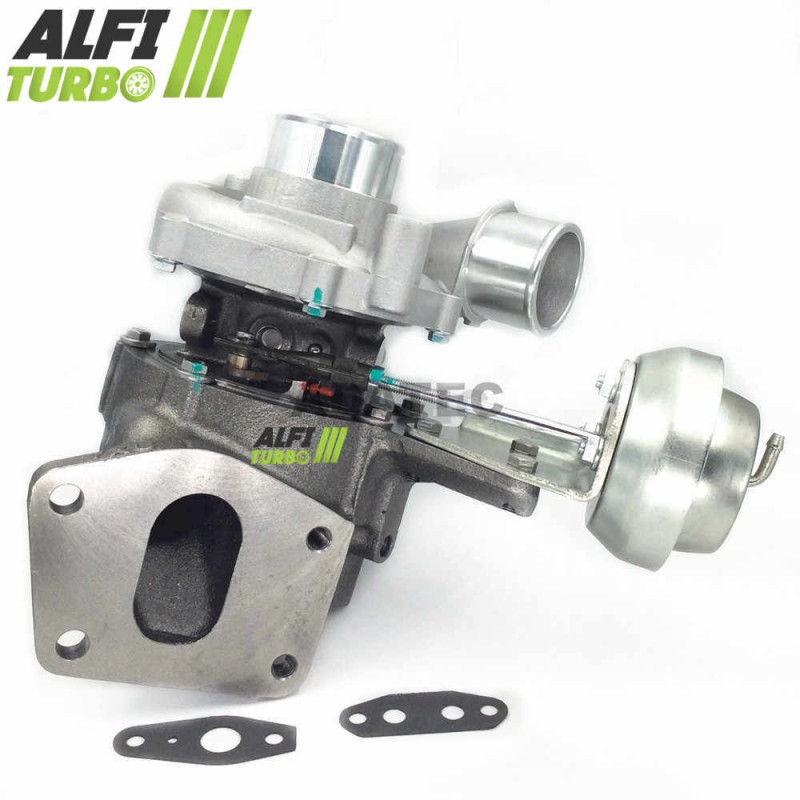
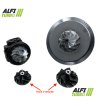
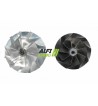
This hybrid turbocharger, designed for the Mitsubishi Pajero 3.2 DI-D fitted with the 4M41 engine, is available in three performance levels. Each configuration utilises a high-flow MFS Performance compressor wheel, a 360° bearing stop and high-speed balancing.
Documented applications cover the Pajero Classic, Pajero IV and Pajero IV Van with power outputs of 160, 170 or 190 hp. The design plug & play allows for external Installation without modification of the assembly.
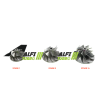
Available configurations — Stage 1, Stage 2 and Stage 2+
Stage 1
Compressor wheel: MFS Performance high-flow
Dimensions: 43.40 / 56.00 mm
Blade configuration: 6+6
Bearing stop: 360°
Balancing: high-speed at 150,000 rpm on a Cimat VSR test bench
This set-up is based on an MFS Performance compressor wheel, the dimensions and geometry of which are tailored for a higher air flow rate d. However, the final performance depends on the engine management system and all associated components.
Stage 2
Compressor wheel: MFS Performance high-flow oversized
Dimensions: 44.20 / 58.00 mm
Blade configuration: 7+7
d intake housing: re-profiled for ly to accommodate the impeller oversized
Bearing thrust: 360°
Balancing: high-speed at 150,000 rpm on a Cimat VSR test bench
The oversized impeller and the reprofiling of the d intake housing allow d the air passage d to be adapted to this new geometry. This modification may alter the flow rate and response of the turbocharger depending on the operating conditions d.
Stage 2+
Compressor wheel: MFS Performance, high flow rate oversized
Dimensions: 46.50 / 60.00 mm
Blade configuration: 7+7
Intake housing d: re-profiled for ccommodate the impeller oversized
Bearing thrust: 360°
Balancing: high-speed at 150,000 rpm on a Cimat VSR test bench
This version features the largest compressor impeller of the three documented configurations. Its suitability depends on the engine’s overall configuration, as an increase in diameter may also alter the response time and the range d optimal operation.
What is a hybrid turbo?
A hybrid turbo utilises a turbocharger architecture adapted for accommodate modified internal components. Depending on the modification, these changes may relate to the compressor wheel, its dimensions, the geometry of its blades, the machining of the housings, the thrust bearing or the balancing.
The aim is d to adapt the compression capacity and air flow rate d. A hybrid turbo is therefore not defined solely by the appearance of its impeller: the dimensions, aerodynamics and overall coherence of the unit are crucial.
MFS compressor wheel: standard or Performance?
MFS stands for ‘Milled From Solid’, meaning a wheel machined from a solid block. This manufacturing process alone does not guarantee an increase in air flow rate d. A standard MFS wheel can retain a geometry equivalent to that d of the original.
An MFS impeller Performance has a geometry tailored to the purpose of the modification. On this product, the blade diameters and configurations are precisely defined for at each stage.
A standard MFS impeller can perform just as well as an MFS Performance impeller. It is not its appearance that determines its performance, but its geometry and its ability to move more d air. A higher airflow can contribute to power output with a suitably tuned engine, though it does not in itself guarantee a gain.
Why does the geometry of the blades influence the air flow rate d?
The compressor impeller draws in and then compresses the air sent to the engine. Its diameter, profile, height, width and the arrangement of its blades influence its aerodynamic behaviour and the volume d of air displaced within certain operating ranges.
The result also depends on the compressor housing, the turbine section, the boost pressure and the engine management system. A larger impeller does not automatically guarantee better performance and may alter the turbo’s response.
Reliability and balancing of the hybrid turbo
The 360° stop present on all three stages helps to distribute axial forces over a wider surface area. However, it does not replace d'proper lubrication or d'correct installation.
Each preparation undergo d ‘high-speed balancing at 150,000 rpm on a Cimat VSR test bench’. This process aims to minimise vibrations and mechanical stresses on the rotor, without compensating for any faults d ‘in the installation’ or d ‘in the oil supply’.
Engine remapping and preparation
Operating d a hybrid turbo may require adjustments to the engine mapping and boost pressure management. The wastegate must be adjusted during the fitting and remapping of the ECU.
Depending on the level of tuning, the fuel injection, exhaust system, intake air cooling d, transmission and other vehicle components must be checked or adjusted. Fitting d a hybrid turbo does not automatically guarantee a power gain without appropriate configuration.
Turbo specifications
OEM part numbers — Mitsubishi
1515A163
VAD30024
Manufacturer reference
VT13
Compatible vehicles and applications
Mitsubishi
Pajero Classic (V2_W, V6_W, V7_W) — PC — 170 hp3.2 DI-D Diesel — 09/2006 to unspecified end date
Engine code: 4M41
Pajero IV (V8_W, V9_W) — PC — 160 hp3.2 DI-D Diesel — 02/2007 to unspecified end date
Engine code: 4M41
Pajero IV (V8_W, V9_W) — PC — 170 hp3.2 DI-D Diesel — 02/2007 to unspecified end date
Engine code: 4M41
Pajero IV Van (V9_, V8_, V8_V) — LCV — 190 hp3.2 DI-D Diesel — 02/2007 to unspecified end date
Engine code: 4M41
Additional technical specifications
Product type: hybrid turbo
Installation: plug & play, with no external modifications to the mounting
Engine: 3.2 DI-D
Fuel: Diesel
Documented power outputs: 160, 170 and 190 hp
Engine code: 4M41
Documented production periods: from 09/2006 or 02/2007 depending on the application
Fitting instructions
⚠️ WARNING — IMPORTANT BEFORE INSTALLATION
Before installation, identify and rectify the cause of the previous failure. Check the lubrication circuit, the oil supply and return d as well as the cleanliness of all pipes.
Check the inlet for any foreign objects. Prime the system in accordance with the applicable guidelines and follow the manufacturer’s instructions. The wastegate must be adjusted during fitting and remapping.
Unresolved lubrication issues may lead to the turbocharger failing again.
How do you identify the correct turbo?
Check the part number marked on the original turbo d and compare it with the OEM part numbers 1515A163 and VAD30024, as well as the manufacturer’s part number VT13. Also check the model, generation, body style, engine type 3.2 DI-D, power output, production period and engine code 4M41.
An identical engine code is not always sufficient to confirm compatibility, as there may be several different set-ups depending on the vehicle version.
⚠️ Check your turbo’s part numbers
Before ordering, compare the part number marked on your original turbo d with the part numbers listed in this data sheet. An identical engine specification does not always guarantee compatibility.
If in doubt, contact our team with the part number clearly visible on your original turbo d and your vehicle details.