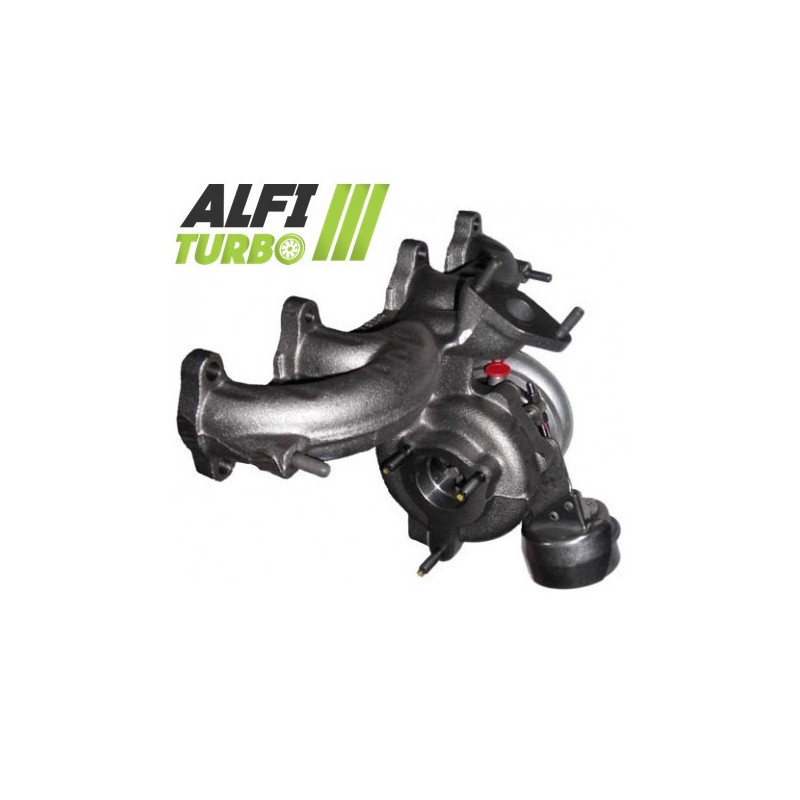
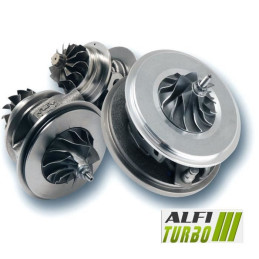
This hybrid turbo is designed for to increase compression capacity and flow rate dair, thanks to a high-flow MFS compressor wheel. Three levels of preparation are documented, with modifications tailored to each stage.
It is suitable for a range of applications Ford, , Seat, , Skoda and Volkswagen equipped d’a 1 engine.9 TDI 130 or 150 hp. Compatibility must be confirmed using the turbo’s part number d’origin’.
Available products — Stage 1, Stage 2 and Stage 3
Stage 1
Compressor wheel: High-capacity MFS
Stop: 360° bearing
Balancing: high speed at 150,000 rpm on a Cimat VSR test bench
This preparation acts primarily on the compressor wheel in order to d’adjust the compression and flow rate’ d’air, whilst retaining a carefully designed layout for direct installation.
Stage 2
Compressor wheel: High-capacity MFS oversized
Carter d’Admission:’ re-profiled for to receive the wheel oversized
Stop: 360° bearing
Balancing: high speed at 150,000 rpm on a Cimat VSR test bench
The Stage 2 incorporates a compressor wheel oversized to a casing d’re-profiled intake’. This configuration is designed to adapt the airflow and compression to the dimensions of the new impeller.
Stage 3
Compressor wheel: High-capacity MFS oversized
Carter d’Admission:’ re-profiled for to receive the wheel oversized
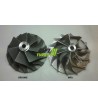
Turbine wheel: high-speed oversized
Turbine casing: re-profiled for to receive the wheel oversized
Stop: 360° bearing
Balancing: high speed at 150,000 rpm on a Cimat VSR test bench
This procedure is carried out on the compressor and turbine sides. The casings are re-profiled for to accommodate the oversized wheels; this change may also affect response times and conditions doptimal use.
What is a hybrid turbo ?
A hybrid turbo retains a turbocharger design that is suitable for accommodating modified internal components. Depending on the course, the preparation may involve the compressor wheel, the casings, the turbine wheel, the thrust bearing and balancing.
The aim is d’adjust the compression capacity and flow rate’ dair. However, a hybrid turbocharger is not defined solely by the appearance of its impeller: the geometry of its components and the way they are combined determine its performance.
MFS compressor wheel: standard or Performance ? ?
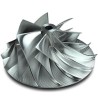
MFS stands for ‘Milled From Solid’, meaning a wheel machined from a solid block. This manufacturing process does not, on its own, guarantee an increase in throughput. A standard MFS wheel can retain a geometry equivalent to that d’origin’.
An MFS wheel Performance can be configured with a geometry suited to the preparation. A standard MFS wheel can be just as shiny as an MFS wheel Performance. It is not its appearance that determines its performance, but its geometry and its ability to move more dair. Higher power output can only be utilised properly with appropriate engine tuning.
Why does the geometry of the blades affect the flow rate? d’air ?
The diameter of the wheel, the profile, the height, the width and the arrangement of the blades all influence the intake and compression of air. The result also depends on the casings, the turbine, the boost pressure and the engine management system. A larger wheel therefore does not automatically guarantee better performance.
Reliability and balancing of the hybrid turbocharger
The documented 360° stop helps to distribute axial forces. The rotor is balanced at high speed – up to 150,000 rpm on a Cimat VSR test bench – in order to minimise vibrations and mechanical stresses. This balancing does not compensate for an assembly error or a lack of lubrication.
Engine remapping and tuning
The engine mapping and pressure control need to be adjusted for make the most of the turbo’s features. Fuel injection, exhaust, air cooling d’Intake and transmission must also be monitored in accordance with the level of preparedness’. The wastegate must be adjusted when remapping the ECU.
Turbo part numbers
OEM part numbers
038253014V
038253014
038253010
Manufacturer’s part numbers
54399700016
54399800016
54399880016
54399900016
BV39B-0016
Compatible vehicles and assignments
Ford
Galaxy 1 Phase 2 — 130 hp
1.9 TDI — from January 2000, end date not specified
Engine code : not specified
Galaxy 1 Phase 2 — 150 hp
1.9 TDI — from January 2000, end date not specified
Engine code : not specified
Seat
Alhambra 2 — 130 hp
1.9 D — from January 2000, end date not specified
Engine code : not specified
Alhambra 2 Phase 2 — 130 hp
1.9 TDI — from January 2003, end date not specified
Engine code : not specified
Alhambra 2 Phase 2 — 150 hp
1.9 TDI — from January 2003, end date not specified
Engine code : not specified
Córdoba 4 — 130 hp
1.9 TDI — from January 2002, end date not specified
Engine code : not specified
Ibiza 3 — 130 hp
1.9 TDI — from January 2001, end date not specified
Engine code : not specified
Ibiza 4 — 130 hp
1.9 TDI — from January 2001, end date not specified
Engine code : not specified
Leon — 130 hp
1.9 TDI — from January 1999, end date not specified
Engine code : not specified
Toledo Series 2 — 130 hp
1.9 TDI — from January 1998, end date not specified
Engine code : not specified
Skoda
Fabia — 130 hp
1.9 TDI — from January 1999, end date not specified
Engine code : not specified
Fabia Phase 2 — 130 hp
1.9 TDI — from January 2004, end date not specified
Engine code : not specified
Volkswagen
Polo 7 — 130 hp
1.9 TDI — from January 2001, end date not specified
Engine code : not specified
Polo 8 — 130 hp
1.9 TDI — from January 2005, end date not specified
Engine code : not specified
Sharan — 130 hp
1.9 TDI — from January 2000, end date not specified
Engine code : not specified
Sharan 2 — 150 hp
1.9 TDI — from January 2000, end date not specified
Engine code : not specified
Additional technical specifications
Product type: hybrid turbo
Engine: 1.9 TDI, with one allocation.9 D documented
Documented power ratings: 130 and 150 hp
Installation: configuration plug & play, without any changes to the setup
Assembly instructions
⚠️ WARNING — IMPORTANT BEFORE ASSEMBLY
Identify and rectify the cause of the previous fault. Check the lubrication circuit, as well as the supply and return lines doil. Check that the ducts and the intake are clean and free from foreign objects. Carry out the priming in accordance with the relevant guidelines and follow the manufacturer’s instructions. If a lubrication fault is not rectified, it may lead to the turbocharger failing again.
How do you choose the right turbo ?
Check the turbo part number d’origin, OEM and manufacturer part numbers, make, model, generation, engine type, power output, theYear installation and engine code. Having the same engine is not always enough to confirm compatibility.
⚠️ Check your turbo’s part numbers
Before placing your order, Compare the part number on your turbocharger d’origin’ using the references given in this fact sheet. Having the same motor does not always guarantee compatibility. If you have any queries, please contact us before placing your order.