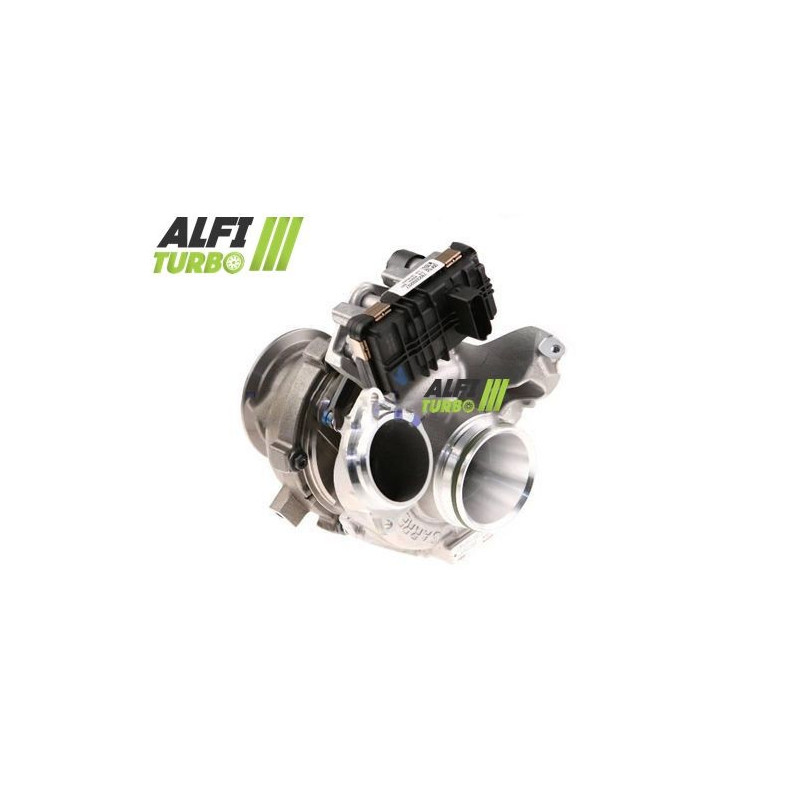
This hybrid turbocharger is designed for the following engines Bmw 3.0 D N57N with 218 and 258 hp as listed in the specifications below. A hybrid tuning programme aims to adapt the internal characteristics of the turbocharger to meet a target air flow rate dand operating parameters defined in consultation with the engine tuner.
Documented applications cover several models Bmw, 3 Series, 4 Series, 5 Series, 7 Series, X3, X4 and X5. As the precise internal configuration and any tuning stages are not specified in the available data, these must be confirmed before ordering.
What is a hybrid turbo?
A hybrid turbo is based on a turbocharger architecture designed for accommodate internal modifications. Depending on the modification, these may involve the compressor wheel, the blade geometry, the wheel dimensions, the machining of the housings, the turbine wheel, the thrust bearing system or the balancing.
The aim may be dto adjust the compression capacity and the air flow rate d. A hybrid turbo is therefore not defined solely by the appearance of its compressor wheel, and a larger-diameter wheel does not automatically guarantee better performance.
MFS compressor wheel: standard or Performance?
MFS stands for ‘Milled From Solid’, meaning a wheel machined from a solid block. This manufacturing process alone does not guarantee an increase in air flow d. A standard MFS wheel may retain a geometry equivalent to that dof the original, whilst an MFS Performance wheel can be given a geometry tailored to the tuning objective.
A standard MFS impeller can be just as shiny as an MFS impeller Performance. It is not its appearance that determines its performance, but its geometry and its ability to move more d’air. The presence d’of an MFS or MFS Performance impeller on this product must be confirmed, as no detailed specifications are available.
Why does the blade geometry influence the air flow rate d?
The impeller diameter, the profile, height, width and arrangement of the blades all influence the aerodynamic behaviour of the compressor. The result also depends on the casings, the turbine wheel, the boost pressure and the engine set-up. A change in size can also affect the response time and the range dof optimal operation.
Reliability and balancing of the hybrid turbo
Rotor balancing helps to limit vibrations and mechanical stresses. A 360° stop can improve the distribution of axial forces when included in the tuning package, but its inclusion is not documented here. Balancing does not compensate for incorrect installation or inadequate lubrication.
Engine remapping and tuning
Operating da hybrid turbo may require adjustments to the engine mapping and boost pressure management. Depending on the vehicle and the level of tuning, the fuel supply, intake air cooling d, the exhaust system and the transmission must also be checked. No power gain is guaranteed without a coherent configuration.
Turbo specifications
OEM part numbers
7823202B03
7823202E05
7823202G07
11657823202
7823202
11657823270
7823270
Manufacturer’s part numbers
806094-0003
806094-0005
806094-0006
806094-0007
806094-3
806094-5
806094-6
806094-7
806094-5003S
806094-5005S
806094-5006S
806094-5007S
806094-0009
806094-5009S
806094-9
806094-0010
806094-5010S
806094-10
Compatible vehicles and applications
Bmw
330 d (F30 / F31 / F34) — 258 hp3.0- D — 07/2012 to unspecified end date
Engine code: N57N
430 d (F32 / F33 / F36) — 258 hp3.0 D — November 2013 to an unspecified end date
Engine code: N57N
530 d (F07 / F10 / F11) — 258 hp3.0 D — 09/2011 to an unspecified end date
Engine code: N57N
730 d (F01 / F02) — 258 hp3.0 D — 07/2012 to an unspecified date
Engine code: N57N
X3 30 dx (F25) — 258 hp3.0 D — 09/2011 to unspecified end date
Engine code: N57N
X4 30 right (F26) — 258 hp3.0 D — 09/2011 to unspecified end date
Engine code: N57N
X5 25 right (F15) — 218 hp3.0 D — 11/2013 to an unspecified end date
Engine code: N57N
X5 30 right (F15) — 258 hp3.0 D — 08/2013 to an unspecified end date
Engine code: N57N
Additional technical specifications
Product type: Hybrid Turbo
Engine: 3.0 Bmw D
Fuel: Diesel
Power outputs: 218 and 258 hp
Engine code: N57N
Documented production periods: from 09/2011 onwards, depending on the model variant
Fitting instructions
⚠️ WARNING — IMPORTANT BEFORE INSTALLATION
Identify and rectify the cause of the previous fault before dinstalling the turbocharger.
dCheck the lubrication system, the oil supply and return lines, and ensure the pipes are clean. Also check the intake for any foreign objects.
Carry out the priming procedure in accordance with the applicable recommendations and follow the manufacturer’s instructions.
A lubrication fault that is not rectified may result in the turbocharger failing again.
How do you identify the correct turbo?
Check the turbo’s part number d– the original, OEM and manufacturer part numbers, as well as the model, generation, body style, engine type, power output,Year and engine code. An identical engine type does not always guarantee compatibility.
⚠️ Check your turbo’s part numbers
Before ordering, compare the part number marked on your original turbo d with the part numbers listed in this data sheet. An identical engine specification does not always guarantee compatibility.
If in doubt, please contact us with the part number found on your turbocharger.