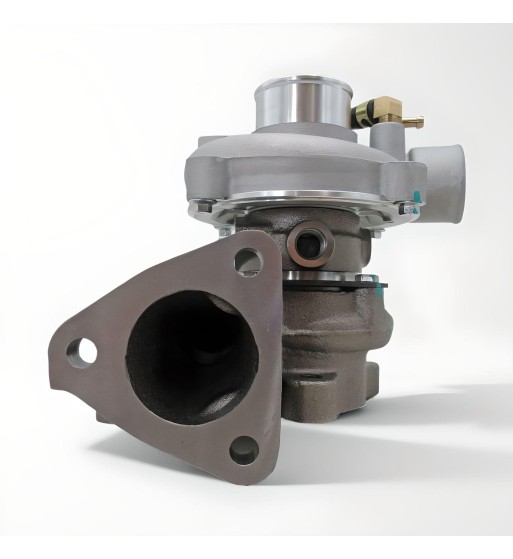
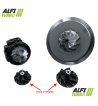
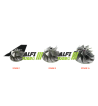
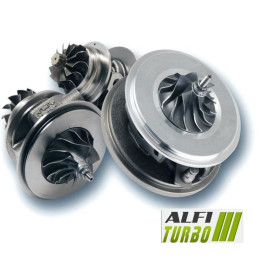
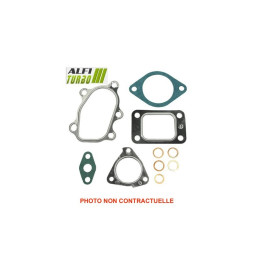
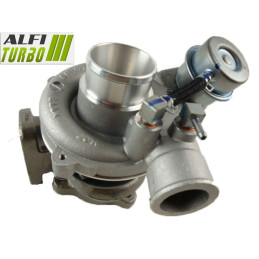
This hybrid turbo for, fitted to the 2.5 CRDi 140 hp engine, features da tuning programme designed to optimise air flow d. Depending on the package chosen, it includes a high-flow MFS compressor wheel, re-profiled casings or even a turbine wheel oversized.
Its design plug & play is intended for for the Hyundai H1 and Starex models manufactured from 2002 onwards. To make the most of its performance characteristics, a consistent and correctly tuned engine configuration is required.
Available tuning kits — Stage 1, Stage 2 and Stage 3
Stage 1
Compressor wheel: MFS high-flow
Thrust bearing system: 360° thrust bearing
Balancing: High-speed balancing at 150,000 rpm on a Cimat VSR test bench
This modification primarily affects the compressor impeller in order dto adjust the compression capacity and the dair flow rate. The 360° thrust bearing helps to distribute the rotor’s axial forces.
Stage 2
Compressor impeller: MFS high-flow oversized
Compressor housing: Reprofiled for accommodate the new impeller oversized
Thrust bearing system: 360° thrust bearing
Balancing: High-speed balancing at 150,000 rpm on a Cimat VSR test bench
Stage 2 combines a oversized compressor impeller with a dre-profiled intake housing. This modification is designed to ensure the correct fit and smooth operation of the new impeller, without assuming da specific increase in power.
Stage 3
Compressor impeller: MFS high-flow oversized
Compressor housing: Reprofiled for to accommodate the new impeller oversized
Thrust bearing system: 360° thrust bearing
Turbine impeller: High-flow oversized
Turbine housing: Reprofiled for ly to accommodate the new impeller oversized
Balancing: High-speed balancing at 150,000 rpm on a Cimat VSR test bench
This modification applies to the compressor and turbine sides. The larger impeller dimensions and the re-profiling of both housings alter the flow characteristics das well as the behaviour of the turbocharger; the result depends on the overall engine configuration.
What is a hybrid turbo?
A hybrid turbo is based on a turbocharger architecture designed for accommodate internal components that differ from the original configuration d. Depending on the upgrade stage, the modification may involve the compressor wheel, the turbine wheel, the housings, the thrust bearing system and the rotor balancing.
The aim is dto adapt the compression capacity and air flow rate dto a specific engine modification. However, a hybrid turbo is not defined solely by the appearance of its compressor wheel: the geometry of the components and the overall coherence of the unit are crucial.
MFS compressor wheel: standard or ‘ Performance ’?
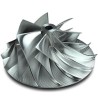
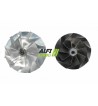
MFS stands for ‘Milled From Solid’, meaning a wheel machined from a solid block. This designation primarily describes a manufacturing process and does not, on its own, guarantee an increase in air flow d.
A standard MFS impeller may retain a geometry equivalent to that of the original d. A Performance MFS impeller may adopt a geometry tailored to the tuning objective, with different dimensions or blade profiles where such modifications are intended.
A standard MFS impeller can be just as glossy as an MFS impeller Performance. It is not its appearance that determines its performance, but its geometry and its ability to move more d’air. A higher airflow can help to generate more power, but only with appropriate engine tuning.
Why does the geometry of the blades influence the air flow rate d?
The compressor impeller draws in and then compresses the air sent to the engine. Its diameter, profile, height, width and the arrangement of its blades influence the compressor’s aerodynamic behaviour and the amount dof air displaced under certain operating conditions.
The result also depends on the compressor housing, the impeller and the turbine housing, the boost pressure and the engine management system. A larger impeller therefore does not automatically guarantee better performance and may alter the turbo’s response time.
Reliability and balancing of the hybrid turbo
The three documented stages fea da 360° bearing stop, designed for better distribute axial forces. This component does not deliminate the need for proper lubrication or compliance with fitting conditions.
The rotor is balanced at high speed, up to 150,000 rpm, on a Cimat VSR test bench. This process aims to minimise vibrations and mechanical stresses, without compensating for inadequate lubrication, contamination or incorrect installation.
Engine remapping and preparation
The engine management system must be adapted for fully utilise the characteristics of the hybrid turbo. The wastegate must be adjusted during the ECU reprogramming.
Depending on the level of tuning, it is also advisable to check or d’adjust the fuel injection, boost pressure, exhaust system, cooling system, intake system and, if necessary, the transmission. Fitting the turbo alone does not guarantee any increase in power.
Turbo part numbers
OEM part numbers
28200-42560
2820042560
Manufacturer part numbers
716938-5001S
716938-0001
716938-1
Compatible vehicles and applications
Hyundai
H1 — 140 hp
2.5 CRDi — start in 2002, month unspecified — end unspecified
Engine code: not specified
Starex — 140 hp
2.5 CRDi — started in 2002, month unspecified — end unspecified
Engine code: not specified
Additional technical specifications
Product type: Hybrid Turbo
Engine: 2,..5 CRDi
displacement: 2.5 l
Power: 140 hp
Documented period: From 2002
Installation: Designed for the plug & play configuration without any modification to the mounting
Fitting advice
⚠️ WARNING — IMPORTANT BEFORE INSTALLATION
Before installation, identify and rectify the cause of the previous fault. Check the lubrication circuit, the oil supply and return das well as the cleanliness of all pipes.
Check the inlet for any foreign objects. Prime the system in accordance with the applicable guidelines and follow the vehicle manufacturer’s instructions.
A lubrication fault that is not rectified may lead to further damage to the turbocharger.
How do you identify the correct turbo?
Check the part number marked on the original turbo dand compare it with the OEM and manufacturer part numbers in this sheet. Also check the make, model, engine type 2.5 CRDi, power output 140 hp, installation period and, where available, the engine code.
The same engine variant may be fitted with different turbocharger set-ups depending on the vehicle and its configuration.
⚠️ Check your turbo’s part numbers
Before ordering, compare the part number marked on your original turbo d with the part numbers listed in this data sheet. An identical engine does not always guarantee compatibility.
If you are unsure about identification or compatibility, please contact us with the part number clearly visible on your original turbo d.