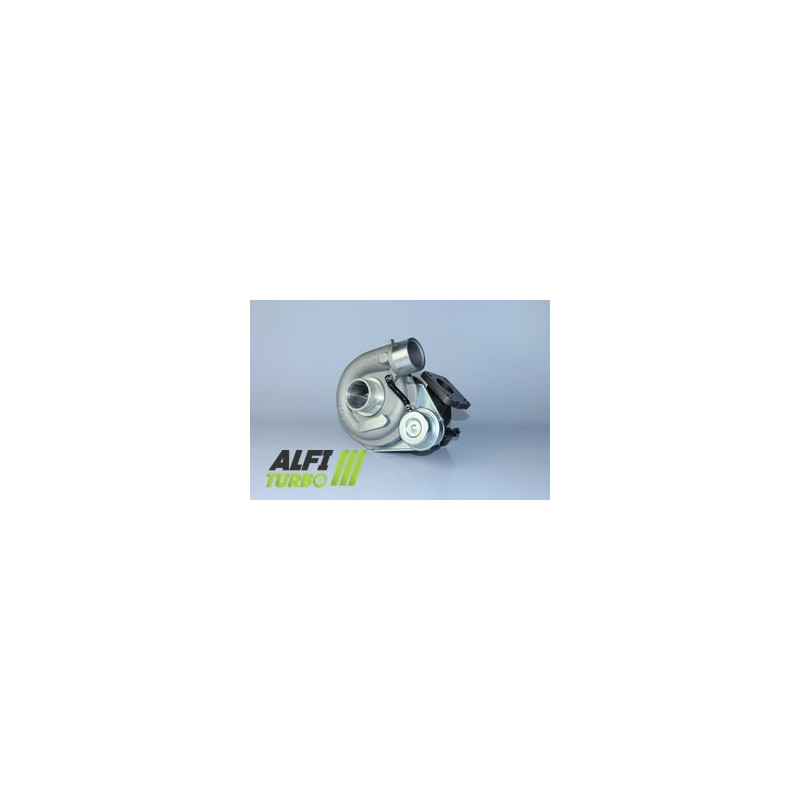
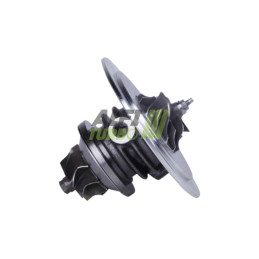
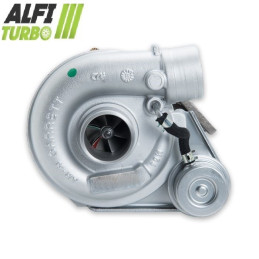
This hybrid turbo for engine variants 2.8 TD benefits from d'an internal assembly based on an MFS compressor wheel' Performance, a 360° bearing stop and high-speed balancing. Three levels of preparation are documented to meet different flow rate objectives d'airflow and turbocharger behaviour'.
The allocations listed relate in particular to certain Fiat Ducato, Iveco Daily, , Opel Movano and Vivaro, as well as Renault Mascott and Master. The benchmark for turbochargers d'The origin must be verified before any order is placed'.
Available products — Stage 1, Stage 2 and Stage 2+
Stage 1
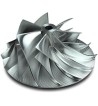
Compressor wheel: High-capacity MFS Performance
Dimensions: 38.62 / 52.19 mm
Blade configuration: 11+0
Bearing stop: 360°
Balancing: 150,000 revolutions per minute on a Cimat VSR test bench
This assembly uses an MFS wheel Performance designed to adjust the compressor’s flow rate whilst maintaining the documented dimensions for this work placement.
Stage 2
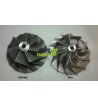
Compressor wheel: High-capacity MFS oversized Performance
Dimensions: 39.61 / 56.02 mm
Blade configuration: 11+0
Carter d'Admission:' re-profiled for to receive the wheel oversized
Bearing stop: 360°
Balancing: 150,000 revolutions per minute on a Cimat VSR test bench
The wheel oversized and the re-profiling of the casing d'admission requirements allow' d'adapt the airflow to this configuration'. The result also depends on engine management and peripheral equipment.
Stage 2+
Compressor wheel: High-capacity MFS oversized Performance
Dimensions: 44.52 / 60.00 mm
Blade configuration: 11+0
Carter d'Admission:' re-profiled for to receive the wheel oversized
Bearing stop: 360°
Balancing: 150,000 revolutions per minute on a Cimat VSR test bench
This version uses the largest compressor wheel documented on this page. An increase in diameter may affect the flow rate d'air, response time and range d'optimal use; on its own, it does not guarantee a specific power output'.
What is a hybrid turbo ?
A hybrid turbo is based on a specially adapted turbocharger design for to receive internal components that differ from the configuration d'origin'. Depending on the course, the preparation may cover the compressor wheel, its dimensions, the geometry of the blades, and the housing d'intake, stop or balancing'.
The aim is d'adjust the compression capacity and flow rate' d'air'. However, a hybrid turbo is not defined solely by the appearance of its impeller: the consistency between the components, machining and settings remains crucial.
MFS compressor wheel: standard or Performance ? ?
MFS stands for ‘Milled From Solid’, meaning a wheel machined from a solid block. This manufacturing process does not, on its own, guarantee an increase in throughput d'air'. A standard MFS wheel can retain a geometry equivalent to that d'origin'.
A standard MFS wheel can be just as shiny as an MFS wheel Performance. It is not its appearance that determines its performance, but its geometry and its ability to move more d'air'. A wheel Performance can be fitted with a blade profile, diameter or configuration suited to the preparation task. A higher flow rate can contribute to power output when the engine has been properly tuned, although this does not guarantee a gain in power.
Why does the geometry of the blades affect the flow rate? d'air?' ?
The compressor wheel draws in and then compresses the air. Its diameter, profile, height, width and the arrangement of its blades all influence its aerodynamic behaviour. The right geometry can move more d'air under certain conditions, but the result also depends on the casings, the turbine wheel, the boost pressure and the engine tuning'. A larger wheel is therefore not automatically the best choice in all conditions.
Reliability and balancing of the hybrid turbocharger
The three documented work placements include d'a 360° bearing stop, designed for to distribute axial forces more evenly. The assembly is balanced at high speed, up to 150,000 revolutions per minute on a Cimat VSR test bench, in order to minimise vibrations and mechanical stresses. However, this balancing does not compensate for a lack of lubrication or incorrect installation.
Engine remapping and tuning
Appropriate engine management may be required for make the most of the hybrid turbo’s features. According to the project, the mapping, boost pressure, fuel injection, exhaust system and air cooling d'The intake and transmission must be checked or adjusted'. The wastegate must be adjusted during fitting and remapping. No increase in power happens automatically without proper preparation.
Turbo part numbers
OEM part numbers
500385898
7701044612
99466793
45000939
4500939
860077
9161239
93184040
7711135840
5001859132
Manufacturer’s part numbers
454061-0008
454061-0010
454061-0014
454061-10
454061-14
454061-5010S
454061-8
Compatible vehicles and assignments
Fiat
Ducato 2 — 122 hp
Engine 2.8 TD — started in 2001; month and end date not specified
Engine code : not specified
Iveco
Daily 2 — 115 hp
Engine 2.8 TD — began in 1996; month and end date not specified
Engine code : not specified
Daily 3 — 125 hp
Engine 2.8 TD — began in 1999; month and end date not specified
Engine code : not specified
Opel
Movano — 115 hp
Engine 2.8 TD — began in 1996; month and end date not specified
Engine code : not specified
Vivaro — 115 hp
Engine 2.8 TD — began in 1996; month and end date not specified
Engine code : not specified
Renault
Mascott — 115 hp
Engine 2.8 TD — began in 1997; month and end date not specified
Engine code : not specified
Master 2 — 115 hp
Engine 2.8 TD — began in 1997; month and end date not specified
Engine code : not specified
Additional technical specifications
Product type: hybrid turbo
Engine: 2.8 TD
Documented power ratings: 90, 110, 115, 122 and 125 hp depending on the application
Period covered: from 1996 onwards, depending on allocation
Engine code : not specified
Installation: configuration plug & play announced without change
Assembly instructions
⚠️ WARNING — IMPORTANT BEFORE ASSEMBLYIdentify and rectify the cause of the previous fault. Check the lubrication circuit, the supply and the return d'oil', as well as the cleanliness of the ducts. Check the intake and ensure there are no foreign objects present, then prime the system in accordance with the relevant guidelines. Follow the manufacturer’s instructions and have the wastegate adjusted during fitting and remapping. If a lubrication fault is not rectified, it may lead to the turbocharger failing again.
How do you choose the right turbo ?
Check the turbo part number d'origin, OEM and manufacturer part numbers, make, model, generation, engine type, power output, theYear installation and engine code. The same engine can be fitted with several different turbo set-ups.
⚠️ Check your turbo’s part numbersBefore placing your order, Compare the part number on your turbocharger d'origin' using the references given in this fact sheet. Having the same motor does not always guarantee compatibility.
If you are in any doubt, please contact us, quoting the reference number clearly visible on your turbocharger.