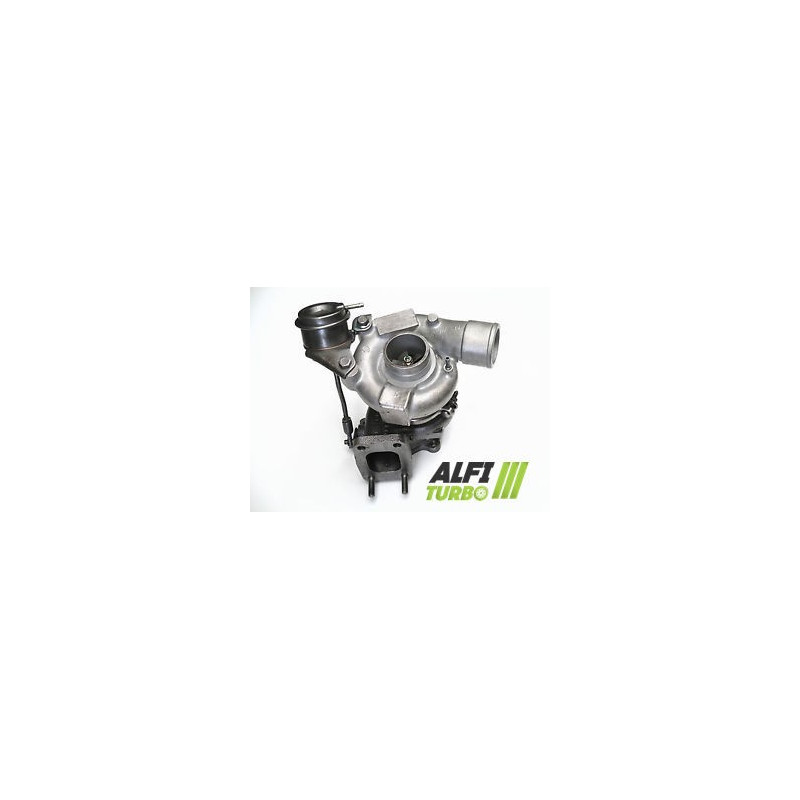
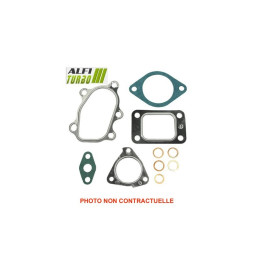
This hybrid turbo for for the 2.8- TD engine is available in several mechanical specification levels.. It is designed for a ‘ plug & play ’ installation without any modifications to the original system d, subject to a precise check of the turbocharger’s part number.
Depending on the upgrade package chosen, the preparation includes a high-flow MFS compressor wheel, a 360° thrust bearing, high-speed balancing and, for for the higher tiers, recontouring of the housings or modification of the turbine section.
Available upgrades — Stage 1, Stage 2 and Stage 3
Stage 1
Compressor wheel: MFS high-flow
Thrust bearing: 360° bearing
Balancing: high-speed at 150,000 rpm on a Cimat VSR test bench
This modification primarily affects the compressor impeller in order d to adapt the flow rate d to the air. The 360° thrust bearing helps to distribute the axial forces borne by the rotating assembly more evenly.
Stage 2
Compressor impeller: MFS high-flow oversized
d' intake housing: re-profiled for accommodate the new impeller oversized
Thrust bearing: 360° bearing
Balancing: high-speed balancing at 150,000 rpm on a Cimat VSR test bench
oversized ’s compressor impeller requires the intake housing to be re-profiled d. This combination is designed to alter the compression capacity and air flow rate d, though it does not, on its own, guarantee a specific engine power output.
Stage 3
Compressor impeller: MFS high-flow oversized
Intake housing d: reprofiled for to accommodate the new impeller oversized
Thrust bearing: 360° bearing
Turbine impeller: high flow oversized
Turbine casing: re-profiled for ly to accommodate the new impeller oversized
Balancing: high-speed at 150,000 rpm on a Cimat VSR test bench
This modification alters the compressor and turbine sides. The final performance depends on the overall engine configuration, in particular the turbocharging management, intake, exhaust and mapping.
What is a hybrid turbo?
A hybrid turbo is based on a turbocharger architecture adapted for to accommodate internal components that differ from the original d configuration. Depending on the upgrade, modifications may involve the compressor wheel, the housings, the turbine wheel, the thrust bearing or the balancing.
The aim is d to adapt the compression capacity and air flow d to a specific engine set-up. A hybrid turbo is therefore not defined solely by the appearance of its compressor wheel, but by the consistency of its geometry and the mechanical modifications carried out.
MFS compressor wheel: standard or Performance?
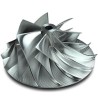
MFS stands for ‘Milled From Solid’, meaning a wheel machined from a solid block. This designation describes its manufacturing process, but does not in itself guarantee an increase in airflow d'. The data for this modification indicate a high-flow aluminium MFS impeller, which is lighter, larger and taller than the d'original' impeller.
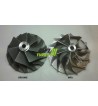
A standard MFS wheel can retain a geometry equivalent to the original. An MFS wheel Performance may, depending on its design, feature a diameter, profile or blade configuration suited to the purpose of the modification.
A standard MFS impeller can be just as glossy as an MFS impeller Performance. It is not its appearance that determines its performance, but its geometry and its ability to move more d'air. A higher flow rate may be accompanied by an increase in power when the engine tuning is correctly adapted, without this alone guaranteeing a result.
Why does the geometry of the blades influence the air flow rate d?
The compressor impeller draws in and then compresses the air sent to the engine. Its diameter, profile, height, width and the arrangement of its blades influence the aerodynamic behaviour of the compressor.
A suitably designed geometry can move more air d under certain conditions, but the result also depends on the casings, the turbine wheel, the boost pressure and the engine tuning. A larger wheel does not automatically guarantee better performance and may alter the turbo’s response time.
Reliability and balancing of the hybrid turbo
The 360° bearing stop, featured on all three documented stages, distributes axial forces over a wide surface area. However, it does not replace d'proper lubrication or d'correct installation.
Each modification undergoes d ‘high-speed balancing at 150,000 rpm on a Cimat VSR test bench’. This process aims to minimise vibrations and mechanical stresses on the rotor, without compensating for inadequate lubrication, contamination of the system or incorrect installation.
Engine remapping and tuning
The engine management system must be adapted for to make full use of the characteristics d of a hybrid turbocharger. The wastegate must be adjusted whilst remapping the ECU.
Depending on the level of tuning, the fuel injection, exhaust system, cooling, boost pressure and transmission must also be checked or adjusted. A hybrid turbo does not automatically guarantee a power gain without a coherent engine configuration.
Turbo specifications
OEM comparison part numbers
500335369
500358190
500372213
500372214
99462607
99464734
504071573
504071574
2998318
2998322
2998324
99464737
5001851013
5001860076
7485120059
5001851014
5001860075
Manufacturer’s part numbers
49377-07010
49377-07000
49377-07050
49377-07070
Compatible vehicles and applications
No specific compatibility details by make, model, year or engine code are documented in the available information. Compatibility must be confirmed using the original turbo part number d.
Additional technical specifications
Product type: hybrid turbo
Engine: 2.8 TD
displacement: 2.8 L
Documented power outputs: 105, 125 and 130 hp
Installation: plug- plug & play configuration, requiring no modifications to the original d
Fitting advice
⚠️ WARNING — IMPORTANT BEFORE INSTALLATION
Identify and rectify the cause of the previous fault before installing the turbo d.
Check the lubrication circuit, the oil supply and return lines, and ensure all pipes are clean d.
Check the intake and ensure there are no foreign objects. Prime the system in accordance with the applicable recommendations and follow the manufacturer’s instructions.
A lubrication fault that is not rectified may lead to the turbocharger failing again.
How do you identify the correct turbo?
Check the part number marked on the original turbo d, then compare it with the OEM and manufacturer part numbers in this datasheet.. Also check the make, model, generation, body style, engine type, power output at hp, production period and engine code where available.
An identical engine specification does not always guarantee compatibility, as there may be several different set-ups for for the same vehicle version.
⚠️ Check your turbo’s part numbers
Before ordering, compare the part number marked on your original turbo d with the part numbers listed in this data sheet. An identical engine specification does not always guarantee compatibility.
If in doubt, please contact us with the full part number taken from your turbocharger.