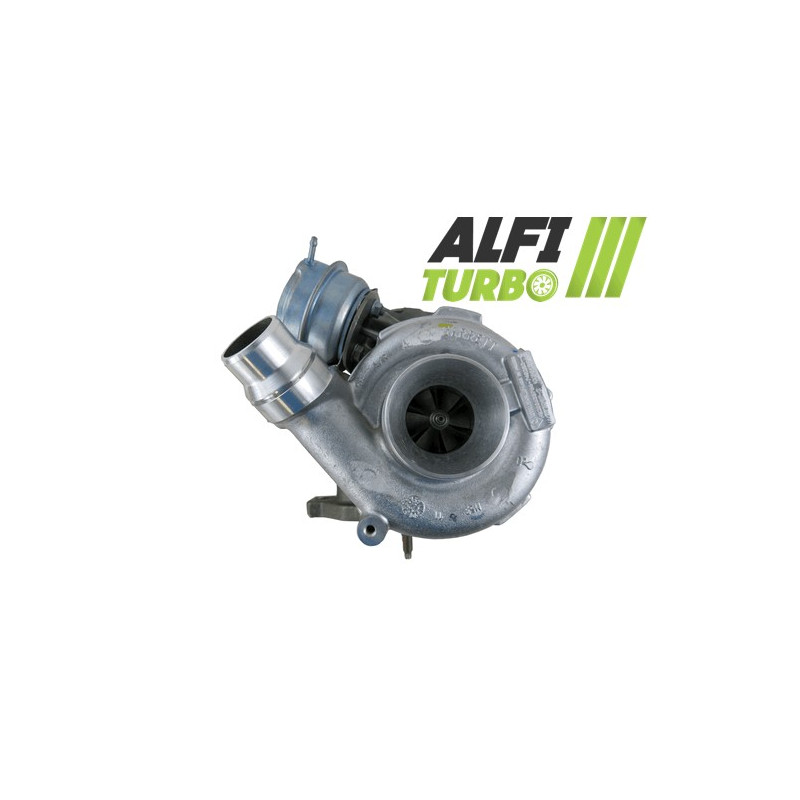
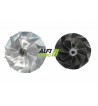
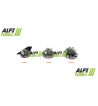
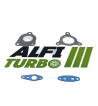
This hybrid turbo for engine options 2.0 dCi benefits from d'an internal assembly based on an MFS compressor wheel' Performance, a 360° bearing stop and high-speed balancing. Three levels of preparation are documented in order to d'to adapt the turbocharger’s specifications to the engine design'.
The assignments listed include, in particular, several Nissan The Qashqai and X-Trail, as well as Renault Espace, Koleos, Laguna, Latitude, Mégane and Vel Satis. Compatibility must always be confirmed using the turbo’s part number d'origin'.
Available products — Stage 1, Stage 2 and Stage 2+
Stage 1
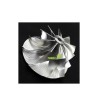
Compressor wheel: MFS Performance high-speed
Dimensions: 38.00 / 49.00 mm
Configuration: 6+6 blades
Stop: 360° bearing
Balancing: 150,000 rpm on a Cimat VSR test bench
This kit includes an MFS wheel Performance with a 360° stop. Its design is intended to adjust the flow rate d'air whilst retaining a Installation without modification documented external.
Stage 2
Compressor wheel: MFS Performance high-speed oversized
Dimensions: 48.58 / 52.00 mm
Configuration: 6+6 blades
Intake manifold: reprofiled for to receive the wheel oversized
Stop: 360° bearing
Balancing: 150,000 rpm on a Cimat VSR test bench
Reprofiling the casing d'admission allows' d'fit the wheel' oversized. This change may affect the compression capacity and the throughput d'airflow and turbo behaviour; its operation depends on the engine configuration'.
Stage 2+
Compressor wheel: MFS Performance high-speed oversized
Dimensions: 41.58 / 56.03 mm
Configuration: 7+7 blades
Intake manifold: reprofiled for to receive the wheel oversized
Stop: 360° bearing
Balancing: 150,000 rpm on a Cimat VSR test bench
This version features a 7+7 wheel of specific dimensions and a casing d'adapted admission'. A larger wheel does not automatically guarantee a better result in all conditions: the answer depends on the overall set-up.
What is a hybrid turbo ?
A hybrid turbo relies on a specially adapted design for to receive internal components that differ from the configuration d'origin'. Depending on the overhaul, modifications may relate to the compressor wheel, its dimensions, the blade configuration, the reprofiling of the housing, the thrust bearing and the balancing.
The aim is d'adjust the compression capacity and flow rate' d'air'. A hybrid turbocharger is therefore not defined solely by the appearance of its compressor wheel, but by the consistency of its geometry and the associated mechanical modifications.
MFS compressor wheel: standard or Performance ? ?
MFS stands for ‘Milled From Solid’, meaning a wheel machined from a solid block. This manufacturing process does not, on its own, guarantee an increase in throughput d'air'. A standard MFS wheel can retain a geometry equivalent to that d'origin'.
A standard MFS wheel can be just as shiny as an MFS wheel Performance. It is not its appearance that determines its performance, but its geometry and its ability to move more d'air'. Depending on the set-up, one wheel Performance may have a specific diameter, profile or blade arrangement. A higher flow rate can help to generate more power with the right engine tuning, although this does not guarantee a performance gain.
Why does the geometry of the blades affect the flow rate? d'air?' ?
The compressor wheel draws in and then compresses the air. Its diameter, profile, height, width and the arrangement of its blades all influence its aerodynamic behaviour. The result also depends on the compressor housing, the turbine, the boost pressure and the mapping. An increase in size may also affect the response time and the range d'optimal use'.
Reliability and balancing of the hybrid turbocharger
The documented 360° stop distributes axial forces across the entire surface. The rotor is balanced at 150,000 rpm on a Cimat VSR test bench in order to minimise vibrations and mechanical stresses. However, these measures do not compensate for incorrect installation or a lack of lubrication.
Engine remapping and tuning
It may be necessary to adapt the mapping and management of overfeeding for make the most of the turbo’s features. Fuel injection, exhaust, air cooling d'The intake, clutch or gearbox must be checked in accordance with the design'. The wastegate must be adjusted during the installation and tuning of the ECU.
Turbo part numbers
OEM part numbers
8200646108
7711497063
7701477853
8201124252
8201051044
8200741580
8200741579A
8200741579
8200695786
8200583860
7701477162
8201051044A
8200740282E
8200740282
8200732546
1441100Q1C
1441100Q0G
1441100K0F
8200673417D
8200673417
8200638766
7711497401
7701478918
Manufacturer’s part numbers
774833-0001
774833-1
774833-2001
774833-5001S
774833-5002S
773087-0002
773087-2
773087-2002
773087-5002S
773087-5003S
765016-0004
765016-2004
765016-4
765016-5004S
756016-0001
756016-0006
756016-1
756016-6
765016-2006
765016-5001S
765016-5002S
765016-5006S
770116-0001
770116-1
770116-2001
770116-5001S
770116-5002S
Compatible vehicles and assignments
Nissan
Qashqai / Qashqai +2 I (J10, NJ10, JJ10E) — 150 hp
Diesel — February 2007 to December 2013
Engine codes: M1D, M9R
X-Trail II (T31) — 150 hp
Diesel — June 2007 to November 2013
Engine code : M9R
X-Trail II (T31) — 173 hp
Diesel — June 2007 to November 2013
Engine code : M9R 760
X-Trail II (T31) — 177 hp
Diesel — October 2009 to November 2013
Engine code : M9R 760
X-Trail III (T32_, T32R, T32RR) — 177 hp
Diesel — October 2016 to an unspecified date
Engine code : M9R
X-Trail Van (T31) — 150 hp
Diesel — January 2011 to February 2014
Engine code : M9R
Renault
Espace IV (JK0/1_) — 131 hp
Diesel — January 2006 to an unspecified date
Engine codes: M9R 740, M9R 750, M9R 760, M9R
Espace IV (JK0/1_) — 173 hp
Diesel — January 2006 to an unspecified date
Engine codes: M9R 760, M9R 761, M9R 762, M9R
Koleos I (HY_) — 150 hp
Diesel — September 2008 to an unspecified date
Engine codes: M9R 832, M9R 833, M9R 834, M9R
Koleos I (HY_) — 150 hp
Diesel — September 2008 to an unspecified date
Engine codes: M9R 855, M9R 856, M9R 862, M9R
Koleos I (HY_) — 173 hp
Diesel — September 2008 to an unspecified date
Engine code : M9R 830
Koleos I (HY_) — 173 hp
Diesel — July 2013 to an unspecified date
Engine code : M9R 865
Koleos II (HC_) — 177 hp
Diesel — April 2016 to an unspecified date
Engine code : M9R 868
Koleos II (HC_) — 185 hp
Diesel — January 2020 to an unspecified date
Engine code : M9R 716
Laguna Coupé (DT0/1) — 173 hp
Diesel — September 2008 to December 2015
Engine codes: M9R 800, M9R 806, M9R 809, M9R
Laguna Coupé (DT0/1) — 178 hp
Diesel — September 2008 to December 2015
Engine codes: M9R 816, M9R 820, M9R 828
Laguna II (BG0/1_) — 173 hp
Diesel — January 2006 to August 2007
Engine code : M9R 760
Laguna II Grandtour (KG0/1_) — 173 hp
Diesel — January 2006 to December 2007
Engine code : M9R 760
Laguna III (BT0/1) — 131 hp
Diesel — October 2007 to December 2015
Engine codes: M9R 742, M9R 744, M9R 802, M9R
Laguna III (BT0/1) — 173 hp
Diesel — January 2008 to December 2015
Engine codes: M9R 800, M9R 806, M9R 809, M9R
Laguna III (BT0/1) — 178 hp
Diesel — March 2008 to December 2015
Engine codes: M9R 816, M9R 820, M9R 828
Laguna III Grandtour (KT0/1) — 173 hp
Diesel — January 2008 to December 2015
Engine codes: M9R 800, M9R 806, M9R 809, M9R
Laguna III Grandtour (KT0/1) — 178 hp
Diesel — March 2008 to December 2015
Engine codes: M9R 816, M9R 820, M9R 828
Latitude (L70_) — 150 hp
Diesel — February 2011 to an unspecified date
Engine codes: M9R 824, M9R 846
Latitude (L70_) — 173 hp
Diesel — May 2011 to an unspecified date
Engine codes: M9R 804, M9R 817, M9R 844
Mégane II (BM0/1_, CM0/1_) — 173 hp
Diesel — January 2007 to February 2008
Engine code : M9R 724
Vel Satis (BJ0_) — 150 hp
Diesel — August 2005 to an unspecified date
Engine code : M9R 760
Vel Satis (BJ0_) — 173 hp
Diesel — January 2006 to an unspecified date
Engine codes: M9R 760, M9R 762, M9R 763
Additional technical specifications
Type: hybrid turbo
Engine: 2.0 dCi diesel
Documented power ratings: 131, 150, 173, 177, 178 and 185 hp
Installation: configuration plug & play documented, without any external modifications
Assembly instructions
⚠️ WARNING — IMPORTANT BEFORE ASSEMBLY
Search for and correct the cause of the previous failure. Check the lubrication circuit, the supply and the return d'oil, the cleanliness of the pipes, and the intake, as well as the absence of foreign objects'. Carry out the priming in accordance with the relevant guidelines and follow the manufacturer’s instructions. If a lubrication fault is not rectified, it may lead to the turbocharger failing again.
How do you choose the right turbo ?
Check the turbo part number d'Origin, OEM and manufacturer part numbers, as well as the make, model, generation, body style, engine type, power output, production period and engine code'. Having the same engine is not always enough to confirm compatibility.
⚠️ Check your turbo’s part numbers
Before placing your order, Compare the part number on your turbocharger d'origin' using the references given in this fact sheet. Having the same motor does not always guarantee compatibility. If you’re unsure, please contact us with the reference number shown on your turbo.