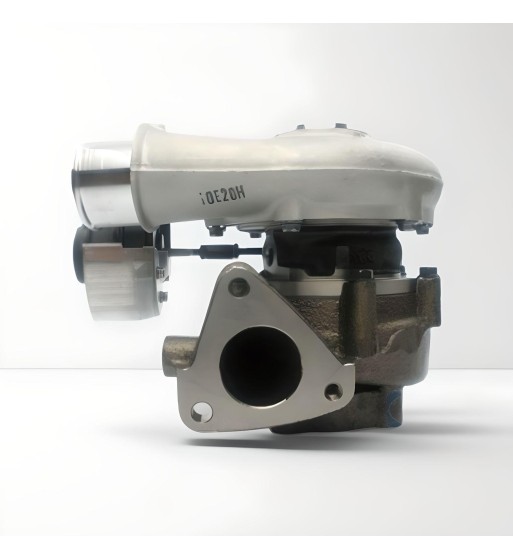
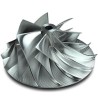
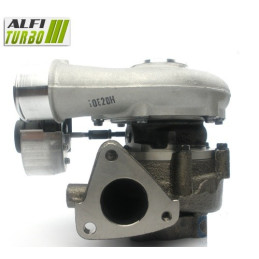
This hybrid turbocharger, designed for the following engines: Hyundai 2.2 CRDI 155 hp, combines a design intended for with Installation without modification d ‘adaptation’ to internal components optimised according to the selected stage.. The high-flow MFS compressor wheel, the 360° thrust bearing and high-speed balancing are among the documented components.
The applications listed include, in particular, the Hyundai Azera, Grandeur and Santa Fe 2 from 2006 onwards. The part number of the original d turbocharger must always be checked before ordering.
Available versions — Stage 1, Stage 2 and Stage 3
Stage 1
Compressor wheel: MFS high-flow
Thrust bearing: 360° bearing
Balancing: High speed at 150,000 rpm on a Cimat VSR test bench
This modification primarily affects the compressor section in order d to adapt the compression capacity and the air flow rate d. The 360° thrust bearing helps to distribute the axial forces acting on the rotor more evenly.
Stage 2
Compressor impeller: MFS high-flow oversized
d intake housing: Reprofiled for accommodate the new impeller oversized
Thrust bearing: 360° bearing
Balancing: High-speed balancing at 150,000 rpm on a Cimat VSR test bench
The Stage 2 is fitted with a oversized compressor wheel and a d intake housing, which has been re-profiled for accommodate it. This configuration aims to increase the air flow capacity d, with performance that also depends on the mapping and the overall engine tuning.
Stage 3
Compressor wheel: MFS high-flow oversized
Intake housing d: Reprofiled for to accommodate the new impeller oversized
Thrust bearing: 360° bearing
Turbine wheel: High-flow oversized
Turbine housing: Reprofiled for ly to accommodate the new impeller oversized
Balancing: High-speed balancing at 150,000 rpm on a Cimat VSR test bench
This modification alters both the compressor and turbine sides. Resizing the impellers and re-profiling the housings allow d'adapt the air and gas flow rates d'but may also alter the response time and the range d'for optimal use of the turbocharger.
What is a hybrid turbo?
A hybrid turbo is based on a turbocharger architecture adapted for to accommodate internal components that differ from the original configuration d'. Depending on the upgrade stage, modifications may involve the compressor wheel, the housings, the turbine wheel, the thrust bearing or the balancing.
The aim is d to adapt the compression capacity and the air flow rate d. However, a hybrid turbo is not defined solely by the appearance of its compressor wheel: the geometry of the wheels, the machining of the housings and the overall coherence of the unit are decisive.
MFS compressor wheel: standard or ‘ Performance ’?
MFS stands for ‘Milled From Solid’, meaning a wheel machined from a solid block. This manufacturing process alone does not guarantee an increase in air flow rate d'air. A standard MFS wheel can retain a geometry equivalent to that d'of the original.
An MFS wheel Performance may adopt a geometry adapted to the modification, notably with a different blade profile, height, width or diameter, provided these modifications are documented. For this product, the wheel is described as lighter, larger and taller than the original d, with a claimed 15 per cent increase in compression.
A standard MFS impeller can be just as effective as an MFS impeller Performance. It is not its appearance that determines its performance, but its geometry and its ability to move more d'air. A higher airflow can only be utilised properly with appropriate engine tuning.
Why does the geometry of the blades influence the air flow rate d?
The compressor impeller draws in and then compresses the air sent to the engine. Its diameter, profile, height, width and the arrangement of its blades influence its aerodynamic behaviour. A suitable geometry can move more d air under certain conditions, but the result also depends on the casings, the turbine, the boost pressure and the engine management system. A larger impeller therefore does not automatically guarantee better performance across all operating ranges.
Reliability and balancing of the hybrid turbocharger
The 360° thrust bearing distributes axial forces over a wide surface area. The rotor is balanced at high speed, up to 150,000 rpm on a Cimat VSR test bench, in order to minimise vibrations and mechanical stresses. However, this balancing does not protect the turbocharger against incorrect installation, inadequate lubrication or the presence d of a foreign object.
Engine remapping and preparation
The engine mapping and boost pressure control must be adjusted for to make the most of the hybrid turbo’s characteristics. The fuel injection, exhaust, intake air cooling d and transmission must also be checked depending on the level of tuning. The wastegate must be adjusted whilst remapping the ECU. No power gain can be guaranteed without appropriate engine configuration.
Turbo part numbers
OEM part numbers
2823127810
28231-27810
Manufacturer part numbers
49135-07310
49135-07311
49135-07312
Compatible vehicles and applications
Hyundai
Azera — 2.2 CRDI — 155 hp
Engine variants: 2-., 2- CRDI — from 2006, end date unspecified
Engine code: not specified
Size — 2.2 CRDI — 155 hp
Engine 2.2 CRDI — from 2006, end date unspecified
Engine code: not specified
Santa Fe 2 — 2.2 CRDI — 155 hp
Engine 2.2 CRDI — from 2006, end date unspecified
Engine code: not specified
Additional technical specifications
Product type: Hybrid Turbo
Engine: 2.2 CRDI
Power: 155 hp
Documented period: From 2006 — end unspecified
Installation advice
⚠️ WARNING — IMPORTANT BEFORE INSTALLATION
Identify and rectify the cause of the previous fault. It is essential to check the lubrication circuit as well as the oil supply and return lines d.
Check that the pipes and the inlet are clean and free from foreign objects. Carry out the priming procedure in accordance with the applicable recommendations and follow the manufacturer’s instructions.
A lubrication fault that is not rectified may result in the turbocharger failing again.
How do you identify the correct turbo?
Check the part number engraved on the original turbo d and compare it with the OEM and manufacturer part numbers in this sheet. Also check the make, model, generation, engine type 2.2 CRDI, the power output 155 hp, theYear and, where available, the engine code. An identical engine specification does not automatically guarantee compatibility.
⚠️ Check your turbo’s part numbers
Before ordering, compare the part number marked on your original turbo d with the part numbers listed in this data sheet. An identical engine specification does not always guarantee compatibility.
If in doubt, please contact us with the full part number from your turbocharger.