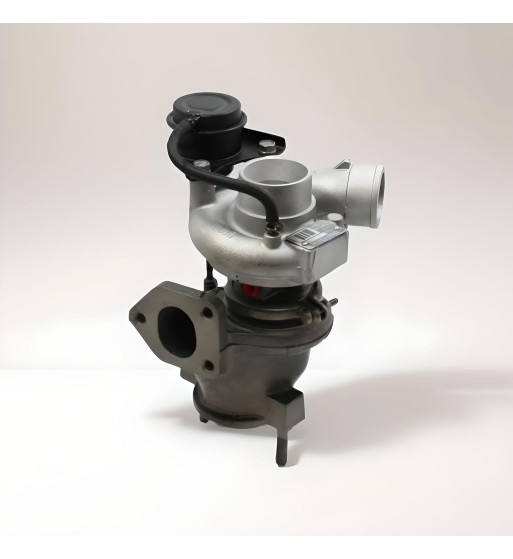
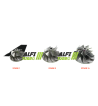
This hybrid turbocharger is designed for the Bmw M21 D24 and M51 D25 diesel engines listed below, with documented power outputs of 115, 116 and 143 hp. A hybrid tuning programme adapts the turbocharger’s architecture to meet a specific operating objective defined in consultation with the engine tuner.
The main applications include the E30 and E36 3 Series Bmw, as well as the E34 and E39 5 Series Bmw, including certain Touring body styles. Compatibility must be confirmed using the original turbo part number d.
Hybrid conversion
Configuration to be verified
The available data does not specify the level ( Stage 1, Stage 2 or Stage 2+), nor the wheel dimensions, machining, thrust bearing type or balancing parameters d. These specifications must be confirmed before selecting the appropriate configuration.
Hybrid turbo technology
What is a hybrid turbo?
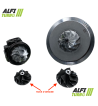
A hybrid turbo is based on a turbocharger architecture designed for to accommodate internal modifications. Depending on the specification, these may relate to the compressor wheel, the blade geometry, the housings, the turbine, the thrust bearing or the balancing. Their aim may be dto adjust the compression capacity and the air flow rate d, although no specific modification can be attributed to this product in the absence of detailed technical data.
MFS compressor impeller: standard or ‘ Performance ’?
MFS stands for ‘Milled From Solid’: the impeller is machined from a solid block. This process alone does not guarantee an increase in air flow rate. A standard MFS impeller may retain a geometry close to the original, whilst an MFS Performance impeller may adopt a profile, dimensions or blade configuration tailored to the application. A standard MFS impeller can be just as polished as an MFS impeller Performance. It is not its appearance that determines its performance, but its geometry and its ability to move more d’air.
Airflow d, balancing and engine tuning
The diameter, profile, height, width and arrangement of the blades all influence the compressor’s aerodynamic behaviour. The result also depends on the casings, the turbine, the boost pressure and the engine management system. Rotor balancing helps to limit vibrations and mechanical stresses. Adjustments to the mapping, fuel delivery, intercooling, the exhaust system or the transmission may be necessary depending on the modification, without automatically resulting in a power gain.
Turbo specifications
OEM part numbers
2243398G
2243398B
2243398
11652243398B
11652243398
2243579
2244116
2244347
11652244116
11652243579
11652244347
2245203
11652245203
Manufacturer’s part numbers
465555-0002
465555-0003
465555-2
465555-2003
465555-3
465555-5003S
4655550002
4655550003
4655552003
4655555003S
49177-06500
4917706500
49177-06501
4917706501
49177-06510
4917706510
466700-5002S
49177-06400
4917706400
Compatible vehicles and assignments
Bmw
Bmw 3 (E30) — PC variant — 115 hp
Diesel — 09/1987 to 08/1991
Engine code : M21 D24 (246TB)
Bmw 3 (E36) — PC type — 115 hp
Diesel — 09/1991 to 02/1998
Engine code : M51 D25 (256T1)
Bmw 3 (E36) — type PC — 143 hp
Diesel — May 1993 to February 1998
Engine code : M51 D25 (256T1)
Bmw 3 Touring (E30) — type PC — 115 hp
Diesel — Jan 1988 to Jun 1993
Engine code : M21 D24 (246TB)
Bmw 3 Touring (E36) — PC model — 143 hp
Diesel — 03/1995 to 04/1999
Engine code : M51 D25 (256T1)
Bmw 5 (E34) — PC model — 115 hp
Diesel — 03/1993 to 08/1995
Engine code : M51 D25 (256T1)
Bmw 5 (E34) — PC model — 143 hp
Diesel — 09/1991 to 08/1995
Engine code : M51 D25 (256T1)
Bmw 5 (E39) — type PC — 116 hp
Diesel — 01/1997 to 06/2003
Engine code : M51 D25 (256T1)
Bmw 5 Touring (E34) — type PC — 115 hp
Diesel — 03/1993 to 07/1996
Engine code : M51 D25 (256T1)
Bmw 5 Touring (E34) — type PC — 143 hp
Diesel — Dec 1991 to Jul 1996
Engine code : M51 D25 (256T1)
Additional technical specifications
Product type: Hybrid Turbo
Fuel: Diesel
Documented power outputs: 115, 116 and 143 hp
Engine codes: M21 D24 (246TB), M51 D25 (256T1)
Documented production periods: 09/1987 to 06/2003 depending on application
Fitting instructions
⚠️ WARNING — IMPORTANT BEFORE INSTALLATION
Identify and rectify the cause of the previous fault. Carefully check the lubrication system, the oil supply and return lines d, the cleanliness of the pipes, and the intake, ensuring there are no foreign objects.. Prime the system in accordance with the applicable recommendations and follow the manufacturer’s instructions.. A lubrication fault that is not rectified may lead to further turbocharger failure.
How do you identify the correct turbo?
Check the turbo’s part number d, the original OEM and manufacturer part numbers, the model, generation, body style, engine type, power output, production period and engine code.. An identical engine type does not always guarantee compatibility.
⚠️ Check your turbo’s part numbers
Before ordering, compare the part number marked on your original turbo d with the part numbers listed in this specification sheet. An identical engine specification does not always guarantee compatibility.
If in doubt, please contact us with the part number clearly visible on your turbocharger’s nameplate.