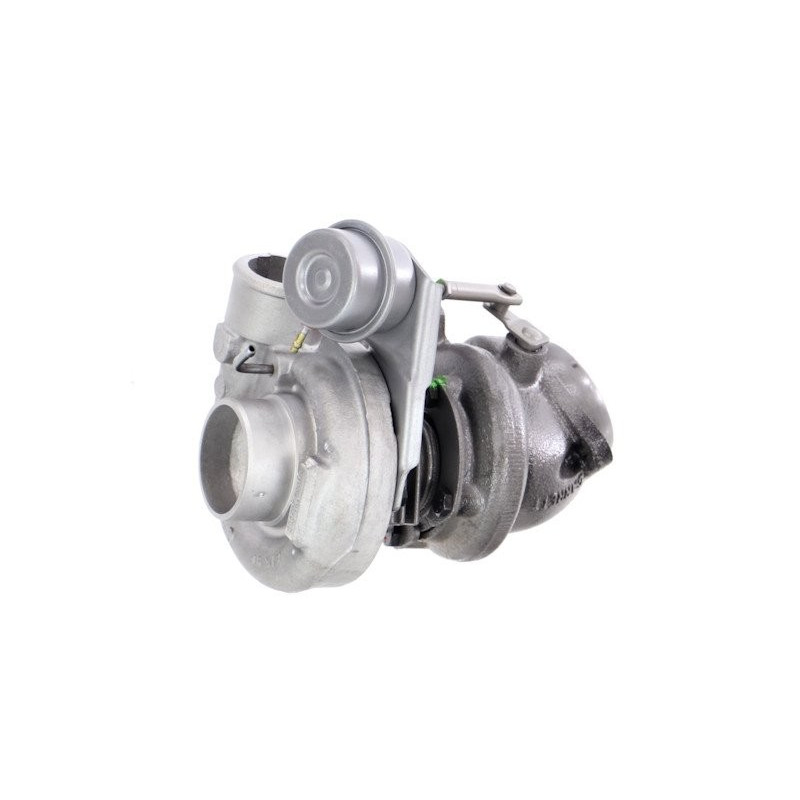
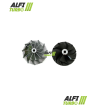
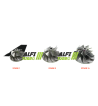
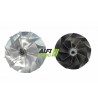
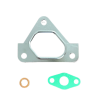
This hybrid turbo is designed for Mercedes-Mercedes-Benz Sprinter 2.9 diesel vehicles fitted with the OM 602 engine.980, with a capacity of 102, 115 or 122 hp depending on the version. His preparations are based on an MFS compressor wheel Performance and features tailored to each course.
The fixing points d'the originals are retained' for to allow installation without modifying the brackets, subject to compatibility. It is usually necessary to adjust the engine management system for harness the potential of the turbocharger.
Available products — Stage 1, Stage 2 and Stage 2+
Stage 1 — MFS wheel Performance
Compressor wheel: High-performance MFS
Dimensions: 38.69 / 52.24 mm
Blade configuration: 6+6, Performance Design
Bearing stop: 360°
Balancing: up to 150,000 rpm on a Cimat VSR test bench
This preparation improves flow capacity d'air thanks to the geometry of its MFS compressor wheel' Performance.
Stage 2 — MFS wheel oversized
Compressor wheel: High-performance MFS
Dimensions: 40.30 / 54.35 mm
Blade configuration: 6+6, Performance Design
Carter d'Admission:' reprofiled for the wheel oversized
Bearing stop: 360°
Balancing: up to 150,000 rpm on a Cimat VSR test bench
The larger compressor wheel and the recontouring of the housing d'intake systems increase flow capacity' d'air'. The result depends on the engine’s overall configuration and tuning.
Stage 2+ — MFS high-flow impeller
Compressor wheel: High-performance MFS
Dimensions: 42.20 / 60.40 mm
Blade configuration: 10+0, Performance Design
Carter d'Admission:' reprofiled for the wheel oversized
Turbine wheel: unchanged
Bearing stop: 360°
Balancing: up to 150,000 rpm on a Cimat VSR test bench
The larger-diameter compressor wheel offers greater flow potential d'upper air'. This change may also affect the response time and the range d'Getting the most out of the turbo'.
What is a hybrid turbo ?
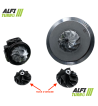
A hybrid turbo retains an architecture suited to the application d'original form whilst undergoing targeted internal modifications'. Depending on the course, these may relate to the compressor wheel, its dimensions, the geometry of the blades, or the housing d'intake, the stop system or balancing'.
The aim is d'adjust the compression capacity and flow rate' d'air'. A hybrid turbo is therefore not defined solely by the appearance of its compressor wheel.
MFS compressor wheel: standard or Performance ? ?
MFS stands for ‘Milled From Solid’: the wheel is machined from a solid block. This manufacturing process does not, on its own, guarantee an increase in throughput d'air'. A standard MFS wheel can retain a geometry equivalent to that d'origin'.
A standard MFS wheel can be just as shiny as an MFS wheel Performance. It is not its appearance that determines its performance, but its geometry and its ability to move more d'air'. With the right engine tuning, a higher flow rate can help to increase the engine’s potential, although this does not guarantee a specific performance gain.
Why does the geometry of the blades affect the flow rate? d'air?' ?
The compressor wheel draws in and then compresses the air. Its diameter, profile, height, width and the arrangement of its blades all influence its aerodynamic behaviour. The result also depends on the compressor housing, the turbine, the turbine housing, the boost pressure and the engine tuning. A larger wheel therefore does not automatically guarantee better handling in all conditions.
Reliability and balancing of the hybrid turbocharger
The 360° stop, documented for each stage, helps to distribute the axial forces. The rotor is balanced at high speeds of up to 150,000 rpm on a Cimat VSR test bench in order to minimise vibrations and mechanical stresses. However, this balancing does not compensate for either incorrect installation or inadequate lubrication.
Engine remapping and tuning
It is usually necessary to adjust the mapping and management of boost pressure. Depending on the course and the objective, the fuel system, the exhaust system and the air cooling system d'The intake system, the clutch or the gearbox may also need to be checked or adjusted'. The wastegate setting must be checked during tuning.
Turbo part numbers
Manufacturer’s part numbers Garrett 454111
454111-0001
454111-1
454111-2001
454111-5001S
4541110001
4541112001
4541115001S
GA1454111-0001
Manufacturer’s part numbers Garrett 454184
454184-0001
454184-1
454184-2001
454184-5001S
4541840001
4541842001
4541845001S
GA1454184-0001
Manufacturer’s part numbers Garrett 454207
454207-0001
454207-1
454207-2001
454207-5001S
454207-5002S
4542070001
4542072001
4542075001S
4542075002S
GA1454207-0001
GA1454207-5001S
OEM part numbers Mercedes-Benz
602096089980
6020960199
6020901380
6020960699
6020960899
Compatible vehicles and assignments
Mercedes-Benz
Sprinter 2-stroke (B901, B902) — minibus — 102 / 122 hp
2.9 turbo diesel — 1995–2000
Engine code : OM 602.980
Sprinter 2-stroke (B901, B902) — panel van — 102 / 122 hp
2.9 turbo diesel — 1995–2000
Engine code : OM 602.980
Sprinter 2-stroke (B901, B902) — chassis-cab — 102 / 122 hp
2.9 turbo diesel — 1995–2000
Engine code : OM 602.980
Sprinter 3-t (B903) — minibus — 102 / 122 hp
2.9 turbo diesel — 1995–2002
Engine code : OM 602.980
Sprinter 3-t (B903) — panel van — 102 / 122 hp
2.9 turbo diesel — 1995–2002
Engine code : OM 602.980
Sprinter 3-tonne (B903) — chassis cab — 102 / 122 hp
2.9 turbo diesel — 1995–2002
Engine code : OM 602.980
Sprinter 4-cylinder (B904) — panel van — 102 / 115 / 122 hp
2.9 turbo diesel — 1996–2006
Engine code : OM 602.980
Sprinter 4-cylinder (B904) — chassis cab — 102 / 115 / 122 hp
2.9 turbo diesel — 1996–2006
Engine code : OM 602.980
Additional technical specifications
Product type: hybrid turbo
Engine: 2.9 turbo diesel
Fuel: diesel
Power : 102, 115 or 122 hp depending on the version
Engine code : OM 602.980
Editing: fixing points d'original versions retained, subject to compatibility'
Assembly instructions
⚠️ WARNING — IMPORTANT BEFORE ASSEMBLY
Identify and rectify the cause of the previous fault. Check the lubrication circuit, as well as the supply and return lines d'oil'. Check that the ducts and the intake are clean and free from foreign objects. Carry out the priming in accordance with the relevant guidelines and follow the manufacturer’s instructions. If a lubrication fault is not rectified, it may lead to the turbocharger failing again.
How do you choose the right turbo ?
Check the turbo part number d'Origin, OEM and manufacturer part numbers, as well as the model, generation, body style, engine type, power output, production period and engine code'. Having the same engine is not always enough to confirm compatibility.
⚠️ Check your turbo’s part numbers
Before placing your order, Compare the part number on your turbocharger d'origin' using the references given in this fact sheet. Having the same motor does not always guarantee compatibility.
If you are unsure which part you have, please contact us with the reference number clearly visible on the turbocharger plate.