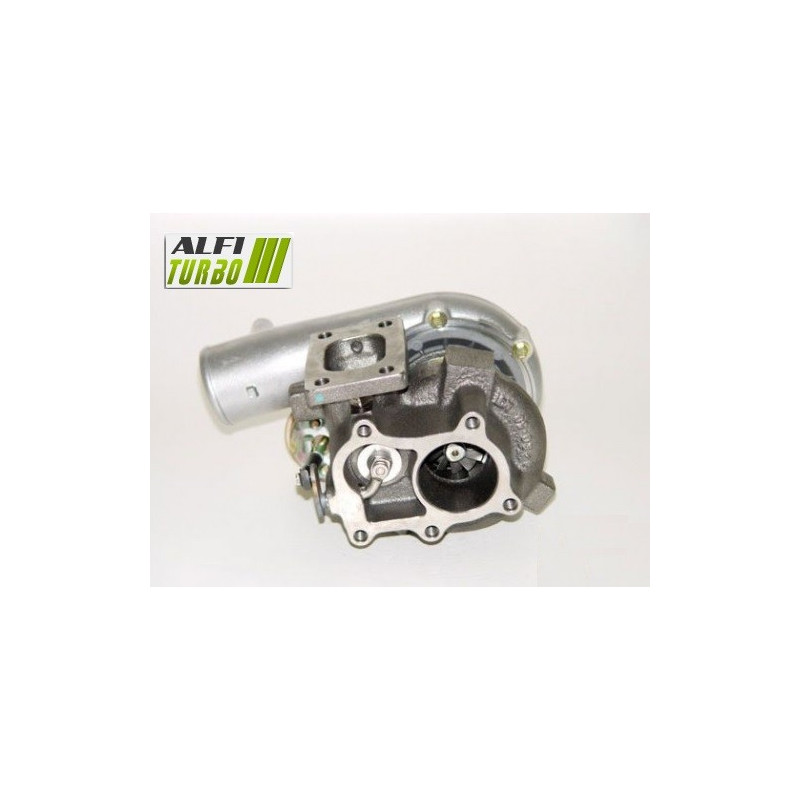
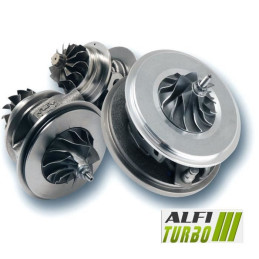
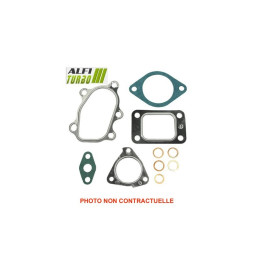
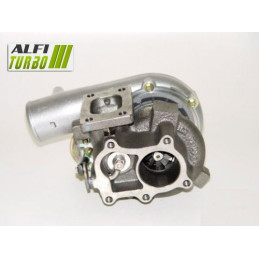
This plug & play hybrid turbocharger is designed for to Installation without modification its installation. It is available in several specification levels, combining a high-flow MFS compressor wheel, a 360° bearing stop and high-speed balancing.
The precisely documented application concerns the Nissan Terrano 2 fitted with the 2.7 Di engine producing 118 hp from 2001 onwards. Compatibility must always be confirmed using the original turbo’s part number d.
Available upgrades — Stage 1, Stage 2 and Stage 3
Stage 1
Compressor wheel: MFS high-flow
Thrustbearing: 360° thrust bearing
Balancing: High-speed balancing at 150,000 rpm on a Cimat VSR test bench
This modification primarily affects the compressor impeller in order dto adjust the compression capacity and dthe air flow rate, whilst maintaining a dconfigurationInstallation without modification.
Stage 2
Compressor impeller: MFS high-flow oversized
Intake casing d: Reprofiled for accommodate the new impeller oversized
Thrustbearing: 360° thrust bearing
Balancing: High-speed balancing at 150,000 rpm on a Cimat VSR test bench
The Stage 2 combines a oversized compressor wheel with a reprofiled dintake housing. This modification is designed to deliver superior flow capacity as part dof a comprehensive engine upgrade.
Stage 3
Compressor impeller: MFS high-flow oversized
dintake housing: Reprofiled for accommodate the new impeller oversized
Thrustbearing: 360° thrust bearing
Turbine wheel: High-flow oversized
Turbine casing: Reprofiled for ly to accommodate the new impeller oversized
Balancing: High-speed balancing at 150,000 rpm on a Cimat VSR test bench
This version features modifications on both the compressor and turbine sides. Larger sizing may alter flow rate and response time; its operation therefore depends on the engine’s overall configuration.
What is a hybrid turbocharger?
A hybrid turbo retains an architecture suited to the intended installation whilst incorporating internal modifications. Depending on the stage, these may involve the compressor impeller, the casings, the turbine impeller, the thrust bearing system and the balancing.
The aim is dto adapt the compression capacity and air flow rate d. The result, however, depends on the overall configuration: engine management, boost pressure, fuel supply, cooling and exhaust.
MFS compressor wheel: standard or Performance?
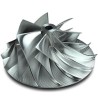
MFS stands for ‘Milled From Solid’, meaning a wheel machined from a solid block. This manufacturing process alone does not guarantee an increase in air flow rate d’air. A standard MFS wheel can retain a geometry equivalent to that d’of the original.
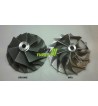
An MFS wheel Performance can be given a geometry adapted to the modification. On this product, the wheels shown are made of forged aluminium and feature a lighter, larger and taller profile than the d’original. The technical description indicates an additional compression capacity of 15 per cent.
A standard MFS impeller can be just as shiny as an MFS impeller Performance. It is not its appearance that determines its performance, but its geometry and its ability to move more d’air. A higher airflow can only be fully utilised with a suitable engine set-up.
Why does the geometry of the blades influence the air flow rate d?
The compressor wheel draws in and then compresses the air sent to the engine. Its diameter, profile, height, width and the arrangement of its blades influence its aerodynamic behaviour and the amount d’of air it can move under certain conditions.
The result also depends on the housings, the turbine wheel, the boost pressure and the engine mapping. A larger wheel does not automatically guarantee better performance and may alter the turbocharger’s response time.
Reliability and balancing of the hybrid turbo
The 360° bearing stop, featured on all three documented stages, distributes axial forces over a wide surface area. It accommodates the stresses associated with rotor operation without making the turbo immune to fitting or lubrication faults.
Each engine preparation undergoes dhigh-speed balancing at 150,000 rpm on a Cimat VSR test bench. This process aims to minimise vibrations and mechanical stresses on the rotor.
Engine remapping and tuning
Adjustments to the engine mapping and boost pressure management are necessary for to make full use of the hybrid turbo’s characteristics. Depending on the tuning package, the fuel injection, exhaust system, cooling system, intake and transmission may also need to be checked or adjusted. The wastegate must be adjusted whilst remapping the ECU.
Turbo part numbers
OEM part numbers
144117F411
14411-7F411
Manufacturer part numbers
722687-0001
722687-1
722687-5001S
Compatible vehicles and applications
Nissan
Terrano 2 — 2.7 Di — 118 hp
Engine 2.7 Di — from 2001, end date unspecified
Engine code: not specified
Additional technical specifications
Product type: Hybrid Turbo
Installation: Plug & play, no modification to the layout required
Specified engine variants: 2.7D and 2.7 Di
Specified power ratings: 160 hp and 118 hp
Main reference: 722687
Fitting instructions
⚠️ WARNING — IMPORTANT BEFORE INSTALLATION
Identify and rectify the cause of the previous failure. Check the lubrication circuit, the oil supply and return das well as the cleanliness of all pipes.
Check the inlet for foreign objects. Prime the system in accordance with the applicable guidelines and follow the manufacturer’s instructions.
A lubrication fault that is not rectified may result in the turbocharger failing again.
How do you identify the correct turbo?
Check the part number marked on the original turbo d, then compare the OEM and manufacturer part numbers.. Also check the make, model, generation, engine type, power output at hp, the mountingYear and the engine code where available.
An identical engine specification does not always guarantee compatibility between two turbochargers.
⚠️ Check your turbo’s part numbers
Before ordering, compare the part number marked on your original turbo d with the part numbers listed in this data sheet. An identical engine specification does not always guarantee compatibility.
If in doubt, please contact us, providing the full part number from your turbo.