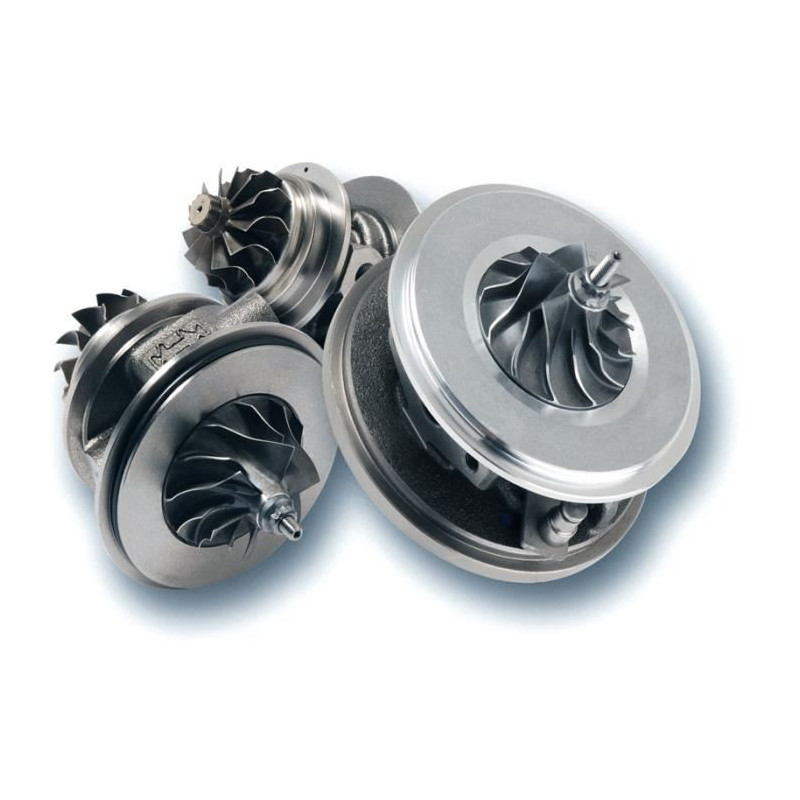
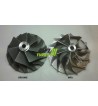
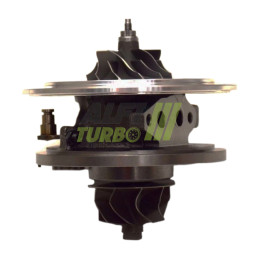
This hybrid turbocharger for, designed for a 2., 2 dCi engine with a 143 hp, is based on a configuration plug & play intended for for a Installation without modification specific application.. Its specification combines a high-flow MFS compressor wheel, a 360° bearing stop and high-speed balancing, depending on the selected stage.
Three levels of tuning are documented to dadapt the turbocharger configuration to the engine project, without making any assumptions dabout the final power output.
Available tuning packages — Stage 1, Stage 2 and Stage 3
Stage 1
Compressor wheel: MFS high-flow
Thrustbearing: 360° thrust bearing
Balancing: High-speed at 150,000 rpm on a Cimat VSR test bench
This configuration acts on the compressor side to dadapt the air flow d. The 360° thrust bearing helps to distribute axial forces more evenly during operation.
Stage 2
Compressor impeller: MFS high-flow oversized
d’ intake housing: Reprofiled for accommodate the new impeller oversized
Thrustbearing: 360° thrust bearing
Balancing: High-speed balancing at 150,000 rpm on a Cimat VSR test bench
The Stage 2 combines a oversized compressor impeller with a reprofiled housing d’admission. This modification is designed to ensure the impeller fits correctly and to increase the compressor’s air displacement capacity d.
Stage 3
Compressor impeller: MFS high-flow oversized
dintake housing: Reprofiled for to accommodate the new impeller oversized
Thrustbearing: 360° thrust bearing
Turbine impeller: High-flow oversized
Turbine casing: Reprofiled for ly to accommodate the new impeller oversized
Balancing: High-speed balancing at 150,000 rpm on a Cimat VSR test bench
This configuration includes modifications to the compressor and turbine sides. The resulting performance, however, depends on the engine as a whole, the boost pressure and the settings applied.
What is a hybrid turbo?
A hybrid turbo retains an architecture suited to its application whilst incorporating internal modifications. Depending on the stage, these may involve the compressor impeller, the housings, the turbine impeller, the thrust bearing or the balancing.
The aim is dto adapt the compression capacity and the air flow rate d. A hybrid turbo is not defined solely by the appearance of its impeller: the geometry, dimensions and adaptation of the housings are crucial.
MFS compressor wheel: standard or Performance?
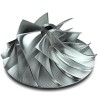
MFS stands for ‘Milled From Solid’, meaning a wheel machined from a solid block. This manufacturing process alone does not guarantee an increase in air flow rate d. A standard MFS wheel may retain a geometry equivalent to the original.
An MFS wheel Performance can feature a geometry specific to the build. In this product, the wheel shown is made from forged aluminium; it is lighter, larger and taller than the original d. The product specifications indicate an additional compression capacity of 15 per cent.
A standard MFS impeller can be just as shiny as an MFS impeller Performance. It is not its appearance that determines its performance, but its geometry and its ability to move more d’air. A higher airflow can only be utilised properly with a consistent engine set-up.
Why does the geometry of the blades influence the air flow rate d?
The compressor wheel draws in and then compresses the air sent to the engine. Its diameter, profile, height, width and the arrangement of its blades influence its aerodynamic behaviour. A suitable geometry can move more dair under certain conditions, but the result also depends on the casings, the turbine, the boost pressure and the mapping. A larger impeller can also alter the response time and the range dof optimal operation.
Reliability and balancing of the hybrid turbo
The documented 360° thrust bearing distributes axial forces over a wide surface area. The rotor is balanced at high speeds, up to 150,000 rpm, on a Cimat VSR test bench to minimise vibrations and mechanical stresses. However, this balancing does not compensate for a lack of lubrication or incorrect installation.
Engine remapping and preparation
The operation dof a hybrid turbo requires appropriate engine management. The mapping, boost pressure, injection, exhaust and cooling must be checked or adjusted depending on the project. The clutch, gearbox and other components may also require inspection. The wastegate must be adjusted when the ECU is remapped. No power gain is automatic without proper preparation.
Turbo part numbers
OEM Reference
14411-ES60A
Manufacturer’s part numbers
750441-0005
750441-5005S
Compatible vehicles and applications
Fittings to be verified
Specified engine codes: 2.2 dCi, 143 hp. No specific model, engine code or production period is provided; compatibility must therefore be confirmed using the original turbocharger reference numbers d.
Additional technical specifications
Product type: Hybrid Turbo
Engine: 2.2 dCi
Power specified: 143 hp
Installation: Configuration plug & play, without modification to the corresponding application
Installation advice
⚠️ WARNING — IMPORTANT BEFORE INSTALLATION
Identify and rectify the cause of the previous fault. It is essential to check the lubrication circuit as well as the oil supply and return d.
Check that the pipes and the inlet are clean and free from foreign objects. Carry out priming in accordance with the applicable recommendations and follow the manufacturer’s instructions.
A lubrication fault that is not rectified may lead to further damage to the turbocharger.
How do you identify the correct turbo?
Check the part number engraved or marked on the original turbo d, then compare the OEM and manufacturer part numbers.. Also check the vehicle, its generation, body style, engine type, power output, mounting Year and engine code.. An identical engine does not always guarantee compatibility.
⚠️ Check your turbo’s part numbers
Before ordering, compare the part number marked on your original turbo d with the part numbers listed in this specification sheet. An identical engine specification does not always guarantee compatibility.
If in doubt, please contact us with the full part number of your original turbo d.