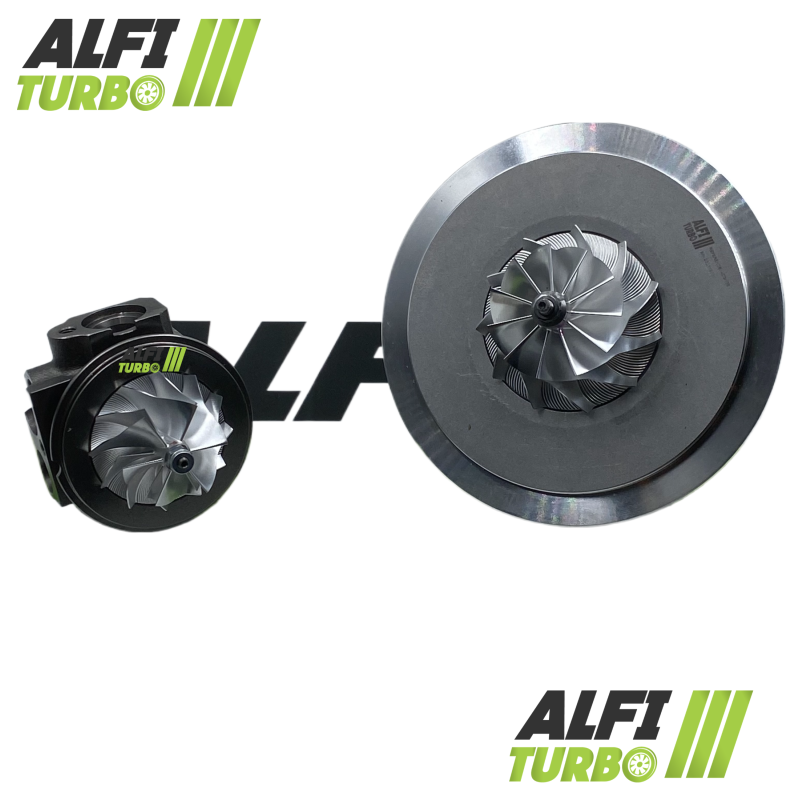
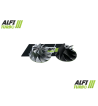
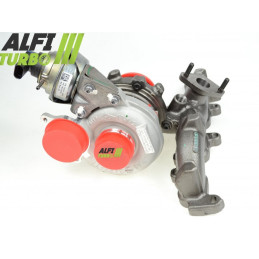
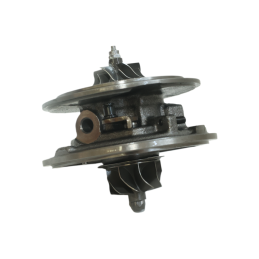
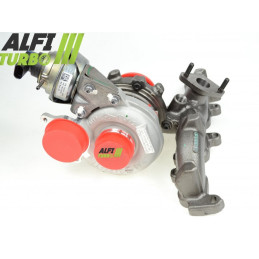
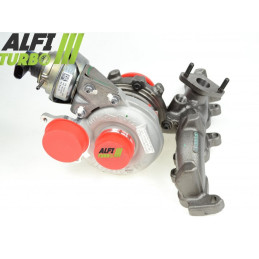
This central cartridge Cartridge The hybrid is designed for different versions 2.0 TDI some Volkswagen Transporter, Caravelle, Multivan and California T5 and T6. The three formulations on offer all incorporate an MFS compression wheel Performance high flow rate, a 360° bearing stop and high-speed balancing.
Designed for Direct fit without any modifications to the vehicle; this option must be selected by checking the turbo part number d’origin, engine code, power output and date of assembly.
Available products — Stage 1, Stage 2 and Stage 2+
Stage 1
Compressor wheel: MFS Performance high-throughput
Dimensions: 32.50 / 46.00 mm
Configuration: 6+6 blades
Level: 360° stop
Balancing: 150,000 rpm on a Cimat VSR test bench
This setup uses an MFS wheel Performance whose geometry is designed to adjust the flow rate dcompressor air. Its ultimate performance depends on the engine management system and all the associated components.
Stage 2
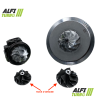
Compressor wheel: MFS Performance high-capacity oversized
Dimensions: 36.40 / 49.00 mm
Configuration: 6+6 blades
Carter d’Admission:’ reprofiled for to receive the wheel oversized
Level: 360° stop
Balancing: 150,000 rpm on a Cimat VSR test bench
The larger diameter of the wheel means the casing needs to be re-profiled d’admission’. This association aims to adjust the compression capacity and flow rate d’air, without prejudging the final power output or the response time achieved on the vehicle.
Stage 2+
Compressor wheel: MFS Performance high-capacity oversized
Dimensions: 38.40 / 52.00 mm
Configuration: 6+6 blades
Carter d’Admission:’ reprofiled for to receive the wheel oversized
Level: 360° stop
Balancing: 150,000 rpm on a Cimat VSR test bench
This version features the largest documented Ferris wheel for this product and a casing d’an inlet suited to its dimensions’. A larger wheel does not automatically guarantee better performance in all conditions: the result depends on the engine’s overall configuration.
What is a hybrid turbo ?
A Cartridge The hybrid turbo is based on a specially adapted turbocharger design for to receive internal components that differ from the standard configuration. Depending on the modification, changes may relate to the compressor impeller, its dimensions, the geometry of the blades, the casings, the turbine impeller, the thrust bearing or the balancing.
The aim is d’adjust the compression capacity and flow rate’ dair. A hybrid turbocharger is therefore not defined solely by the appearance of its compressor wheel, but by the consistency of its components and machining.
MFS compressor wheel: standard or Performance ? ?
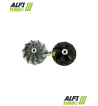
MFS stands for ‘Milled From Solid’, meaning a wheel machined from a solid block. This manufacturing process does not, on its own, guarantee an increase in throughput dair. A standard MFS wheel can retain a geometry equivalent to that d’origin’.
A standard MFS wheel can be just as shiny as an MFS wheel Performance. It is not its appearance that determines its performance, but its geometry and its ability to move more dair. A wheel Performance may have a profile, diameter or blade configuration suited to the preparation objective. A higher flow rate can help to generate more power, but only if the engine has been properly prepared.
Why does the geometry of the blades affect the flow rate? d’air ?
The compressor wheel draws in and then compresses the air intended for the engine. Its diameter, profile, height, width and the arrangement of its blades all influence its aerodynamic behaviour. The right geometry can move more d’air within certain operating ranges, but the result also depends on the casings, the turbine wheel, the boost pressure and the engine management system. An increase in diameter can also affect the response time and the range doptimal use.
Reliability and balancing of the hybrid turbocharger
The 360° stop, as documented in the three training courses, helps to distribute the axial forces around the bearing. However, it does not exempt one from d’proper lubrication nor d’a compliant assembly’.
The rotor is balanced at high speed, up to 150,000 rpm, on a Cimat VSR test bench. This balancing is designed to minimise vibrations and mechanical stresses; it does not protect against a fault dthe oil supply, the presence da foreign object or incorrect installation.
Engine remapping and tuning
The engine management system needs to be adjusted for make proper use of the features da hybrid turbo. Depending on the level of preparation, the mapping, the boost pressure, the fuel injection and the air cooling d’The intake, exhaust and transmission must be checked or adjusted’. The wastegate must be adjusted during fitting and remapping. No increase in power is automatic without the correct configuration.
Turbo part numbers
OEM part numbers
03L253016M
03L253016MV
03L253016MX
Manufacturer’s part numbers
792290-0002
792290-0003
792290-5002S
792290-5003S
792290-5004S
Compatible vehicles and assignments
Volkswagen
California T5 Camper — 84 hp
2.0 TDI Diesel — September 2009 to August 2015
Engine code : CAAA
California T5 Camper — 102 hp
2.0 TDI Diesel — September 2009 to August 2015
Engine code : CAAB
California T5 Camper — 114 hp
2.0 TDI Diesel — May 2011 to August 2015
Engine code : CAAD
California T5 Camper — 136 hp
2.0 TDI Diesel — May 2010 to August 2015
Engine codes: CAAE, CCHB
California T5 Camper — 140 hp
2.0 TDI Diesel — September 2009 to August 2015
Engine codes: CAAC, CCHA
California T5 Camper — 140 hp
2.0 TDI Diesel — October 2009 to August 2015
Engine codes: CAAC, CCHA
California T6 Camper — 102 hp
2.0 TDI Diesel — April 2015 to December 2019
Engine codes: CAAB (up to December 2018), CXGB
California T6 Camper — 140 hp
2.0 TDI Diesel — April 2015 to December 2019
Engine code : CAAC
California T6 Camper — 140 hp
2.0 TDI Diesel — June 2015 to December 2019
Engine code : CAAC
Multivan T5 — 84 hp
2.0 TDI Diesel — September 2009 to August 2015
Engine code : CAAA
Multivan T5 — 102 hp
2.0 TDI Diesel — September 2009 to August 2015
Engine code : CAAB
Multivan T5 — 114 hp
2.0 TDI Diesel — May 2011 to August 2015
Engine code : CAAD
Multivan T5 — 136 hp
2.0 TDI Diesel — May 2010 to August 2015
Engine codes: CAAE, CCHB
Multivan T5 — 140 hp
2.0 TDI Diesel — September 2009 to August 2015
Engine codes: CAAC, CCHA
Multivan T6 — 102 hp
2.0 TDI Diesel — April 2015 to December 2019
Engine codes: CAAB, CXGB
Multivan T6 — 140 hp
2.0 TDI Diesel — April 2015 to December 2019
Engine code : CAAC
Multivan T6 — 140 hp
2.0 TDI Diesel — June 2015 to December 2019
Engine code : CAAC
Transporter T5 Bus — 84 hp
2.0 TDI Diesel — September 2009 to August 2015
Engine code : CAAA
Transporter T5 Bus — 102 hp
2.0 TDI Diesel — September 2009 to August 2015
Engine code : CAAB
Transporter T5 Bus — 114 hp
2.0 TDI Diesel — May 2011 to August 2015
Engine code : CAAD
Transporter T5 Bus — 136 hp
2.0 TDI Diesel — May 2010 to August 2015
Engine codes: CAAE, CCHB
Transporter T5 Bus — 140 hp
2.0 TDI Diesel — September 2009 to August 2015
Engine codes: CAAC, CCHA
Transporter T5 flatbed chassis — 84 hp
2.0 TDI Diesel — September 2009 to August 2015
Engine code : CAAA
Transporter T5 flatbed chassis — 102 hp
2.0 TDI Diesel — September 2009 to August 2015
Engine code : CAAB
Transporter T5 flatbed chassis — 114 hp
2.0 TDI Diesel — May 2011 to August 2015
Engine code : CAAD
Transporter T5 flatbed chassis — 136 hp
2.0 TDI Diesel — May 2010 to August 2015
Engine code : CAAE
Transporter T5 flatbed chassis — 136 hp
2.0 TDI Diesel — May 2010 to August 2015
Engine codes: CAAE, CCHB
Transporter T5 flatbed chassis — 140 hp
2.0 TDI Diesel — September 2009 to August 2015
Engine codes: CAAC, CCHA
Transporter T5 estate van — 84 hp
2.0 TDI Diesel — September 2009 to August 2015
Engine code : CAAA
Transporter T5 panel van — 102 hp
2.0 TDI Diesel — September 2009 to August 2015
Engine code : CAAB
Transporter T5 panel van — 114 hp
2.0 TDI Diesel — May 2011 to August 2015
Engine code : CAAD
Transporter T5 panel van — 136 hp
2.0 TDI Diesel — May 2010 to August 2015
Engine codes: CAAE, CCHB
Transporter T5 panel van — 140 hp
2.0 TDI Diesel — September 2009 to August 2015
Engine codes: CAAC, CCHA
Transporter T6 / Caravelle T6 Bus — 84 hp
2.0 TDI Diesel — April 2015 to July 2019
Engine codes: CAAA, CXGA
Transporter T6 / Caravelle T6 Bus — 102 hp
2.0 TDI Diesel — April 2015 to December 2019
Engine codes: CAAB, CXGB
Transporter T6 / Caravelle T6 Bus — 140 hp
2.0 TDI Diesel — April 2015 to December 2019
Engine code : CAAC
Transporter T6 / Caravelle T6 Bus — 140 hp
2.0 TDI Diesel — June 2015 to December 2019
Engine code : CAAC
Transporter T6 flatbed chassis — 84 hp
2.0 TDI Diesel — April 2015 to November 2019
Engine codes: CAAA, CXGA
Transporter T6 flatbed chassis — 102 hp
2.0 TDI Diesel — April 2015 to November 2019
Engine codes: CAAB, CXGB
Transporter T6 flatbed chassis — 140 hp
2.0 TDI Diesel — April 2015 to November 2019
Engine code : CAAC
Transporter T6 flatbed chassis — 140 hp
2.0 TDI Diesel — June 2015 to November 2019
Engine code : CAAC
Transporter T6 panel van — 84 hp
2.0 TDI Diesel — April 2015 to July 2019
Engine codes: CAAA, CXGA
Transporter T6 panel van — 102 hp
2.0 TDI Diesel — April 2015 to December 2019
Engine codes: CAAB, CXGB
Transporter T6 panel van — 140 hp
2.0 TDI Diesel — April 2015 to December 2019
Engine code : CAAC
Transporter T6 panel van — 140 hp
2.0 TDI Diesel — June 2015 to December 2019
Engine code : CAAC
Additional technical specifications
Product type: Cartridge hybrid turbo
Engine: 2.0 TDI
Fuel: Diesel
Documented power ratings: 84, 102, 114, 136 and 140 hp
Engine codes: CAAA, CXGA, CAAB, CXGB, CAAD, CAAE, CCHB, CAAC, CCHA
Documented periods: September 2009 to December 2019, depending on assignment
Editing: direct fitting without any modifications to the vehicle
Assembly instructions
⚠️ WARNING — IMPORTANT BEFORE ASSEMBLY
Before fitting the cartridge Cartridge, , identify and rectify the cause of the previous fault. Check the lubrication circuit, the supply and the return d’oil, as well as the cleanliness of the pipes.
Check the intake and ensure there are no foreign objects present. Carry out the initialisation in accordance with the relevant guidelines, follow the manufacturer’s instructions and have the settings relating to installation and reprogramming checked.
If a lubrication fault is not rectified, it may lead to the turbocharger failing again.
How do you choose the right turbo ?
Check the part number on the turbo d…the original and compare it with the OEM and manufacturer’s specifications in this data sheet. Also check the model, generation, body style and engine type 2.0 TDI, the power in hp, the assembly period and the engine code. A single motor can be fitted with several different configurations.
⚠️ Check your turbo’s part numbers
Before placing your order, Compare the part number on your turbocharger d’origin’ using the references given in this fact sheet. Having the same motor does not always guarantee compatibility.
If you are unsure about the identification or part number, please contact us with the full reference number noted on your turbocharger.